
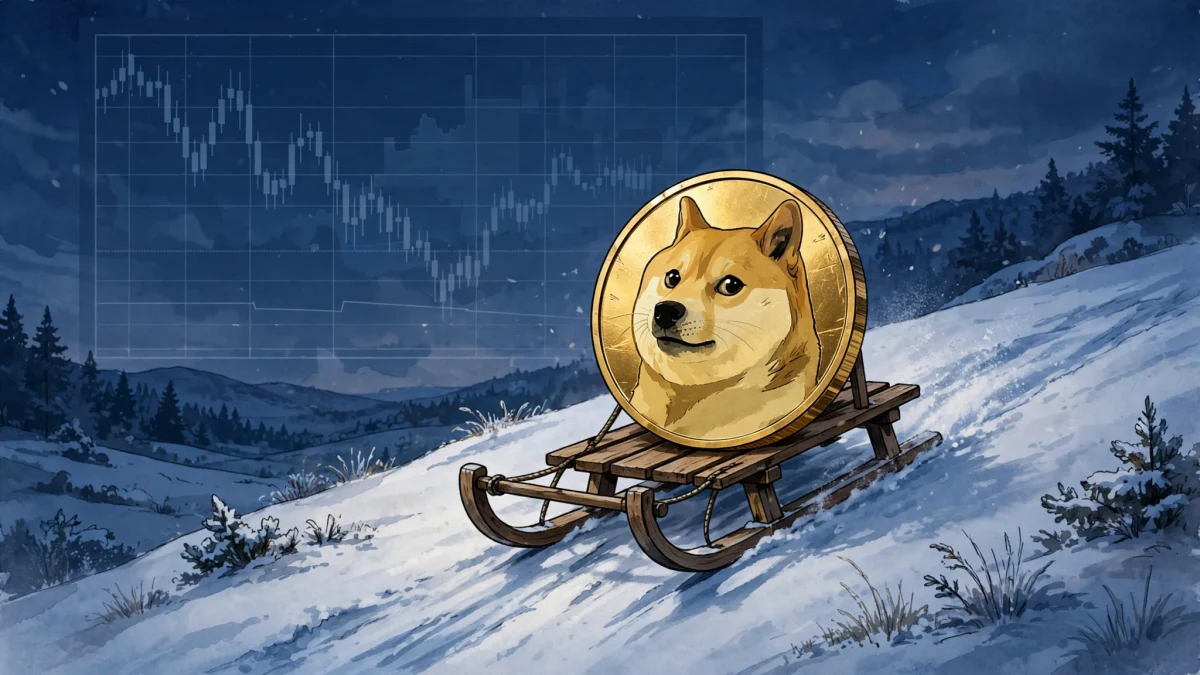
Dogecoin is sliding with the rest of the crypto market, trading near $0.0626 as of November 14, 2026, down about 3.1%. But the most striking Dogecoin headline this month is not the price — it is the silence from the funds. US Dogecoin ETFs have recorded zero net inflows for the whole of November so far: Grayscale’s GDOG and 21Shares’ TDOG saw zero net flow across the first eight US trading sessions of the month, REX-Osprey’s DOJE was also flat, and no DOGE fund has posted a single net inflow day in November.
This article explains, in plain English, what Dogecoin ETFs are, what “zero inflows” actually means (and what it does not mean), why meme coins like DOGE tend to fall first and hardest when fear takes over, and what would have to change for the story to improve.
In this article
Key Takeaways
- Dogecoin trades near $0.0626 as of November 14, 2026, down about 3.1% on the day, swept up in a market-wide selloff.
- Grayscale’s GDOG and 21Shares’ TDOG recorded zero net flow for the first eight US trading sessions of November.
- REX-Osprey’s DOJE has also been flat, and no US DOGE fund has recorded a net inflow at any point in November.
- Bitwise’s BWOW fund was delisted on October 14 and liquidated on October 22, shrinking the DOGE ETF lineup before November even began.
- The wider ETF market is also retreating: all US spot crypto ETFs together saw $187.3 million in outflows in the latest session and $3.80 billion over the last 30 days.
- Zero flow cuts both ways: it shows no fresh institutional buying, but also no rush for the exit — flows have flatlined rather than collapsed.
What Is Happening to the Dogecoin Price?
Dogecoin’s price move today is best understood as a passenger, not a driver. The total crypto market capitalization has fallen to roughly $2.33–2.4 trillion, down about 2–3% in 24 hours. Bitcoin is near $67,050, down about 2.5%, and has broken to its lowest level since August. Ethereum has slipped below $2,000, XRP has lost the $1 level, and Solana has broken under $80. DOGE, at roughly $0.0626 and down about 3.1%, sits right in the middle of that pack.
The causes are market-wide, and we cover them in depth in our explainer on why Bitcoin is down. The short version: US inflation data came in hot for a third straight month (October CPI up 0.4%, core up 0.3%), and Federal Reserve Governor Christopher Waller said on November 10 that he is leaning toward a rate hike in December, with market odds around 89%. Risk assets of every kind have been sold since, the Nasdaq 100 dropped 1.99%, the VIX jumped 9.57% to 20.49, and $1.26 billion of leveraged crypto positions were liquidated in 24 hours — 173,014 traders, with long positions taking about 86% of the damage.
Why Meme Coins Feel Fear First
Dogecoin is the original meme coin: its value rests largely on community enthusiasm, brand recognition, and speculative appetite rather than on fees or network revenue. That makes DOGE a clean barometer of risk appetite. When investors feel confident, meme coins attract fast money. When the Fear and Greed Index sits at 13 — “Extreme Fear,” as it does today — that money leaves first, because nobody needs to hold a joke-born asset in a storm. Our look at what extreme fear has historically meant for Bitcoin explains how these sentiment extremes have played out in past cycles.
Dogecoin ETFs, Explained Simply
A spot Dogecoin ETF is a fund traded on a US stock exchange that holds actual DOGE. Investors can buy shares in the fund through a normal brokerage account instead of opening a crypto exchange account. Every trading day, the funds report “net flows”: if investors put more money in than they took out, that is a net inflow; if they took more out, it is a net outflow. Fund flows are one of the few hard, public numbers in crypto — they show real money moving, not just opinions on social media.
The US DOGE ETF lineup currently includes Grayscale’s GDOG, 21Shares’ TDOG, and REX-Osprey’s DOJE. There used to be a fourth: Bitwise’s BWOW was delisted on October 14 and liquidated on October 22, meaning the fund was closed and its holdings sold off and returned to investors. For context on the whole landscape, the US now has 39 spot crypto ETF funds across 5 assets, with about $109.30 billion in net assets.
The November Scoreboard: Zero, Zero, Zero
Through the first eight US trading sessions of November, GDOG and TDOG recorded zero net flow — not small inflows, not small outflows, but exactly no net movement. DOJE was also flat. And the streak extends beyond those eight sessions: no DOGE fund has recorded a net inflow on any day in November so far.
Read that correctly. Zero flow does not mean the funds are empty, and it does not mean investors sold everything. It means the buying and selling inside the funds balanced out to nothing, day after day — a complete absence of new conviction in either direction. Traders call this “flatlining”: the institutional market for Dogecoin exposure has simply gone quiet.
Is Zero Inflow Bad News — or Quietly Neutral?
There are two honest ways to read a flatline, and both matter for understanding DOGE right now.
The Bearish Reading: No New Buyers
ETFs were supposed to open Dogecoin to a new class of buyers — advisers, institutions, and brokerage-only investors. A full month with zero net inflows says that audience is not showing up. Compare the neighbors: Bitcoin ETFs hold the bulk of the industry’s $109.30 billion in assets and still managed to pull in huge sums earlier this year (cumulative Bitcoin ETF inflows are about $54.63 billion), and even in this selloff, Ethereum ETFs flipped green on November 13 with a $2.36 million inflow. DOGE funds, by contrast, are being ignored entirely — and one issuer, Bitwise, already gave up and closed its fund in October. In a market where attention is oxygen, being ignored is a real problem.
The Neutral Reading: No Panic Either
Now the other side. Zero is not negative. While Bitcoin funds bled $185.45 million on November 13 alone — their seventh straight day of outflows — and Solana funds lost money for seven straight sessions, DOGE funds have not seen an exodus. The investors who hold DOGE through ETFs appear to be sitting still rather than fleeing. Part of that is arithmetic: the DOGE funds are small, so there is simply less money positioned to leave. But flat is flat — in the worst week of sentiment since the summer, the DOGE ETF complex did not crack.
The fair summary is that ETF flows currently give Dogecoin no momentum in either direction. Whatever moves DOGE next will most likely come from the broader market and retail sentiment, not from fund flows — at least until the first inflow day breaks the silence. Our crypto ETF outflows roundup tracks the full flow picture across all five assets.
Facts and Figures
| Metric | Figure (as of November 14, 2026) |
|---|---|
| Dogecoin price | ~$0.0626, down ~3.1% on the day |
| Grayscale GDOG net flow, November | Zero — first 8 US sessions of the month |
| 21Shares TDOG net flow, November | Zero — first 8 US sessions of the month |
| REX-Osprey DOJE net flow, November | Flat |
| DOGE fund net inflow days in November | None |
| Bitwise BWOW status | Delisted October 14; liquidated October 22 |
| All US spot crypto ETFs | 39 funds, 5 assets; net assets ~$109.30 billion |
| All spot crypto ETF flow, latest session | −$187.3 million |
| All spot crypto ETF flow, last 30 days | −$3.80 billion |
| Bitcoin price (market context) | ~$67,050, down ~2.5% |
| Total crypto market cap | ~$2.33–2.4 trillion, down ~2–3% in 24h |
| 24-hour liquidations (all crypto) | $1.26 billion; 173,014 traders; longs ~86% of losses |
| Fear and Greed Index | 13 — Extreme Fear |
What Could Change the Story for DOGE?
Three things would break the current pattern. The first is the simplest: a single day of real net inflows into GDOG, TDOG, or DOJE. After a month of zeros, even a modest inflow would be newsworthy, because it would show at least one buyer using the ETF route to add DOGE exposure at depressed prices.
The second is a broader market turn. DOGE almost never rallies while Bitcoin is falling and sentiment is pinned at extreme fear. The calendar offers possible turning points: the October PCE inflation report on November 25 is the Federal Reserve’s preferred gauge, and a softer reading would undercut the case for the December rate hike that markets now price at roughly 89% odds. The FOMC decision itself lands on December 9, followed by November CPI on December 10. If the rate-hike scare fades, speculative assets — meme coins included — usually feel the relief early and strongly. That cuts both ways: if the data stays hot, the same sensitivity works against DOGE.
The third is retail attention. Dogecoin’s history is a series of long quiet stretches interrupted by sudden bursts of public interest. ETF flows capture institutions; they do not capture the exchange and on-chain activity of the retail crowd that made DOGE famous. Watch both: the crowd can move this coin long before the funds notice. If you are trying to follow all of this without drowning in headlines, our guide on how to follow crypto markets without the noise is a good place to start.
What to Watch Next
- The first DOGE ETF inflow day: whether GDOG, TDOG, or DOJE posts any net inflow before November ends, breaking the month-long flatline.
- Bitcoin’s direction: DOGE has followed the market throughout this selloff; a Bitcoin stabilization is the most likely trigger for a DOGE bounce.
- November 25 — October PCE inflation data (8:30 a.m. ET): a cooler reading would soften rate-hike expectations and help risk assets, meme coins included.
- December 8–9 — FOMC meeting, decision on December 9: the Fed decides whether to follow through on the December hike Governor Waller has leaned toward.
- December 10 — November CPI: the next inflation test for the market’s rate expectations.
- Retail sentiment gauges: the Fear and Greed Index, stuck at 13, would need to climb out of extreme fear to signal that speculative appetite is returning.
Frequently Asked Questions
What is the Dogecoin price today?
As of November 14, 2026, Dogecoin trades near $0.0626, down about 3.1% on the day. The fall is part of a market-wide selloff that has taken Bitcoin below $67,000 and the total crypto market cap down to roughly $2.33–2.4 trillion.
What does it mean that DOGE ETFs recorded zero inflows?
It means that across the first eight US trading sessions of November, investors put no net new money into Grayscale’s GDOG or 21Shares’ TDOG, and REX-Osprey’s DOJE was flat as well. Buying and selling inside the funds balanced to zero — no fresh institutional demand, but also no rush to sell.
Which Dogecoin ETFs exist in the US?
The current lineup is Grayscale’s GDOG, 21Shares’ TDOG, and REX-Osprey’s DOJE. A fourth fund, Bitwise’s BWOW, was delisted on October 14 and liquidated on October 22, 2026.
Why do meme coins like Dogecoin fall hard in a selloff?
Dogecoin’s value depends heavily on enthusiasm and speculative appetite rather than network revenue. When fear takes over — the Fear and Greed Index is at 13, deep in “Extreme Fear” — that speculative money leaves first, so meme coins tend to drop quickly alongside, or ahead of, the wider market.
Is zero ETF flow a bearish signal for DOGE?
It is best read as neutral-to-cautious. On the bearish side, a full month without inflows shows no new institutional buying, especially compared with larger Bitcoin and Ethereum funds. On the other hand, zero is not an outflow: while Bitcoin ETFs lost $185.45 million on November 13 alone, DOGE funds saw no exodus either.
What could make Dogecoin recover?
Analysts would watch for three things: the first day of net inflows into a DOGE ETF, a stabilization in Bitcoin and the wider market, and relief from macro data — starting with the PCE inflation report on November 25 and the Federal Reserve’s rate decision on December 9.
Disclaimer: This article is news and information only, based on market data available as of November 14, 2026. It is not financial advice, and nothing here is a recommendation to buy, sell, or hold any cryptocurrency. Prices move quickly and can change substantially after publication; always do your own research and consider speaking with a qualified financial adviser before making investment decisions.



Leave a Reply