
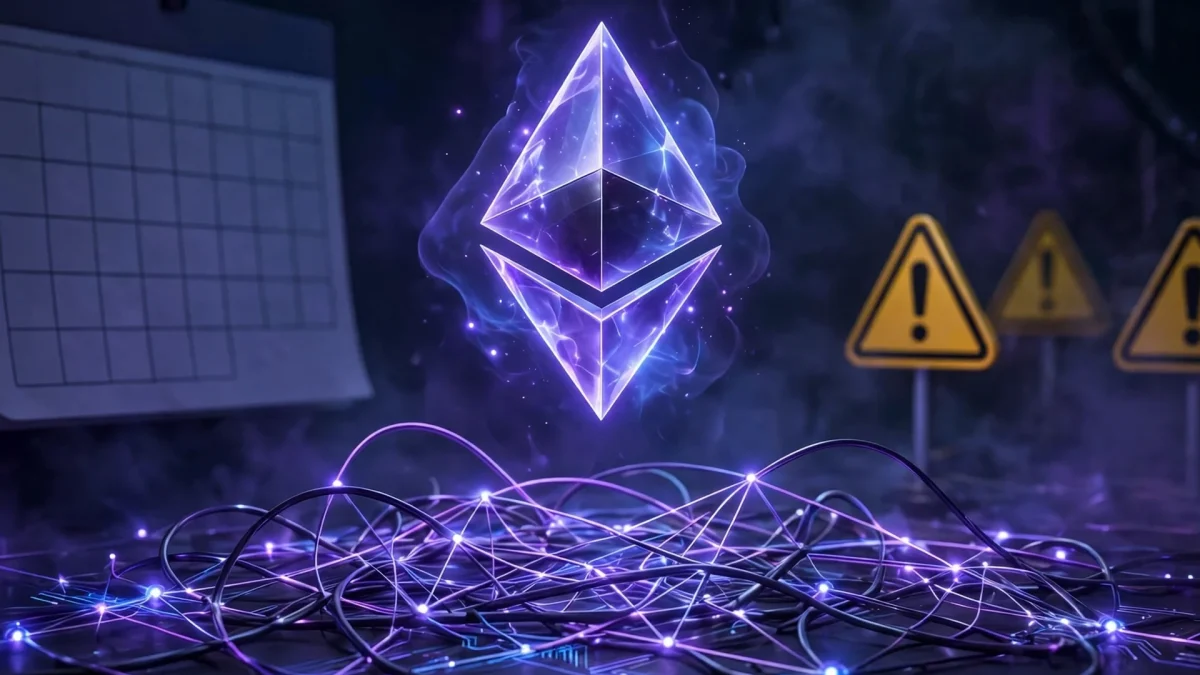
The ethereum glamsterdam upgrade could slip to April or May 2027 if developers decide to rewrite the upgrade’s gas pricing specifications, according to discussions at the All Core Developers meeting on Thursday, November 19, 2026, first reported by Cointelegraph. No decision has been reached — May is the far end of the worst-case branch, not a scheduled date — but an ethereum glamsterdam upgrade delay is now a real possibility for the first time. The original hope of activating the upgrade on the mainnet in December is already gone.
So what is ethereum glamsterdam? It is a planned Ethereum hard fork — a network-wide upgrade that changes the rules all participants must follow — aimed at increasing the network’s capacity and efficiency. The sticking point is a plan to reprice gas, the fee users pay for computation on Ethereum, and a security review that found the new pricing could disrupt thousands of existing smart contracts. Developers now face a choice between shipping on time with known risks, or rewriting the specifications and pushing the upgrade well into next year.
In this article
Key Takeaways
- The ethereum glamsterdam upgrade could slip to April or May 2027 if gas pricing specs are rewritten.
- No decision has been reached; May is the worst-case branch, not the scheduled date.
- Three timelines emerged from the November 19 developers’ meeting, from mid-January to May 2027.
- The sticking point is gas repricing: EIP-8037 and EIP-8038 would change what smart contracts cost to run.
- A ChainSecurity review found 200 compatibility findings, including three high-severity cases.
- As many as 10,000 to 15,000 of roughly 90 million deployed contracts could be affected.
Ethereum Glamsterdam Upgrade: Three Timelines on the Table
Three paths emerged from Thursday’s All Core Developers meeting, and the gap between the fastest and slowest is four months — which is why there is still no firm ethereum glamsterdam upgrade release date. The first option is to keep the current specifications — the written rules that define exactly how the upgrade behaves — which would allow mainnet activation as early as mid-January 2027. That is the best case, and it depends on the remaining security issues being resolved in time.
The second option is to wait until January to decide, and then keep the specifications unchanged. That would push activation to late February or early March 2027, as client teams — the groups that build the software Ethereum’s nodes run — need time to implement and test even an unchanged plan once the decision is made. The third option, and the one that has grabbed headlines, is to adopt revised specifications: rewrite the gas pricing rules, give client teams time to implement and test the changes, and activate in April or May 2027.
Meeting chair Ansgar Dietrichs, an Ethereum Foundation researcher, called late January or early February a more realistic timeframe than the mid-January best case, according to crypto.news. That framing matters: even the people running the process do not expect the fastest timeline. The original hope, reported by crypto.news, was to activate Glamsterdam on the mainnet in December 2026 — a target that has already slipped before any formal decision. What happens next depends on a specification decision expected in January, and on whether the security review’s remaining findings are cleared by then.
Why Is the Ethereum Glamsterdam Upgrade Delayed?
The delay comes down to gas. Every action on Ethereum — sending ether, deploying a smart contract, trading on a decentralised exchange — costs gas, a fee measured in tiny units of ether and paid to the network’s validators. Gas prices are set by a schedule that assigns a cost to each type of operation, and that schedule has not kept pace with what those operations actually cost the network to perform. Fixing that is the job of ethereum gas repricing eip-8037 and its partner proposal, EIP-8038 — and fixing it is what is causing the trouble.
Glamsterdam’s gas repricing would fix that. EIP-8037 — an Ethereum Improvement Proposal, the formal document that describes a change — proposes raising the cost of creating new state: deploying smart contracts and adding data to the network’s storage. EIP-8038 addresses the cost of accessing and modifying existing state. Together, they would bring gas schedules closer to current network costs, making the network fairer and more efficient in the long run. The problem is the short run: changing the schedule changes the economics of every contract already running on Ethereum.
A smart contract is a program that lives on the blockchain and runs automatically when its conditions are met — the code behind decentralised exchanges, lending platforms and token sales. Contracts are written with assumptions about how much gas their operations cost. If those costs change, a contract that worked fine yesterday can suddenly run out of gas mid-operation, fail, or behave in ways its authors never intended. That is the risk at the heart of the Glamsterdam debate, and it is why a change that looks like routine maintenance has turned into the upgrade’s biggest obstacle.
200 Findings and 10,000 Contracts at Risk
The alarm went off in October. Security firm ChainSecurity warned that the proposed gas pricing changes could disrupt existing smart contracts and expose them to exploitation — serious enough that the Hoodi testnet fork, a trial run of the upgrade on a test network originally scheduled for October 26, was postponed as a precaution. Core developers committed to holding no fork until the issues are resolved.
ChainSecurity’s assessment found 200 compatibility findings — cases where the new gas pricing could break or change the behaviour of existing contracts — including three high-severity cases. The three high-severity cases have been addressed or are expected to be resolved by mid-December, and medium-impact projects face remediation work stretching into January. That timeline is one reason the mid-January best case looks optimistic: the fixes and the fork would be landing almost simultaneously.
The scale of the problem grew sharply through November. At a developers’ meeting on November 16, an Ethereum Foundation researcher estimated that as many as 10,000 to 15,000 of roughly 90 million deployed contracts could be affected — far beyond the 13 real-world examples identified in October. The Ethereum Foundation, ChainSecurity and security firm Dedaub have collectively contacted at least 50 affected companies, Ethereum Foundation developer Rahul Kothari told the November 19 meeting. Outreach on that scale shows how seriously the ecosystem is taking the risk.
Ethereum researcher Toni Wahrstätter urged caution about changing the specifications without fully understanding the consequences, warning: “Every spec change could, again, break new invariants that we are not aware of breaking yet.” In plain terms: each rewrite risks breaking something nobody has thought of yet. That is the argument for the slower timelines — and the reason developers are reluctant to rush a decision. The full background is in Coinotag’s report on the November discussions.
Ethereum Glamsterdam Upgrade: What Happens Next
The immediate next step is a test run. Developers tentatively proposed a Hoodi testnet fork for mid-December, with a final go-ahead decision due at the November 26 consensus-layer meeting — the gathering where developers who work on how the network agrees on its state make their calls. The specification decision itself is expected in January, when developers will choose between the three timelines. Until then, anyone asking when is the ethereum glamsterdam upgrade has no single answer: all three timelines remain live options, and May 2027 remains a possibility rather than a plan.
The delay also ripples into what comes after Glamsterdam. Hegotá, the next planned hard fork, may see its scope reduced to accelerate post-quantum features — upgrades designed to protect the network against future quantum computers that could break today’s cryptography. Client teams are due to submit their Hegotá positions ahead of further discussions in two weeks. No decision was reached on that either, but the direction is clear: if Glamsterdam slips, the fork after it gets squeezed.
The market, for now, is barely reacting. Ethereum traded at $1,754 on November 20, down 1.1% over 24 hours and 12.9% over seven days, with a market cap of $214.41 billion, according to CoinPaprika data. That is a price story driven by the wider selloff, not by the upgrade timetable — our full report is at Ethereum price today. But the ethereum glamsterdam upgrade matters for Ethereum’s longer-term story: a network that ships major upgrades late, over security worries, is a different proposition from one that ships on schedule. The wider market picture shows every major coin under the same pressure, and Glamsterdam’s fate will be decided against that backdrop.
Facts and Figures
| Metric | Value (as of November 20, 2026) |
|---|---|
| Upgrade | Glamsterdam (Ethereum hard fork) |
| Purpose | Increase network capacity and efficiency |
| Earliest activation (current specs) | Mid-January 2027 |
| Realistic timeframe (Dietrichs) | Late January or early February 2027 |
| If decision waits until January | Late February or early March 2027 |
| If specs are revised | April or May 2027 |
| Original activation hope | December 2026 (now gone) |
| Decision status | No decision reached |
| Key proposals | EIP-8037 (new state costs), EIP-8038 (existing state costs) |
| ChainSecurity findings | 200 compatibility findings |
| High-severity cases | 3 (addressed or resolved by mid-December) |
| Contracts potentially affected | 10,000–15,000 of ~90 million deployed |
| Real-world examples (October) | 13 |
| Companies contacted | At least 50 (EF, ChainSecurity, Dedaub) |
| Hoodi testnet fork | Tentatively mid-December; go-ahead due November 26 |
| Original Hoodi date | October 26 (postponed) |
| Specification decision expected | January 2027 |
| Next fork after Glamsterdam | Hegotá (scope may shrink for post-quantum features) |
| ACD meeting | November 19, 2026 (chair: Ansgar Dietrichs) |
| Ethereum price | $1,754 (−1.1% 24h, −12.9% 7d) |
| Ethereum market cap | $214.41 billion |
What to Watch Next
First, watch the November 26 consensus-layer meeting. That is when developers decide whether the Hoodi testnet fork goes ahead in mid-December. A green light would keep the faster timelines alive; another postponement would point toward the slower branches, and make April or May 2027 look more likely.
Second, watch for the specification decision in January. That is the real fork in the road: keep the current gas pricing specs and aim for late January or February, or rewrite them and accept April or May. The ChainSecurity remediation work — the three high-severity cases due to be resolved by mid-December and the medium-impact fixes running into January — will shape what developers feel able to choose.
Third, watch Hegotá. If Glamsterdam slips, the next fork’s scope will be squeezed, and the post-quantum features the developers want to accelerate may end up competing for room with everything Glamsterdam pushes back. Client teams submit their Hegotá positions in the next two weeks, and those submissions will show how much of the roadmap is bending around this delay.
Frequently Asked Questions
Q: What is the ethereum glamsterdam upgrade?
The ethereum glamsterdam upgrade is a planned hard fork — a network-wide upgrade — aimed at increasing Ethereum’s capacity and efficiency. It includes a repricing of gas, the fee users pay for computation on the network, through proposals EIP-8037 and EIP-8038. It was originally hoped to activate on the mainnet in December 2026.
Q: Is the ethereum glamsterdam upgrade delayed until May 2027?
Not decided. May 2027 is the far end of the worst-case branch: it would only happen if developers rewrite the gas pricing specifications. No decision has been reached, and the earliest case is still mid-January 2027, with late January or early February described as more realistic by meeting chair Ansgar Dietrichs.
Q: Why could Glamsterdam be delayed?
The sticking point is gas repricing. Security firm ChainSecurity warned in October that the proposed pricing changes could disrupt existing smart contracts and expose them to exploitation. Its review found 200 compatibility findings, including three high-severity cases, and as many as 10,000 to 15,000 of roughly 90 million deployed contracts could be affected.
Q: What are EIP-8037 and EIP-8038?
EIP-8037 proposes raising the cost of creating new state on Ethereum — deploying smart contracts and adding to storage. EIP-8038 addresses the cost of accessing and modifying existing state. Together they would bring gas schedules closer to what those operations actually cost the network, but changing the schedule affects the economics of contracts already running.
Q: When will developers decide on Glamsterdam’s timeline?
A go-ahead decision for the Hoodi testnet fork is due at the November 26 consensus-layer meeting, with the testnet fork tentatively pencilled in for mid-December. The specification decision — keep the current specs or rewrite them — is expected in January 2027.
Q: What is Hegotá?
Hegotá is the next planned hard fork after Glamsterdam. Its scope may be reduced to accelerate post-quantum features, upgrades designed to protect Ethereum against future quantum computers. Client teams are due to submit their Hegotá positions ahead of further discussions in two weeks, and no decision has been reached.
Related Articles
- Ethereum Price Today: ETH Drops to $1,733, Near Its July Low, as ETF Outflows Continue
- Bitcoin ETF Outflows Hit $3.47 Billion in November as IBIT Posts Record $541 Million Exit
- Crypto Market Today: Total Cap Falls to $2.21 Trillion as Fear Stays Extreme
Disclaimer: This article is for news and information purposes only and is not financial advice. Cryptocurrency prices are volatile and can move sharply in either direction. Do your own research before making any investment decision. All prices and figures are as of November 20, 2026.


[…] upgrade, Glamsterdam, is in testing, with no confirmed mainnet date — and, as our report on the Ethereum Glamsterdam upgrade explains, it could slip to May 2027 over gas-pricing […]
[…] smart contract risks, and its gas-pricing changes will shape validator economics. Our report on the Ethereum Glamsterdam upgrade has the latest timeline. Any change to issuance or validator mechanics flows straight through to […]