
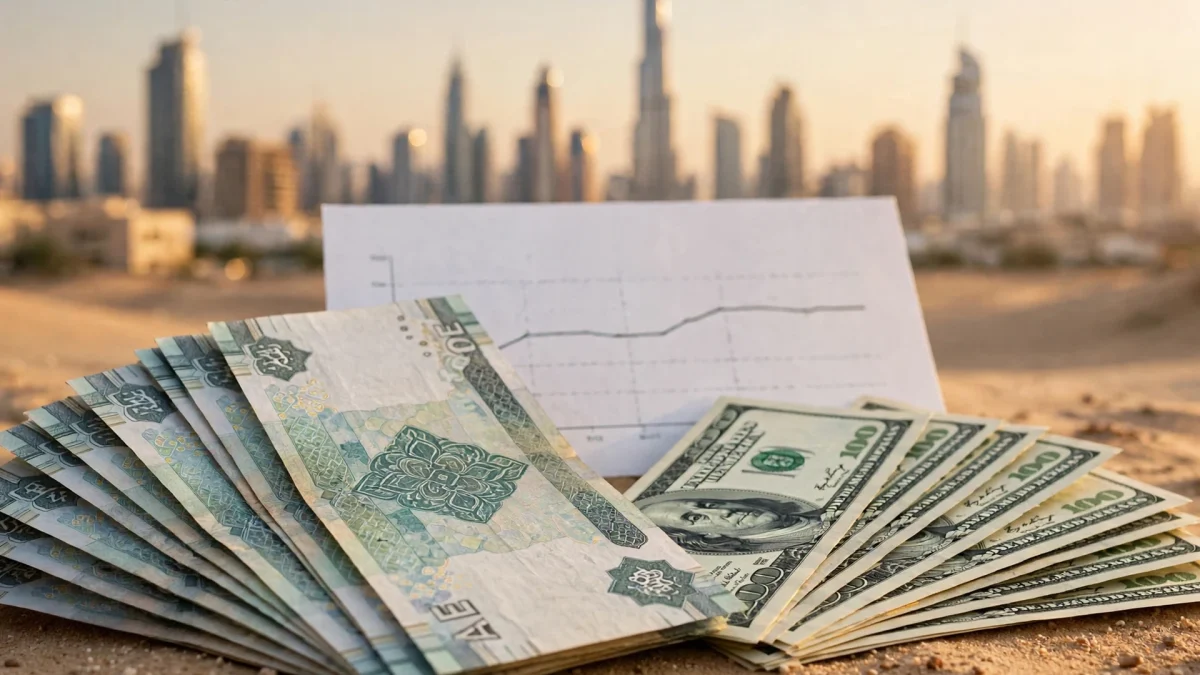
USD AED is trading at 3.6725 on Friday, November 20, 2026 — exactly where it traded yesterday, last week, last month and last year. While almost every other currency in the world has been knocked around by a surging dollar this week, the UAE dirham has not moved at all. It cannot move. The dirham is pegged to the US dollar at a fixed rate of 3.6725, a rate the Central Bank of the UAE has held since 1997, and the peg means one US dollar always buys 3.6725 dirhams.
That stillness is the story. In a week when the dollar index hit a 19-month high, gold fell to its lowest since September 2025 and stock markets slid around the world, the dirham’s peg has done exactly what it is designed to do: nothing. But “nothing” is not the same as “no effect.” Because the dirham moves with the dollar against every other currency, the peg is quietly reshaping the price of everything in the UAE — from gold in the Dubai souks to the cost of a mortgage in Abu Dhabi. The USD AED exchange rate may be the most boring number in currency markets this week, but what it means is anything but.
In this article
Key Takeaways
- USD AED is fixed at 3.6725, unchanged on Friday and every day for the past two weeks — the rate has not moved since 1997.
- The Central Bank of the UAE commits to buy dirhams at 3.673 and sell them at 3.672, and holds foreign reserves to defend the peg.
- The CBUAE base rate is 3.90%, tracking the Fed; a December Fed hike would likely lift it to 4.15%.
- Dubai 24K gold fell Dh19 to Dh425.25 per gram on Friday, a 13-month low, as spot gold slid below $3,563 an ounce.
- Brent crude traded near $91.37 and WTI near $83.42, heading for a third straight weekly loss on strong Gulf exports.
- The UAE’s non-oil PMI eased to 54.8 in October, still solid expansion, but firms raised prices at a record pace.
USD AED: The Numbers
USD/AED — the price of one US dollar in UAE dirhams — is the simplest number in this article, because it never changes. The official rate is 3.6725, and it has been 3.6725 every single day for the past two weeks, with a daily change of exactly 0.00%. Over the last 30 days the published rate has moved only between 3.6715 and 3.6729, averaging 3.6716. That is quote noise around a fixed point, not a market move.
In the other direction, one dirham is worth 0.27229 US dollars — a figure that follows from the same arithmetic (1 divided by 3.6725). US$100 buys AED 367.25, US$1,000 buys AED 3,672.50, and AED 1,000 buys about US$272.29. Those numbers will be the same tomorrow, next month and next year, unless the Central Bank of the UAE changes a policy it has held for nearly three decades.
What does move is the dirham against everything else. Because the peg ties the dirham to the dollar, a surging dollar drags the dirham up with it against the euro, the pound, the rupee and every other floating currency. On Friday, one dirham bought 25.42 Indian rupees, 75.28 Pakistani rupees and 17.36 Philippine pesos. The USD AED peg means the dirham’s nominal effective exchange rate — its value against a basket of trading partners — rose 0.3% in the year to June 2026, simply because the dollar rose.
How the Peg Works — and Why It Holds
Why is the dirham pegged to the dollar? The short answer is oil. The peg dates to 1997 in most accounts (The National pins it to November of that year), although the UAE Ministry of Finance dates the 3.6725 rate to November 1980.
The mechanics are straightforward. The Central Bank of the UAE commits to buy dirhams for US dollars at 3.673 and sell them at 3.672 with eligible market counterparties — a spread of just one-tenth of a fils around the 3.6725 midpoint, as the Economic Times explains. If anyone wants to sell dirhams, the central bank is there to buy them at the peg; if anyone wants to buy, it sells. That two-way commitment is what makes the USD AED peg credible, and credibility is what makes it cheap to defend — markets rarely test a peg they believe will hold.
The peg also means the UAE effectively imports American monetary policy. The CBUAE’s base rate — the rate on its Overnight Deposit Facility — is anchored to the US Federal Reserve’s interest rate on reserve balances. When the Fed held on October 28, the CBUAE held the same evening. As the central bank’s own press release put it, the base rate “signals the general stance of monetary policy and provides an effective floor for overnight money market interest rates in the UAE” — and that stance is set in Washington, not Abu Dhabi.
That is the trade-off at the heart of the peg: stability in exchange for independence. For a country built on trade, tourism and foreign investment, that has been a good deal for nearly 30 years — but the question, asked every time the Fed moves sharply, is whether it stays a good deal when American policy and the UAE’s domestic economy point in different directions.
What the Peg Means When the Dollar Surges
This week is a good test of that question, because the Fed and the UAE economy are pulling in different directions. Our full report on the Fed’s December hike bets has the details.
For borrowers in the UAE, the effect is already visible. Three-month EIBOR — the benchmark most variable home loans follow — fixed at 4.394% on November 12, up from 3.851% at the end of August. Fixed mortgage rates start at about 3.75% for one year and 3.89% to 4.69% for three years, while variable rates work out at roughly 5.3% to 6.3%. A December hike would push all of those higher. The dirham pegged to dollar means UAE homeowners feel a Fed decision in Washington almost as directly as American ones do — a connection that is easy to forget when rates are stable and impossible to ignore when they are rising.
The flip side is the peg’s appeal as a place to hold money. In a week when the Turkish lira hit a fresh record low and the yen pressed toward 160, a currency that literally cannot move is an attractive thing — and one reason the UAE keeps drawing capital even as the region around it faces war, sanctions and shipping disruption.
That growth is real but not without strain. The S&P Global UAE PMI eased to 54.8 in October from 55.3 in September — still solid expansion, with new export orders rising at the fastest pace in two years. Dubai’s PMI rose to an eight-month high of 54.6. But firms raised selling prices at the fastest pace since the survey began in 2009. The peg can stabilise the currency; it cannot stabilise the cost of everything the UAE imports.
Gold, Oil and the Gulf Backdrop
Nowhere is the peg’s effect more visible than in Dubai’s gold souks. So when spot gold slid this week — down as much as 3.27% to below $3,563 an ounce on Friday morning, heading for its worst week in eight months — the USD AED peg meant Dubai’s gold price fell in lockstep.
The numbers tell the story. Dubai 24K gold fell Dh19 to Dh425.25 per gram on Friday, from Dh444.25, a 4.28% drop and a 13-month low. 22K lost Dh17.50 to Dh393.75, falling below Dh400 for the first time in months, while 18K shed Dh14.25 to Dh323.75 and 14K dropped Dh11.25 to Dh252.50. Over five days, 24K has lost Dh42 a gram — from Dh467 on Tuesday to Dh425.25 on Friday. As Gulf News reported, spot gold fell for a fifth straight day on Friday. The Dubai gold price today is a direct read on the global selloff, translated into dirhams at 3.6725.
Note that the retail rate is not the metal value: Dubai shops quote the Dubai Jewellery Group’s suggested retail rate, 2.5% to 4% above the world price, then add a making charge and 5% VAT. Spot-based metal values on Friday evening were lower, around Dh414.50 to Dh415.50 per gram for 24K.
Oil is the other half of the Gulf picture. Brent traded near $91.37 a barrel on Friday and WTI near $83.42, both heading for a third straight weekly loss as strong Gulf exports swamp the market — our oil price report has the full breakdown. The IEA forecasts a 1.7 million barrel-per-day global surplus in Q4. For the UAE, cheaper oil means less revenue, but the non-oil economy keeps growing regardless — exactly the diversification the peg was designed to support.
The security backdrop is the one cloud over the Gulf this week. Houthi missiles hit Riyadh on Thursday, and on Friday the group warned shipping near Saudi Red Sea ports; two tankers hit naval mines in the Strait of Hormuz. The UAE has stayed out of the direct line of fire, and Qatar’s non-energy PMI falling to 46.3 in October shows the strain is not evenly spread. For now, the dirham’s peg is one of the few certainties in a region short of them.
Facts and Figures
| Metric | Value (as of November 20, 2026) |
|---|---|
| USD/AED (official peg) | 3.6725 (unchanged) |
| Daily change | 0.00% (every day, past 2 weeks) |
| 1 AED in USD | 0.27229 |
| 30-day range | 3.6715–3.6729 |
| CBUAE buy rate | 3.673 |
| CBUAE sell rate | 3.672 |
| Peg in place since | 1997 (Ministry of Finance: Nov 1980) |
| CBUAE base rate | 3.90% (held 28 Oct) |
| Previous base rate | 3.65% (raised 17 Sep) |
| Fed funds target range | 3.75%–4.00% |
| Expected base rate after Dec hike | 4.15% |
| 3-month EIBOR (12 Nov) | 4.394% |
| 3-month EIBOR (31 Aug) | 3.851% |
| UAE fixed mortgage rates | From ~3.75% (1-yr) |
| UAE variable mortgage rates | ~5.3%–6.3% |
| Dubai 24K gold (Fri) | Dh425.25/g (−Dh19, −4.28%) |
| Dubai 22K gold (Fri) | Dh393.75/g (−Dh17.50) |
| Dubai 18K gold (Fri) | Dh323.75/g (−Dh14.25) |
| Dubai 24K gold (Tue) | Dh467/g |
| Spot gold (Fri morning) | Below $3,563/oz (−3.27%) |
| Spot gold (Fri evening) | ~$3,514–$3,525/oz |
| Brent crude (Fri) | ~$91.37 |
| WTI crude (Fri) | ~$83.42 |
| UAE non-oil PMI (Oct) | 54.8 (from 55.3 in Sep) |
| Dubai PMI (Oct) | 54.6 (8-month high) |
| 1 AED in INR | 25.42–25.43 |
| 1 AED in PKR | 75.28 |
| 1 AED in PHP | 17.36 |
| US$100 in dirhams | AED 367.25 |
| US$1,000 in dirhams | AED 3,672.50 |
What to Watch Next
First, watch the Fed. The December 8–9 FOMC meeting is the main event for the dirham, because whatever the Fed decides, the CBUAE will almost certainly match within hours. Markets price a 25-basis-point hike as near-certain, which would take the UAE base rate to 4.15% and push EIBOR and mortgage rates higher still. The USD AED rate itself will not move — that is the whole point of the peg — but the cost of borrowing in dirhams will.
Second, watch gold. Dubai’s gold price moves only with the world dollar price, so the direction of spot gold is the direction of the souk. Gold is heading for its worst week in eight months, and if the selloff continues, 24K could fall further from its 13-month low — with no currency cushion either way.
Third, watch the Gulf security situation and oil. The Houthi attacks on Riyadh and the mining incidents in the Strait of Hormuz can move oil prices sharply, and OPEC+ ministers meet on November 29 to decide 2027 output policy. A wider regional escalation would test even the Gulf’s most stable currency arrangement.
Frequently Asked Questions
Q: What is the USD AED rate today?
USD AED is fixed at 3.6725 — one US dollar buys 3.6725 UAE dirhams. The rate has not moved since 1997 and was unchanged again on Friday, November 20, 2026. One dirham is worth 0.27229 US dollars.
Q: Why is the UAE dirham pegged to the US dollar?
The UAE sells its oil in dollars and trades overwhelmingly in the world’s reserve currency, so fixing the dirham to the dollar removes exchange-rate risk from the country’s most important transactions. The peg has held since 1997 (the Ministry of Finance dates the 3.6725 rate to November 1980), making it one of the longest-running fixed exchange rates in the world.
Q: Does the dirham ever move against the dollar?
No — the official rate is fixed at 3.6725 and does not move with the market. Small variations you see on data sites (3.6726, 3.6731) are indicative quotes around the fix, not changes in the peg. The dirham does move against other currencies, because it follows the dollar up and down against the euro, the pound, the rupee and others.
Q: How does the peg affect interest rates in the UAE?
The Central Bank of the UAE anchors its base rate to the US Federal Reserve’s interest rate on reserve balances, so UAE rates track US rates. The base rate is currently 3.90% after the Fed’s September hike, and a December Fed hike would likely lift it to 4.15%. That feeds through to EIBOR and to mortgage rates.
Q: Why did Dubai gold prices fall this week?
Because the dirham is pegged to the dollar, the Dubai gold price is the world dollar price in a different unit. Spot gold fell sharply this week — down as much as 3.27% on Friday to below $3,563 an ounce — and Dubai 24K fell with it, down Dh19 to Dh425.25 per gram, a 13-month low. There is no currency cushion: when gold falls in dollars, it falls by the same amount in dirhams.
Q: What is the USD AED forecast?
There is no meaningful forecast to make: the rate is fixed at 3.6725 and the Central Bank of the UAE has shown no sign of changing it. What can be forecast is the cost of borrowing in dirhams, which follows the Fed. This article is not financial advice.
Related Articles
- Fed December Rate Hike Bets Rattle Crypto as Waller Calls for 50 Basis Points
- Crypto Market Today: Total Cap Falls to $2.21 Trillion as Fear Stays Extreme
- Oil Price Today: Brent Near $91 and WTI Near $83 as Strong Gulf Exports Push Crude to a Third Weekly Loss
- Gold Price Today: Gold Falls to $3,551, Lowest Since September 2025, in Worst Week in Eight Months
- USD ZAR Near R17.55 as Rand Hits Weakest Level of 2026 After SARB Holds
Disclaimer: This article is for news and information purposes only and is not financial advice. Currency prices are volatile and can move sharply in either direction. Do your own research before making any investment decision. All prices and figures are as of November 20, 2026.




Leave a Reply