
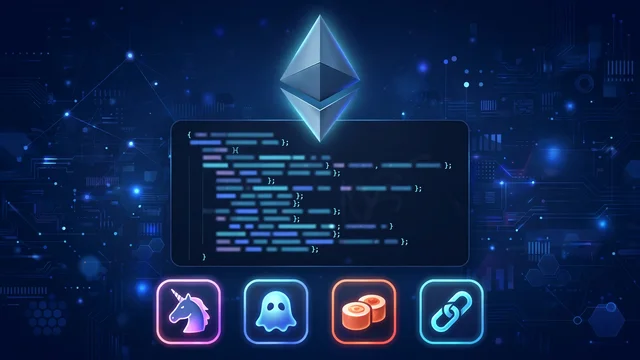
What is Ethereum? In one sentence, Ethereum is a blockchain that runs programs as well as payments. Bitcoin showed the world that a decentralised network could move money without a bank. Ethereum asked what else that network could do — and the answer turned out to be lending, trading, insurance, games, art and entire financial markets, all running as code that nobody can switch off.
Ether, or ETH, is the cryptocurrency that powers it. But calling Ethereum “a cryptocurrency” misses most of the point. Ethereum is closer to a shared world computer: thousands of machines around the globe running the same software, executing the same programs, and agreeing on the results. Anyone can build an application on it, and anyone can use it, without asking permission from a company or a government.
In this article
- Key Takeaways
- Ethereum in Plain English: A Computer, Not Just a Coin
- A Short History: From White Paper to the Merge
- How Does Ethereum Work?
- Smart Contracts and dApps: What Ethereum Is Actually For
- Ether (ETH): What the Coin Does
- Gas Fees Explained
- Ethereum Staking: How Proof of Stake Works
- Facts and Figures
- What to Watch Next
- Frequently Asked Questions
- Related Articles
Key Takeaways
- Ethereum is a programmable blockchain: it runs applications called smart contracts, not just payments.
- It went live on 30 July 2015, after Vitalik Buterin’s white paper in late 2013 and a 2014 token sale that raised about $18 million.
- The Merge on 15 September 2022 switched Ethereum from proof-of-work mining to proof-of-stake, cutting energy use by more than 99%.
- ETH is the network’s native currency: it pays for transactions (gas), secures the network through staking, and has no maximum supply — about 122.2 million ETH circulated in November 2026.
- Gas fees have collapsed from the 2021 peaks: on 21 November 2026 a simple transfer cost about half a US cent at roughly 0.15 gwei.
- Around 44 million ETH — roughly 36% of supply — is staked by more than 800,000 validators, earning a network reward rate near 2.6% a year.
Ethereum in Plain English: A Computer, Not Just a Coin
The simplest way to understand how does Ethereum work is to forget coins for a moment and think about computers. Your phone runs apps on servers owned by companies. If the company changes the rules, shuts the server down, or gets hacked, the app changes or disappears.
Ethereum replaces the company’s server with a network. When a developer writes a program for Ethereum — a smart contract — it is copied to thousands of computers, called nodes, all over the world. Every node runs the same code and checks the same results. No single operator can alter the program, censor a user, or take it offline. The program does exactly what its code says, every time, for everyone.
That is why people call Ethereum a “world computer”. It is slow and expensive compared with a normal server, and deliberately so: the cost buys something a normal server cannot offer, which is trust without a trusted party. You do not need to believe the developer will behave, or the company will stay in business. The code is public, the execution is verified by the whole network, and the outcome is the same for everyone.
The most important applications built on this idea sit in decentralised finance, or DeFi: lending markets, exchanges, and stablecoins that run entirely as Ethereum programs. At the start of November 2026, roughly $46 billion sat in DeFi protocols and about $142.5 billion of stablecoins circulated on Ethereum. Ethereum also hosts most of the world’s NFTs and thousands of tokens.
None of this makes Ethereum a magic solution. Programs can have bugs, and a bug in a smart contract can be expensive because the code runs exactly as written — including its mistakes. Gas fees can still spike when demand surges. And Ethereum’s flexibility is also its complexity: it is a much harder system to secure and upgrade than a simple payment network. But after more than a decade, it remains the largest programmable blockchain by a wide margin, and the default place developers build when they want their code to run without a middleman.
A Short History: From White Paper to the Merge
Ethereum began with a frustration. In late 2013, Vitalik Buterin, then a 19-year-old programmer and co-founder of Bitcoin Magazine, published a white paper arguing that blockchain technology could do more than move money. He had tried to persuade Bitcoin’s developers to add a more powerful programming language to Bitcoin itself; when they declined, he proposed building a new platform from scratch.
The idea was announced at the North American Bitcoin Conference in Miami in January 2014. Buterin was joined by co-founders including Gavin Wood, who wrote the technical “Yellow Paper” in April 2014, Charles Hoskinson, Anthony Di Iorio, Joseph Lubin and Mihai Alisie. That summer the project raised about $18 million in a public token sale, selling ether to fund development.
The network went live on 30 July 2015 with its first release, called Frontier — deliberately bare-bones, a platform for developers to test and deploy applications. The genesis block contained 8,893 transactions distributing ether to early contributors, and miners initially earned a block reward of 5 ETH.
Ethereum’s early years were eventful. In 2016, a large crowdfunded project called The DAO was hacked, draining a large amount of ether and forcing the community into a painful decision: rewrite history to return the funds, or accept the theft as final. The network split. The majority chain, which reversed the hack, kept the name Ethereum; the minority chain became Ethereum Classic. The episode settled an argument that still echoes today: Ethereum’s community will, in extreme circumstances, choose pragmatism over the principle that “code is law”.
The next great turning point took years to prepare. From launch, Ethereum secured itself the same way Bitcoin does — proof-of-work mining. It worked, but it used enormous amounts of electricity. The replacement, proof-of-stake, was built in stages: the Beacon Chain launched on 1 December 2020, and on 15 September 2022 the two chains merged in an upgrade called The Merge. Mining ended overnight, energy use fell by more than 99%, and security passed to validators who stake ETH instead of burning electricity.
Since the Merge, upgrades have come roughly annually. Shapella (April 2023) let stakers withdraw their ETH. Dencun (March 2024) added cheap data space called blobs that slashed layer-2 costs. Pectra (May 2025) let validators stake up to 2,048 ETH in a single validator and gave ordinary wallets smart-contract powers. Fusaka (December 2025) introduced PeerDAS, a way for nodes to verify data by sampling it rather than downloading everything. The next upgrade, Glamsterdam, is in testing, with no confirmed mainnet date — and, as our report on the Ethereum Glamsterdam upgrade explains, it could slip to May 2027 over gas-pricing risks.
How Does Ethereum Work?
It comes down to three ideas: accounts, the Ethereum Virtual Machine, and consensus.
Accounts. Ethereum has two kinds of accounts. Externally owned accounts are controlled by people, with a private key — these are ordinary wallets. Contract accounts are controlled by code — these are smart contracts. Both can hold ETH and tokens; the difference is that a contract account acts only when its code tells it to.
The Ethereum Virtual Machine (EVM). The EVM is the engine that runs smart contracts — a single computer that every node on the network simulates. When you send a transaction that calls a smart contract, every node runs the same code and arrives at the same result. Developers usually write contracts in Solidity, a language designed for Ethereum, and the EVM executes the compiled result.
Consensus. Thousands of nodes must agree on what happened and in what order. Since the Merge, they do it through proof-of-stake. Validators — computers that have locked up at least 32 ETH — take turns proposing new blocks roughly every 12 seconds, and other validators vote on them. A block becomes final after about 12.8 minutes, once validators holding at least two-thirds of the staked ETH have voted for it. Validators who cheat, or who go offline, lose part of their stake — a penalty called slashing.
Transactions are grouped into blocks, and blocks are chained together with cryptography, just as in Bitcoin. What makes Ethereum different is what a transaction can do. A Bitcoin transaction moves coins from one address to another. An Ethereum transaction can do that, or it can call a program that lends money, swaps tokens, mints an NFT, or triggers a chain of other programs.
One more piece matters: layer 2 networks. Ethereum’s main chain, called layer 1, is secure but has limited room. Layer-2 networks such as Arbitrum, Optimism, Base and zkSync process transactions off the main chain in batches and post the results back to Ethereum, inheriting its security while charging far less. Since the Dencun upgrade in 2024 made their data costs far cheaper, most everyday activity has moved to layer 2 — one reason mainnet gas fees have fallen so far.
Smart Contracts and dApps: What Ethereum Is Actually For
A smart contract is a program stored on Ethereum that runs when its conditions are met. The name is older than Ethereum — cryptographer Nick Szabo coined it in the 1990s — but Ethereum was the first platform to make the idea work at scale. A smart contract is neither smart nor, in most cases, a legal contract. It is code: “if X happens, do Y”, executed by the whole network and impossible to stop once deployed.
The classic example is a vending machine. You put in a coin, the machine gives you a drink. Nobody negotiates, nobody trusts anybody, and the machine does not get to change its mind. A smart contract works the same way, but the machine is the Ethereum network and the “drink” can be anything programmable: a loan, a trade, an insurance payout, a vote, a game item.
Applications built from smart contracts are called dApps — decentralised applications. The biggest categories are:
- Decentralised finance (DeFi). Lending protocols such as Aave let users lend crypto and earn interest, or borrow against their holdings, with no bank involved. Decentralised exchanges such as Uniswap let anyone swap tokens directly from their wallet. Stablecoins such as USDT and USDC — tokens pegged to the dollar — run mostly on Ethereum and its layer-2 networks.
- Tokens. Ethereum’s ERC-20 standard lets anyone create a fungible token: a currency, a share, a loyalty point. ERC-721 does the same for non-fungible tokens (NFTs) — unique items such as digital art, collectibles and game assets.
- DAOs. Decentralised autonomous organisations use smart contracts to run treasuries and votes, letting groups of strangers manage shared money by rules everyone can see.
The risks are real and worth stating plainly. Smart contracts are only as good as their code, and bugs have cost users billions over the years. A contract that cannot be changed cannot be fixed either, which is why serious projects pay for independent audits before launch and still sometimes get caught out. And “decentralised” is a spectrum: many dApps have admin keys or upgradeable contracts controlled by small teams. The technology removes some middlemen; it does not remove the need for judgement.
Ether (ETH): What the Coin Does
Ether — ETH — is Ethereum’s native currency, and it has three jobs.
First, it pays for everything on the network. Every transaction costs a fee in ETH, measured in gas. That fee is what makes spam expensive and what pays validators for securing the chain.
Second, it secures the network through staking. Validators lock up ETH as collateral; the stake is both their ticket to participate and the money they stand to lose if they misbehave.
Third, it is the ecosystem’s unit of account. ETH is the collateral in most DeFi lending, the pairing asset on decentralised exchanges, and the reserve asset for layer-2 networks.
What is ETH in supply terms? Unlike Bitcoin’s hard cap of 21 million coins, Ethereum has no maximum supply. New ETH is issued to validators as staking rewards, and ETH is removed from circulation when transaction base fees are burned — a mechanism introduced by EIP-1559 in August 2021. When network activity is high, burning can exceed issuance and supply shrinks; when activity is low, supply grows slowly. That is what happened in 2026: with gas fees near historic lows, burns fell, and supply rose from a post-Merge low of about 120.07 million ETH in April 2024 to about 122.18 million by early November 2026.
ETH is the second-largest cryptocurrency by market capitalisation, behind only Bitcoin. On 21 November 2026 it traded around $1,600–$1,700. One caution: published figures for ETH’s all-time high differ between data providers, so treat any single number with care.
ETH is also now available through regulated investment products. US spot Ether ETFs launched in 2024, and by mid-2026 they held roughly $14.8 billion. That has not stopped outflows in bad markets: our report on Ethereum ETF flows covers a $131 million single-day outflow on 19 November 2026.
Gas Fees Explained
Gas is the fuel of Ethereum, and the word causes more confusion than almost anything else in crypto. Gas is not a token you buy. It is a unit measuring how much computational work a transaction requires. A simple ETH transfer costs 21,000 gas. A token swap on a decentralised exchange can cost 120,000–250,000 gas because it runs far more code.
What you actually pay is gas used multiplied by the gas price, quoted in gwei — one gwei is a billionth of an ETH. Since the London upgrade in August 2021, the gas price has two parts: a base fee, set by the protocol and burned with each block, and a priority fee, or tip, that goes to the validator. The base fee rises when blocks are full and falls when they are empty, adjusting by at most 12.5% per block.
The headline story of 2026 is how cheap gas has become. During the NFT and DeFi booms of 2021, a single transaction could cost $50 or more. By late 2026, mainnet gas mostly sat below 2 gwei. On 21 November 2026 at 18:00 UTC, the gas price was about 0.15 gwei: a simple ETH transfer cost roughly $0.0055, a token swap about $0.04, and an NFT mint about $0.02. November’s cheapest day, 1 November, averaged just 0.041 gwei. Two changes did most of the work: validators raised the block gas limit from 30 million to 60 million during 2025, and most retail activity moved to layer-2 networks, where transactions cost a fraction of a cent.
Cheap gas is not guaranteed. On 10 October 2026, during a market flash crash, gas spiked to 15.9 gwei. Check a gas tracker such as Etherscan’s before sending an important transaction, and if it is not urgent, wait for a quiet hour.
Ethereum Staking: How Proof of Stake Works
Ethereum staking is how the network stays secure now that mining is gone: lock up ETH, help validate the chain, earn rewards.
To run a validator yourself, you deposit 32 ETH and run software that proposes and verifies blocks. That is the minimum stake for a solo validator, and it has not changed since staking began. What Pectra changed in May 2025 is the maximum: a single validator can now hold up to 2,048 ETH, letting large operators consolidate many 32-ETH validators into one. Validators earn newly issued ETH plus tips from transactions, and they lose part of their stake — slashing — if they validate dishonestly or go offline for too long.
You do not need 32 ETH to stake. Staking pools let smaller holders combine their ETH, and liquid staking protocols such as Lido and Rocket Pool issue a token representing your staked ETH, which you can trade or use in DeFi while still earning rewards. Exchanges also offer one-click staking. Each route trades convenience against control: running your own validator keeps your keys; a pool or exchange takes a cut and holds the keys.
The scale is now enormous. In October–November 2026, roughly 43–44 million ETH — about 36% of all ETH — was staked across more than 800,000 active validators, at a network-wide reward rate near 2.6% a year. That rate is not fixed: it falls as more ETH is staked.
Staking is not risk-free. Staked ETH cannot be sold instantly — exiting takes time, and in a market panic that delay matters. Slashing, though rare for honest validators, is a real penalty. Liquid staking tokens can trade below their underlying value when markets stress. And staking rewards are income in most tax systems, with rules that vary by country.
Facts and Figures
| Item | Detail (as of 21 November 2026 unless stated) |
|---|---|
| White paper published | Late 2013, by Vitalik Buterin |
| Public token sale | Mid-2014, raised ~$18 million |
| Mainnet launch | 30 July 2015 (“Frontier”) |
| Consensus | Proof-of-stake since The Merge, 15 September 2022 |
| Circulating supply | ~122.18 million ETH (Etherscan, 2 Nov 2026) |
| Maximum supply | None |
| ETH staked | ~43.7 million ETH, ~36% of supply (Oct–Nov 2026) |
| Active validators | ~815,000–867,000 (Oct–Nov 2026) |
| Minimum solo validator stake | 32 ETH (maximum 2,048 ETH since Pectra) |
| Network staking reward rate | ~2.6% a year (Validator Queue, Oct 2026) |
| Block time | ~12 seconds per slot; finality ~12.8 minutes |
| Gas price | ~0.15 gwei (21 Nov 2026, 18:00 UTC) |
| Simple ETH transfer cost | ~$0.0055 at that gas price |
| ETH price | ~$1,600–$1,700 (21 Nov 2026) |
| Market capitalisation rank | #2, behind Bitcoin |
| Latest upgrade | Fusaka, 3 December 2025 (PeerDAS) |
| Next upgrade | Glamsterdam, in testing, no confirmed date |
What to Watch Next
First, watch Glamsterdam. The next upgrade is in testnet, with no confirmed mainnet date, and there are already warnings it could slip to May 2027 if developers rewrite the gas-pricing specifications. Its headline features — enshrined proposer-builder separation and block-level access lists — are deep protocol changes, and the delay debate is a reminder that Ethereum’s upgrade pace is a choice, not a guarantee.
Second, watch staking. With roughly 36% of all ETH now staked and the reward rate near 2.6%, the economics of validation keep shifting: if more ETH is staked, rewards fall further. Liquid staking’s concentration is the other question — a small number of protocols control a large share of staked ETH.
Third, watch layer 2. Most everyday Ethereum activity now happens on rollups, and the main chain increasingly acts as a settlement layer. That is the plan working as designed — but it raises questions about where value accrues and how much fee revenue the main chain keeps. The Fusaka upgrade’s PeerDAS and the blob-capacity increases of early 2026 were built for this world; Glamsterdam continues it.
Finally, watch the market context. ETH traded around $1,600–$1,700 on 21 November 2026, in the middle of a broad crypto selloff, with ether ETFs recording heavy outflows. Ethereum’s technology roadmap and its price have rarely moved in step, and 2026 is no exception: the network has never processed more transactions, yet the token has never been cheaper relative to its 2021 peak.
Frequently Asked Questions
Q: What is Ethereum in simple terms?
Ethereum is a blockchain that runs programs called smart contracts, not just payments. Thousands of computers run the same code and agree on the results, so applications work without a company in the middle. Its native currency is ether (ETH), which pays for transactions and secures the network.
Q: What is ETH and how is it different from Ethereum?
Ethereum is the network; ETH (ether) is its currency. You use ETH to pay transaction fees (gas), to stake and help secure the network, and as collateral in DeFi.
Q: How does Ethereum work?
Ethereum works through accounts, the Ethereum Virtual Machine (EVM) and proof-of-stake consensus. The EVM runs contract code identically on every node, and validators who have staked at least 32 ETH take turns proposing blocks every 12 seconds, with finality after about 12.8 minutes.
Q: What are gas fees on Ethereum?
Gas is the fee you pay to use Ethereum, priced in gwei (a billionth of an ETH). Your cost is the gas your transaction uses multiplied by the gas price: a base fee (burned) plus a priority tip (paid to the validator). In November 2026 gas was historically cheap — about 0.15 gwei on 21 November, making a simple transfer cost roughly half a US cent.
Q: Can I stake Ethereum?
Yes. Running your own validator needs 32 ETH, but staking pools, liquid staking services such as Lido and Rocket Pool, and exchanges let you stake any amount. The network reward rate was near 2.6% a year in late 2026. Staked ETH cannot be sold instantly, and validators can be penalised (slashed) for misbehaviour.
Q: Is Ethereum a good investment?
That depends on your goals, time horizon and risk tolerance — and this article is not financial advice. Ethereum is the largest programmable blockchain, but ETH’s price is highly volatile: it traded around $1,600–$1,700 in November 2026, far below earlier highs. Anyone considering buying should understand staking, gas, smart-contract risk and their own country’s tax rules first.
Related Articles
- Ethereum Price Today: ETH Drops to $1,733, Near Its July Low, as ETF Outflows Continue
- Ethereum Glamsterdam Upgrade Could Slip to May 2027 Over Smart Contract Risks
- DeFi TVL Falls to $67 Billion as Ethereum, Base and Solana Shed Billions in a Week
- What Is a Smart Contract? How Self-Executing Code Works
- Bitcoin vs Ethereum: BTC vs ETH Compared in 2026
Disclaimer: This article is for news and information purposes only and is not financial advice. Cryptocurrency prices are volatile and can move sharply in either direction. Do your own research before making any investment decision. All prices and figures are as of November 21, 2026.


Leave a Reply