
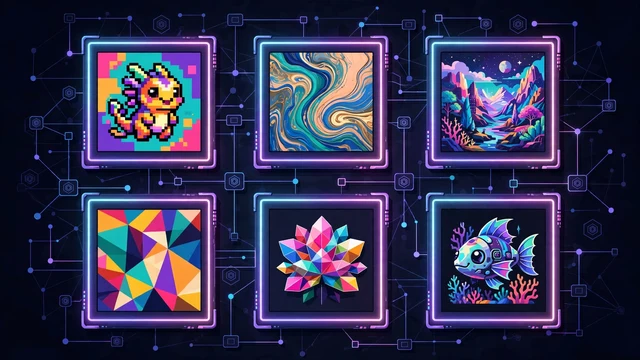
What are NFTs? A non-fungible token is a unique digital certificate recorded on a blockchain — a public, tamper-resistant ledger entry that says a specific wallet owns a specific item. Unlike a bitcoin, which is identical to every other bitcoin, each NFT is one of a kind. That uniqueness is what lets a token stand for a piece of digital art, a concert ticket, a game item, or a membership pass.
NFTs went from an obscure experiment to a global mania in four years, then crashed almost as fast as they rose. At the peak, a single digital collage sold for $69.3 million at Christie’s, and NFT sales topped $23.8 billion in a year. By late 2026, monthly sales had fallen below $200 million, blue-chip collections had lost 90% or more of their value, and most of the marketplaces built for the boom had shut down. Yet the technology did not disappear: tickets, game items, tokenized trading cards and domain names still run on the same mechanism. This guide explains how do NFTs work, what you actually own when you buy one, and what, if anything, is left.
In this article
- Key Takeaways
- What Is an NFT, in Plain English
- How Do NFTs Work?
- What You Actually Own When You Buy an NFT
- A Short History: From CryptoKitties to the $69 Million Beeple Sale
- How to Buy an NFT
- NFT Use Cases Beyond Art
- The Crash: What Happened to NFT Prices After 2022
- The Risks: Wash Trading, Fakes, Royalties and Illiquidity
- Facts and Figures
- What to Watch Next
- Frequently Asked Questions
- Related Articles
Key Takeaways
- An NFT is a unique token on a blockchain that records ownership of a specific item; the pair of contract address and token ID is its globally unique identifier.
- Most NFTs use Ethereum’s ERC-721 standard; ERC-1155 covers games and editions where one contract holds many token types.
- Owning an NFT means owning the token — not usually the copyright, not the only copy of the image, and not a guarantee of value.
- Beeple’s “Everydays” sold for $69.3 million at Christie’s in March 2021; NFT sales peaked at $23.8 billion in 2022.
- By late 2026, monthly NFT sales had fallen below $200 million, Bored Ape’s floor price was down 97% from its peak, and only 21 of 56 early marketplaces were still trading.
- The technology survives in narrower uses: tickets, game items, tokenized trading cards, domain names and membership passes.
What Is an NFT, in Plain English
Start with the word “fungible”. A fungible thing is interchangeable: one dollar bill is as good as another, one bitcoin is as good as another. You do not care which one you hold. A non-fungible thing is unique: a concert ticket for seat A12 is not the same as one for seat Z40, and a signed painting is not the same as a print of it.
An NFT applies that idea to digital items. It is a token on a blockchain with a unique identifier, recorded in a smart contract that tracks who owns each one — a digital deed. The deed itself lives on the blockchain, public and very hard to forge, while the item it points to can be digital art, a video clip, a game character, a ticket, or a record of attendance. Anyone can check who owns a given token and see its full history.
The comparison that helps most people is with a certificate of authenticity. Buying a painting gets you the canvas; buying an NFT gets you the certificate, recorded on a chain, saying this token belongs to your wallet address. The certificate is what is scarce and tradeable. The image it points to can be copied by anyone with a browser — the “right-click save” joke that followed NFTs everywhere. What cannot be copied is the ownership record, and the provable link to the artist who minted it.
NFTs live mostly on Ethereum, though they also exist on Solana, Polygon, Base, Bitcoin (as Ordinals) and others. ERC-721, created in 2017–2018, remains the backbone of the market; ERC-1155 handles cases where one contract manages many token types at once.
How Do NFTs Work?
How do NFTs work under the hood? An NFT is an entry in a smart contract — a program on a blockchain that keeps a table mapping token IDs to owner addresses. When an NFT is minted, the contract records a new row: token number N of this contract now belongs to this wallet address. When it is sold, the contract updates the row, and every transfer is public, so the full ownership history is visible to anyone.
The token itself rarely contains the artwork or file. Storing a large image directly on Ethereum is prohibitively expensive, so the contract usually stores a link called a tokenURI, pointing to a JSON metadata file with the item’s name, description, attributes and image link. The image itself lives somewhere else — and where it lives matters a great deal:
- IPFS or Arweave (decentralised storage): the file is addressed by a cryptographic hash of its content, so it cannot be swapped without changing the link. On IPFS, though, the file only stays available if someone “pins” it — a node promising to keep the data. Without pinning, it can eventually disappear.
- An ordinary web server: if the company behind the project stops paying for the server, the image vanishes and the NFT points to nothing. This has happened to real projects.
- Fully on-chain: a few collections store the artwork inside the contract itself. This is the most durable option and the most costly, so it is rare.
The two main Ethereum standards define how this behaves. ERC-721, finalised in January 2018, is for strictly unique items: one contract tracks many distinct NFTs, each token ID has one owner, and the standard defines the functions every marketplace and wallet relies on — ownerOf(), transferFrom(), and metadata references. ERC-1155 (June 2018) is a multi-token standard: one contract can manage fungible, non-fungible and semi-fungible tokens together, with batch transfers in a single transaction — which is why games use it.
Minting is the act of creating the token. An artist or project uses a smart contract, uploads the media and metadata, and calls the mint function, paying a network gas fee. Once minted, the NFT can be listed on a marketplace — OpenSea is the largest, with others such as Magic Eden (now Solana-focused) — where it can be bought, sold or transferred. Creator royalties, where they exist, are enforced by marketplace policy rather than by the token standard: the contract can suggest a royalty, but whether a marketplace honours it is the marketplace’s choice.
What You Actually Own When You Buy an NFT
You own the token. Your wallet address is recorded in the smart contract as the owner of that token ID, and only you can transfer or sell it. The record is public and verifiable, and nobody can take the token without your private key. If the project grants perks — event access, a community, a future airdrop — those are attached to holding the token.
You usually do not own the copyright. Unless the creator’s terms explicitly grant it, the artist keeps the copyright: you cannot reproduce the image commercially or license it to others just because you hold the token. Some projects do grant broad commercial rights — Bored Ape Yacht Club famously gave holders the right to use their ape commercially — but that is a licence in the project’s terms, not something the token itself confers.
You do not own the only copy. Anyone can download the image or set it as their profile picture. What they cannot do is claim the token, sell it, or prove a link to the artist. The scarcity is in the certificate, not in the pixels — the part that made NFTs a punchline, and also the part that is genuinely novel.
You do not own a guarantee of value. The token is worth what someone will pay for it, and NFT markets are thin: a collection’s “floor price” is the lowest asking price, not a completed sale, and in a dead market there may be no buyers at any price. You also do not own the infrastructure the token depends on: if the metadata server goes down or the project shuts up shop, your token may still exist on-chain, but it points to nothing.
A Short History: From CryptoKitties to the $69 Million Beeple Sale
NFTs began as an experiment by a handful of developers, years before the word went mainstream. The story has three acts: invention, mania, and collapse.
Invention (2017–2020). In June 2017, Matt Hall and John Watkinson of Larva Labs released CryptoPunks — 10,000 generative pixel-art characters on Ethereum, given away free. Three months later, Dieter Shirley of Axiom Zen drafted the ERC-721 standard, the document that first used the initialism “NFT”. In November 2017, Axiom Zen launched CryptoKitties, a game where players breed and trade virtual cats, each one an NFT. It was the first NFT project to reach mainstream awareness — and the first to break Ethereum: at the December 2017 peak, CryptoKitties accounted for roughly 25% of all Ethereum transactions, clogging the network and pushing gas fees up. For the next three years, NFTs stayed niche. Dapper Labs, spun out of Axiom Zen in February 2018, built the Flow blockchain to solve the scaling problems CryptoKitties had exposed, and launched NBA Top Shot — video highlights as NFTs — in 2020.
Mania (2021–2022). Three events in early 2021 lit the fuse. In February, CryptoPunk #7804 sold for $7.6 million. On March 11, Christie’s sold Beeple’s “Everydays: The First 5000 Days” for $69,346,250, paid in 42,329 ETH by Singapore-based buyer Vignesh Sundaresan — the first purely digital NFT work ever offered by a major auction house, making Beeple the third most expensive living artist at auction. In April, Bored Ape Yacht Club launched; by year’s end it had passed $1 billion in total sales. NFT sales grew from roughly $82 million in 2020 to $15.8 billion in 2021, then $23.8 billion in 2022, and Pak’s “Merge” sold for $91.8 million. In November 2021, Collins named “NFT” its Word of the Year.
Collapse (2022–2026). By mid-2022, trading volume had dropped about 90% from the peak, and Bored Ape floor prices fell from over $400,000 toward $100,000 — and kept falling. The lawsuits followed: in December 2022, investors sued Yuga Labs and 37 celebrity defendants over undisclosed promotion through MoonPay; in October 2025, a federal judge dismissed the case, ruling that Bored Ape NFTs were not securities. The decline never reversed: sales fell to $8.7 billion in 2023, $8.9 billion in 2024, $5.63 billion in 2025, and about $2.19 billion in the first ten and a half months of 2026.
How to Buy an NFT
How to buy an NFT is straightforward mechanically — the hard part is everything around the purchase. The steps:
- Set up a wallet. Most NFT trading happens from a self-custody wallet such as MetaMask (for Ethereum) or Phantom (for Solana). The wallet holds your crypto and your NFTs, and its private key — usually a 12- or 24-word seed phrase — is the only thing standing between you and losing everything. Write it down offline and never share it.
- Fund it with the right crypto. Ethereum NFTs are priced in ETH; Solana NFTs in SOL. Buy the crypto on an exchange and transfer it to your wallet, keeping some aside for gas fees.
- Pick a marketplace. OpenSea is the largest general marketplace; Magic Eden focuses on Solana. Check that the site is genuine — fake NFT sites are a staple scam — and verify the collection’s contract address before buying, since copycat collections are everywhere.
- Buy or bid. Buy at the listed price, make an offer, or bid in an auction. The transaction is confirmed on-chain and the NFT appears in your wallet. Remember the floor price is the cheapest listing, not a guarantee of what you can resell for.
- Store it safely. For high-value tokens, a hardware wallet is worth it — and never sign a transaction you do not understand, because malicious signature requests are how most NFT thefts happen.
Before buying anything, check three things: whether the art is stored on IPFS or Arweave rather than a company server; what rights the licence actually grants; and whether the collection has any real trading volume — a token nobody trades is one nobody will buy from you.
NFT Use Cases Beyond Art
Tickets. An NFT ticket is hard to fake, easy to verify at the door, and can carry resale rules set by the organiser — a capped resale price, for instance, or a royalty back to the artist. A ticket is already a unique, non-fungible item, so it maps naturally onto the technology.
Gaming items. Skins, weapons and characters that players genuinely own and can trade are the use case the ERC-1155 standard was built for. The vision of items moving freely between games has not materialised, but in-game trading economies on single titles continue to run on NFTs.
Tokenized collectibles and real-world assets. The strongest surviving corner of the market is tokenized trading cards: Courtyard, which tokenizes graded physical cards held in a vault, led global weekly NFT sales through late 2026 at $8–8.6 million a week — roughly a quarter of the entire market’s volume. The same pattern extends to tokenized shares: our report on GTA VI tokenised shares covers a market that hit $249.5 million in a day.
Domain names and identity. Names such as alice.eth are NFTs on the Ethereum Name Service: they work as wallet addresses, website names and portable identities. Certificates and diplomas can likewise be issued as NFTs that anyone can verify instantly.
The Crash: What Happened to NFT Prices After 2022
The numbers tell the story plainly. NFT sales peaked at $23.8 billion in 2022 and fell every year after: $8.7 billion in 2023, $8.9 billion in 2024, $5.63 billion in 2025, and about $2.19 billion in the first ten and a half months of 2026 — roughly $210 million a month, less than half the 2025 average. October 2026 saw $182.7 million in sales, down 71% from October 2025, and the week ending November 9, 2026 recorded $26.24 million — the weakest weekly volume in nearly six years.
The blue chips fell hardest. Bored Ape Yacht Club’s floor stood at 6.11 ETH (about $11,250) on November 14, 2026, down 97.3% in dollar terms from its record of 153.7 ETH (about $420,430) on May 1, 2022. CryptoPunks held up better at 29.49 ETH (about $54,300), down 88.7% from their record. The tracked market cap of all NFT collections was $2.21 billion in September 2026, against roughly $35 billion at the March 2022 peak, and the average sale fetched $75 in 2026, against $420–460 at the peak.
The infrastructure went with the money. An October 2026 survey found only 21 of 56 notable NFT marketplaces launched between 2017 and 2023 still actively trading; the NFT platforms of Coinbase, Binance, Kraken, Bybit and GameStop all closed, along with Nifty Gateway, MakersPlace and Foundation. Blur, the marketplace that briefly beat OpenSea, saw monthly volume collapse from about $1.43 billion in March 2023 to under $7 million by March 2026, and switched off its website on November 12, 2026. OpenSea survived by becoming something else: in October 2025, its biggest volume month in three years, it traded $1.6 billion of ordinary crypto tokens against $230 million of NFTs.
Three forces did most of the damage: speculation fed on itself, as prices rose because prices were rising; supply was endless, since anyone could mint a collection; and the broader crypto bear market drained the liquidity that had funded the boom. The crash exposed what the mania had hidden: most NFTs were collectibles with no use beyond trading, and once the trading stopped, there was nothing underneath.
The Risks: Wash Trading, Fakes, Royalties and Illiquidity
NFTs carry risks that go beyond ordinary price volatility, and several of them are specific to how the market works.
Wash trading — selling an NFT to yourself to manufacture volume and fake a price — has plagued the market from the start. CryptoSlam, which filters flagged trades out of its headline figures, excluded about $60 million of flagged volume against about $120 million of counted sales in the first three weeks of September 2026: roughly one flagged dollar for every genuine dollar. Any volume figure should be read with that in mind.
Fakes and copycats are endemic. Anyone can mint an NFT of anything, including art they did not create. Copycat collections with near-identical names list alongside the real ones, and fake marketplace sites harvest wallet connections from careless buyers. Always verify a collection’s contract address against the project’s official channels, and treat unsolicited NFT airdrops as hostile — many are phishing lures that drain wallets.
Royalties are not guaranteed. Creator royalties depend on marketplace policy, not on the token standard. When marketplaces began making royalties optional to compete for volume, artists’ income from secondary sales collapsed. A creator who mints today cannot assume they will earn anything from resales.
Illiquidity is the risk that bites hardest in a dead market. Unlike a fungible token, which can always be sold into a pool, an NFT needs a specific buyer willing to pay for that specific item. In a thin market, the gap between the floor price and the price you can actually get can be enormous — and for many collections, there is no bid at all. The floor price is an asking price, not a valuation.
Regulatory uncertainty has eased but not disappeared. The SEC closed its investigation into OpenSea without action in February 2026, and a federal judge ruled in October 2025 that Bored Ape NFTs were not securities. But when an NFT crosses the line into a security — particularly for projects that promise returns or fractionalise tokens — is still unsettled, and the UK’s FCA has warned that cryptoassets and NFTs carry no Financial Services Compensation Scheme protection.
Facts and Figures
| Item | Detail (as of November 2026) |
|---|---|
| NFT standard (unique items) | ERC-721 (drafted Sep 2017, finalised Jan 2018) |
| Multi-token standard | ERC-1155 (June 2018) |
| Beeple “Everydays” sale | $69,346,250, Christie’s, 11 March 2021 |
| NFT sales 2021 / 2022 | $15.8B / $23.8B (CryptoSlam) |
| NFT sales 2023 / 2024 / 2025 | $8.7B / $8.9B / $5.63B |
| NFT sales 2026 (to 14 Nov) | ~$2.19B (avg ~$210M/month) |
| October 2026 sales | $182.7M (down 71% year on year) |
| Tracked NFT market cap | $2.21B (Sep 2026) vs ~$35B (Mar 2022 peak) |
| CryptoPunks floor (14 Nov 2026) | 29.49 ETH (~$54,300), down 88.7% from record |
| BAYC floor (14 Nov 2026) | 6.11 ETH (~$11,250), down 97.3% from record |
| BAYC record floor | 153.7 ETH (~$420,430), 1 May 2022 |
What to Watch Next
First, watch whether the surviving use cases keep growing. Tokenized trading cards now drive roughly a quarter of all NFT volume, ticketing pilots keep expanding, and tokenized shares are a live market — our GTA VI tokenised shares report shows both the demand and the fraud that follows it. If NFTs have a future, it looks like this: boring, useful, and attached to things people already want to own.
Second, watch the marketplaces. OpenSea’s pivot to token trading saved the company but says something bleak about NFT demand: in its biggest month in three years, NFTs were 13% of what it traded. Whether a dedicated NFT marketplace can survive on NFT volume alone is now an open question.
Third, watch regulation. The SEC closing its OpenSea investigation and the courts ruling Bored Apes are not securities removed two overhangs, but the UK’s new crypto regime — which brings a wide range of cryptoasset activities under FCA authorisation from October 2027 — will set the rules for how NFT platforms can serve British customers. Our report on UK crypto regulation has the timetable.
Frequently Asked Questions
Q: What are NFTs in simple terms?
An NFT, or non-fungible token, is a unique digital certificate recorded on a blockchain. It proves that a specific wallet owns a specific item — a piece of art, a ticket, a game item or a membership pass. Unlike bitcoin, which is interchangeable, each NFT is one of a kind, and its ownership history is public and verifiable.
Q: How do NFTs work?
An NFT is an entry in a smart contract, usually Ethereum under the ERC-721 standard. The contract maps each token ID to an owner address, and transfers update that record. The token usually links to metadata and media held off-chain (often on IPFS), rather than the file itself.
Q: What do you actually own when you buy an NFT?
You own the token — the blockchain record saying your wallet holds that specific NFT. You usually do not own the copyright in the artwork, the only copy of the image, or any guarantee of value. Commercial rights depend on the project’s licence terms.
Q: How do I buy an NFT?
Set up a self-custody wallet such as MetaMask, fund it with the blockchain’s currency (usually ETH), choose a marketplace such as OpenSea, verify the collection’s contract address, and buy at the listed price or place a bid. Keep your seed phrase offline and never sign a transaction you do not understand.
Q: Are NFTs dead?
Not entirely, but the speculative market has collapsed: sales in 2026 run about 90% below the 2022 peak, blue-chip floor prices are down 89–97%, and most early marketplaces have closed. What survives is narrower and more practical — tokenized trading cards, tickets, game items, domain names and membership passes.
Q: Why did NFT prices crash?
The boom was driven by speculation: prices rose because buyers expected to sell higher, and supply was unlimited since anyone could mint a collection. When the broader crypto market turned in 2022, liquidity drained, volumes fell about 90%, and most collections had no underlying use to support their prices. Wash trading had also inflated the market’s apparent size.
Related Articles
- GTA VI Tokenised Shares Hit $249.5 Million as Fake Tokens Flood Solana
- Ethereum Glamsterdam Upgrade Could Slip to May 2027 Over Smart Contract Risks
- What Is Ethereum? ETH, Smart Contracts and DeFi Explained
- What Is a Smart Contract? How Self-Executing Code Works
- Best Crypto Wallet in 2026: Top Picks Compared
Disclaimer: This article is for information purposes only and is not financial advice. Cryptocurrency and NFT prices are volatile and can move sharply in either direction. NFTs are illiquid and can lose most or all of their value. Do your own research before making any investment decision. All prices and figures are as of November 21, 2026.

Leave a Reply