
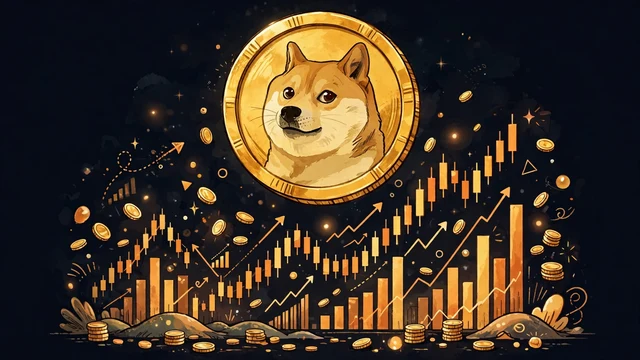
What is Dogecoin? It is the cryptocurrency that started as a joke and refused to go away. Launched in December 2013 by two software engineers who wanted to poke fun at the wild speculation around Bitcoin, Dogecoin features the face of a Shiba Inu dog as its logo and takes its name from the “doge” meme — a photo of a quizzical-looking dog captioned in broken Comic Sans English. Thirteen years later, it is still one of the largest cryptocurrencies in the world, with a market value of around $9 billion.
Dogecoin’s staying power is one of crypto’s strangest stories. It was built in about three hours, has no supply cap and no smart contracts — and yet it has outlasted thousands of more serious projects, survived multiple market crashes, and is now available through regulated exchange-traded funds in the United States. Its community’s motto, “Do Only Good Everyday,” has funded Olympic bobsledders, clean-water wells and a NASCAR driver.
This guide explains Dogecoin explained in full: where it came from, how does Dogecoin work under the hood, why its unlimited supply matters, what it is actually used for, and what the risks are in 2026.
In this article
Key Takeaways
- Dogecoin launched on 6 December 2013 as a joke, created by Billy Markus and Jackson Palmer from Litecoin’s code.
- It is a proof-of-work cryptocurrency using the Scrypt algorithm, with one-minute block times.
- Dogecoin has been merge-mined with Litecoin since September 2014, which secures it with Litecoin’s hash power.
- There is no maximum supply: every block pays a fixed 10,000 DOGE, adding about 5 billion new coins a year, forever.
- DOGE peaked at about $0.74 in May 2021 and trades near $0.056 in November 2026, about 92% below its record.
- US Dogecoin ETFs began trading in September 2025, but combined assets are tiny — under $20 million.
What Is Dogecoin? The Short Answer
Dogecoin (DOGE) is a peer-to-peer, open-source cryptocurrency — a digital currency that people can send to each other directly, without a bank in the middle. It runs on its own blockchain, a public ledger maintained by miners around the world. It was designed to be fast, cheap and friendly: transactions confirm in about a minute and cost a fraction of a cent, and the coin’s culture has always centred on small, light-hearted transactions rather than long-term saving.
The name comes from the “doge” meme, which was everywhere on the internet in 2013. The meme featured Kabosu, a Shiba Inu dog from Japan, photographed with a sideways glance and captioned with internal monologue in multicoloured Comic Sans — “such wow,” “very coin,” “much money.” The original photo was taken in February 2010 by Kabosu’s owner, Atsuko Satō, a kindergarten teacher who had adopted the dog from an animal shelter in 2008. Kabosu became one of the most recognisable animals on the internet, and when she died on 24 May 2024, the news was covered around the world.
Dogecoin’s creators never intended it to be taken seriously. Jackson Palmer, a product marketer at Adobe in Sydney, tweeted the joke and bought the Dogecoin.com domain, putting up a parody splash page with the coin’s logo and scattered Comic Sans text. Billy Markus, a software engineer at IBM in Portland, Oregon, saw the site, reached out to Palmer, and built the coin from Luckycoin — itself a fork of Litecoin — in about three hours by his own account. The first block was mined on 6 December 2013, and public mining opened two days later.
What nobody expected was that the joke would catch on. Within its first 30 days, Dogecoin.com had over a million visitors, and on 19 December 2013 — less than two weeks after launch — DOGE jumped nearly 300% in 72 hours. The community that formed around it was unusually warm by crypto standards: generous with tips, quick to fundraise, and allergic to the get-rich-quick posturing of other coins. That community is the main reason Dogecoin is still here.
It is worth being precise about what Dogecoin is not. It is not a token on another blockchain — it is a Layer-1 chain of its own, with its own nodes, miners and economic policy. It is not a smart-contract platform like Ethereum or Solana; it cannot run apps. And it is not a scarce asset like Bitcoin. Dogecoin is, by design, abundant and inflationary — a currency meant to be spent, not hoarded.
The Story: From a Joke Tweet to a Top-15 Crypto
Dogecoin’s history falls into three acts: the earnest early years, the 2021 explosion, and the long comedown since.
The early years were defined by the community. In January 2014, just weeks after launch, Dogecoin users raised about $30,000 worth of DOGE — 27 million coins — to send the Jamaican bobsled team to the Winter Olympics in Sochi after the team qualified but could not afford the trip. Weeks later came Doge4Water, which raised about $30,000 to fund clean-water wells in Kenya. Then the community crowdfunded $55,000 to sponsor NASCAR driver Josh Wise, whose car raced with a giant Dogecoin paint scheme. These were not marketing stunts arranged by a company; they were spontaneous fundraisers by a Reddit community that had decided its joke coin should do good. The Dogecoin Foundation, a non-profit, was formed in 2014 to support the project, and it still exists today, with advisers over the years including Ethereum co-founder Vitalik Buterin, Dogecoin co-creator Billy Markus, and Jared Birchall, a long-time associate of Elon Musk.
The second act began in January 2021. As Reddit traders piled into GameStop stock, attention spilled over into Dogecoin, and the price quintupled in a single day, reaching $0.07. Elon Musk, who had been tweeting about Dogecoin since 2019, stepped up his posts, calling DOGE “the people’s crypto” in February 2021. Snoop Dogg and Gene Simmons joined in. The Dallas Mavericks, owned by Mark Cuban, began accepting DOGE for tickets and merchandise in March. By May, Dogecoin’s market value had passed $85 billion — more than many companies in the S&P 500 — and the price peaked at about $0.74 on 8 May 2021, the day Musk hosted Saturday Night Live. On the show, Musk joked that Dogecoin was “a hustle.” Within three days, the price had lost about a third.
The third act is the comedown. DOGE fell through 2022 with the rest of the market, recovered partially in 2024 and 2025, and has spent 2026 sliding again. It closed 2025 at about $0.117, and by 20 November 2026 it traded near $0.056 — down about 52% for the year and about 92% below its 2021 peak. Along the way, the coin picked up an unlikely honour: in January 2025, a US government cost-cutting effort led by Musk was named the Department of Government Efficiency — DOGE — a deliberate nod to the coin. Co-founder Jackson Palmer left the crypto community in 2015 and has stayed away.
Through all of it, the network itself has never stopped. Dogecoin has run since December 2013 with no hack of the protocol and no major halt — a quieter achievement than the price chart, but a real one.
How Does Dogecoin Work?
Understanding how does Dogecoin work means starting with its family tree. Dogecoin’s code comes from Luckycoin, which came from Litecoin, which came from Bitcoin. It is a proof-of-work blockchain: miners run specialised computers to solve computational puzzles, and the winner of each round adds the next block of transactions and earns newly created DOGE.
The mining algorithm is Scrypt, the same one Litecoin uses, rather than Bitcoin’s SHA-256. Scrypt was originally chosen because it was friendlier to ordinary computers, though in practice Dogecoin mining today is dominated by specialised ASIC machines, just like Bitcoin’s. New blocks arrive about every minute — ten times faster than Bitcoin’s ten-minute blocks — which is why Dogecoin transactions confirm quickly. Fees are very low, a fraction of a cent in most cases.
Dogecoin’s most important technical decision came in September 2014, when the network adopted merge-mining with Litecoin. Merge-mining — technically AuxPoW, or auxiliary proof of work — lets miners secure two compatible blockchains with the same work. A Litecoin miner can mine Dogecoin at the same time at no extra cost, earning rewards on both networks. The change went live at block 371,337 in September 2014, and most Litecoin miners soon began collecting Dogecoin as a free bonus. Markus has called merge-mining the decision that saved the project: it gave Dogecoin the security of Litecoin’s large mining network without Dogecoin having to pay for it alone. A 51% attack on Dogecoin would now effectively mean overpowering the combined hash power of both networks, which is why the chain’s security is far stronger than its price or development activity alone would suggest.
Dogecoin mining today is therefore mostly a Litecoin-mining byproduct. The two chains are linked at the hip: Litecoin’s miners keep Dogecoin secure, and Dogecoin’s block rewards add to their income. That dependency cuts both ways — Dogecoin’s security depends on Litecoin miners continuing to find the extra reward worth collecting — but after twelve years, the arrangement has proved durable.
What Dogecoin does not have is also worth stating. There is no staking: as a proof-of-work coin, DOGE holders earn no yield from the protocol. There are no smart contracts and no DeFi ecosystem to speak of. Development is slow and part-time, maintained by a small group of core developers.
Dogecoin’s Supply: Why There Is No Cap
Dogecoin supply is the feature that most separates it from Bitcoin, and the one beginners most often misunderstand. Bitcoin will only ever have 21 million coins. Dogecoin has no maximum supply at all — and that is deliberate, not an oversight.
Every block pays miners a fixed reward of 10,000 DOGE. That reward has been fixed since block 600,000, mined in February 2015; before that, rewards were random amounts in the earliest days, then fixed amounts that stepped down over time. With a new block about every minute — roughly 1,440 blocks a day — the network creates about 14.4 million new DOGE every day, or about 5.26 billion a year. The Dogecoin project itself describes this as a fixed yearly issuance of 5 billion coins. There is no end date and no scheduled reduction.
About 157 billion DOGE are in circulation as of November 2026 (trackers disagree — CoinMarketCap shows a higher figure, around 172 billion — but most sources cluster near 157 billion). At the current rate of issuance, that means annual inflation of about 3.2%.
Here is the subtle part: because the number of new coins each year is fixed while the total supply keeps growing, the inflation rate falls every year. Five billion new coins add 5% to a supply of 100 billion, but only 2.5% to a supply of 200 billion. Dogecoin’s inflation is therefore predictable and declining in percentage terms, even though the absolute number of new coins never changes. It will never reach zero, but it shrinks steadily — which is very different from a coin that prints a fixed percentage forever.
The design reflects a philosophy. Bitcoin’s fixed supply rewards holding: if the price rises, early holders gain most. Dogecoin’s permanent issuance is meant to do the opposite — to discourage hoarding and keep the coin circulating as a currency for tipping and small payments. It also solves a long-term problem Bitcoin still faces: when Bitcoin’s block subsidy eventually falls to near zero, miners will depend on fees alone. Dogecoin’s miners are paid forever, which keeps the network secure indefinitely.
What Is Dogecoin Used For?
Dogecoin’s uses are modest, and its supporters are usually honest about that. There are three main ones: tipping, payments, and speculation.
Tipping was the coin’s original killer app. In its early years, Dogecoin users tipped each other on Reddit and other platforms for good posts, jokes and helpful answers — small amounts, given freely, in a way that felt natural because the coin was nearly worthless and the community was generous. That tipping culture defined Dogecoin’s identity and still exists, though it is a smaller part of the picture now that the coin has real market value.
Payments are the second use. Dogecoin’s one-minute blocks and tiny fees make it practical for small transactions in a way Bitcoin’s ten-minute blocks and higher fees are not. A growing list of merchants accepts DOGE, usually through payment processors such as BitPay, CoinGate and NOWPayments. The best-known names: Tesla accepts Dogecoin for merchandise in its online store (since January 2022, though not for cars); SpaceX accepts it for merchandise too; AMC Theatres accepts DOGE for tickets and concessions; Newegg accepts it for electronics; the Dallas Mavericks accept it for tickets and merchandise; and travel sites including Travala and airBaltic take it for bookings. Charities including The Water Project, Save the Children and the American Cancer Society accept DOGE donations.
The third use — speculation — is the largest by far. Most DOGE trading is people buying and selling the coin on exchanges, betting on price moves driven by attention: a Musk post, a meme cycle, a market rally. Dogecoin’s price has always moved mostly on attention rather than usage, and that is both its superpower and its weakness. Attention can arrive quickly and leave just as fast.
Dogecoin ETFs and the Risks
The newest chapter in Dogecoin’s story is its arrival on Wall Street. In September 2025, the REX-Osprey DOGE ETF (ticker DOJE) became the first US exchange-traded fund to offer Dogecoin exposure, listing on Cboe. It is structured under the Investment Company Act of 1940 and gets part of its DOGE exposure through a Cayman Islands subsidiary; its expense ratio is 1.5%. In November 2025, Grayscale’s Dogecoin Trust ETF (GDOG) listed on NYSE Arca as the first pure spot Dogecoin product, holding DOGE directly, with a 0.35% fee after a waiver. The 21Shares Dogecoin ETF (TDOG) followed on Nasdaq in January 2026, launched with the endorsement of House of Doge, then the official corporate arm of the Dogecoin Foundation. Bitwise also launched a Dogecoin fund in November 2025 — then announced in September 2026 that it would liquidate and close it, less than a year after launch.
The honest verdict on the ETF era so far: regulated access arrived, and almost nobody came. The three surviving funds held only about $17.8 million combined in mid-November 2026, down from about $23 million in late October. The two spot funds tracked by SoSoValue (GDOG and TDOG) held about $9.1 million in combined net assets on 19 November, after recording a $409,000 outflow that day — their first flow of any kind after 26 straight trading sessions with zero flows.
The risks of Dogecoin are straightforward. First, volatility: DOGE has fallen more than 90% from its peak and has a history of drops of 80% or more. Second, concentration of attention: the price is unusually sensitive to a single person’s public comments, and to social media cycles nobody can predict. Third, the permanent supply: about 5 billion new coins a year must be absorbed by new demand. Fourth, thin development: the protocol changes slowly, maintained by a small team. Fifth, competition: the memecoin market Dogecoin created is now crowded with thousands of rivals — Shiba Inu, Pepe and countless Solana-based tokens — competing for the same speculative attention.
There are genuine strengths too. The network has run for thirteen years without a protocol hack or a major halt. Merge-mining with Litecoin makes it very expensive to attack. It is listed on virtually every exchange, accepted by real merchants, and recognised by people who have never heard of any other altcoin. In March 2026, an SEC interpretation listed Dogecoin as an example of a digital commodity, giving it a measure of regulatory clarity many coins lack.
Facts and Figures
| Item | Detail (as of November 21, 2026) |
|---|---|
| Launched | 6 December 2013 |
| Creators | Billy Markus (IBM) and Jackson Palmer (Adobe) |
| Based on | Luckycoin / Litecoin code |
| Logo | Kabosu, a Shiba Inu dog (died 24 May 2024) |
| Consensus | Proof of work, Scrypt algorithm |
| Block time | ~1 minute |
| Block reward | 10,000 DOGE (fixed since February 2015) |
| New DOGE per year | ~5–5.26 billion |
| Maximum supply | None |
| Circulating supply | ~157 billion DOGE |
| Annual inflation | ~3.2% (falling over time) |
| Merge-mining | With Litecoin since September 2014 (block 371,337) |
| DOGE price | ~$0.056 |
| Market cap | ~$9 billion (rank ~#11–12) |
| All-time high | ~$0.74 (8 May 2021) |
| Peak market cap | Over $85 billion (May 2021) |
| 2026 change | Down ~52% year to date |
| First US DOGE ETF | DOJE (REX-Osprey), 18 September 2025 |
| Spot DOGE ETFs | GDOG (24 Nov 2025), TDOG (22 Jan 2026) |
| Combined ETF assets | ~$18 million (mid-November 2026) |
| Bitwise DOGE ETF | Closed September 2026 |
| Tesla | Accepts DOGE for merchandise (since January 2022) |
| Motto | “Do Only Good Everyday” |
| Staking yield | None (proof of work) |
What to Watch Next
First, watch whether the ETFs ever attract real money. Twenty-six straight sessions with zero flows, followed by an outflow, is about as quiet as a fund launch can be. If institutional demand for DOGE never materialises, the ETF story becomes a footnote rather than a turning point. Our report on Dogecoin’s price slide tracks the ETF flow drought and the price levels that matter.
Second, watch the memecoin cycle. Dogecoin’s price has always moved with waves of speculative attention, and those waves now spread across hundreds of rival tokens — Shiba Inu, Pepe and the Solana memecoin factory all compete for the same traders.
Third, watch development. The Dogecoin Foundation and core developers have talked for years about upgrades, but delivery has been slow. Any concrete protocol progress would be a genuine change of pace for a coin that has barely changed in a decade.
Finally, watch the $0.05 level. DOGE is trading near its lowest since June 2022, and a break below $0.05 would take it into territory it has not seen in more than four years. For a coin whose value rests on attention and community rather than cash flows, price levels are as much about sentiment as anything — but sentiment is what has always moved this coin.
Frequently Asked Questions
Q: What is Dogecoin in simple terms?
Dogecoin is a cryptocurrency that started as a joke in December 2013, based on the “doge” meme featuring a Shiba Inu dog. It runs on its own proof-of-work blockchain, confirms in about a minute, and is mainly used for tipping, small payments and speculation. It has no maximum supply.
Q: How does Dogecoin work?
Dogecoin uses proof of work with the Scrypt algorithm: miners solve puzzles to add new blocks about every minute and earn 10,000 DOGE per block. Since September 2014 it has been merge-mined with Litecoin, meaning Litecoin miners secure both networks with the same work, which makes Dogecoin much harder to attack.
Q: Does Dogecoin have a maximum supply?
No. Dogecoin has no supply cap. Every block creates 10,000 new DOGE, adding about 5 billion coins a year forever. Because the yearly amount is fixed while the total supply grows, the inflation rate falls over time — about 3.2% in November 2026.
Q: What was Dogecoin’s all-time high?
Dogecoin peaked at about $0.74 on 8 May 2021, the day Elon Musk hosted Saturday Night Live, giving it a market value above $85 billion. As of November 2026 it trades near $0.056, about 92% below that peak.
Q: Can you buy Dogecoin through an ETF?
Yes. Three US funds offer Dogecoin exposure: the REX-Osprey DOGE ETF (DOJE, launched September 2025), the Grayscale Dogecoin Trust ETF (GDOG, November 2025) and the 21Shares Dogecoin ETF (TDOG, January 2026). Demand has been very thin — the three funds held only about $18 million combined in mid-November 2026. A fourth fund, from Bitwise, closed in September 2026.
Q: Is Dogecoin a good investment?
That depends on what you expect from it. Dogecoin has a thirteen-year track record, a huge community, real merchant acceptance and a secure network — but no supply cap, no yield, minimal development and a price driven mostly by social media attention. Anyone considering it should understand that its price can move sharply on attention alone, and should never invest more than they can afford to lose.
Related Articles
- Dogecoin Price Today: DOGE Slips Toward $0.055 as ETF Demand Stalls
- Shiba Inu Price Today: SHIB Falls to $0.0000035, Lowest Since May 2021
- Pepe Price Today: PEPE Falls to $0.00000339, Lowest Since September, as Meme Coins Bleed
- Litecoin Price Falls to $40 as LTC Nears Its 2026 Low in the Market Selloff
- What Is Bitcoin? How BTC Works, Explained Simply
Disclaimer: This article is for news and information purposes only and is not financial advice. Cryptocurrency prices are volatile and can move sharply in either direction. Do your own research before making any investment decision. All prices and figures are as of November 21, 2026.


Leave a Reply