
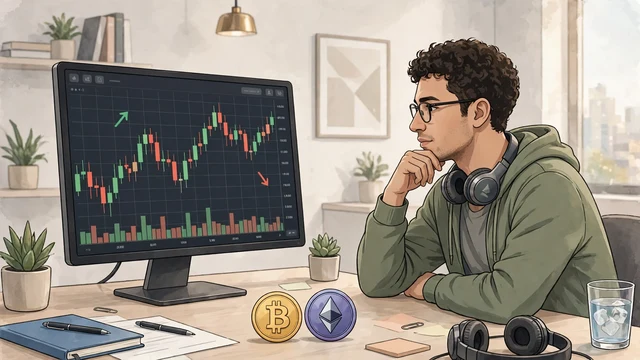
Crypto trading for beginners starts with an uncomfortable truth: most new traders lose money. Not because they are foolish, but because they arrive underinformed — buying on hype, trading with leverage they do not understand, and holding losing positions in the hope they come back. The market is open around the clock, moves faster than any stock market, and has no circuit breakers.
This guide is the preparation: how trading works, the difference between owning coins and betting on price moves, the order types you need, the strategies beginners use, and — most importantly — the risk rules that keep a bad week from becoming a blown account. There are no promises of profit here. Trading is a skill that takes practice and a willingness to learn from small losses.
In this article
- Key Takeaways
- What Crypto Trading Actually Is
- Spot Trading vs Derivatives: Start With Spot
- How to Start Crypto Trading: Your First Steps
- Order Types Every Beginner Must Know
- Crypto Trading Strategies for Beginners
- Technical Analysis: The Only Indicators Beginners Need
- Risk Management: The Skill That Keeps You in the Game
- Facts and Figures
- What to Watch Next
- Frequently Asked Questions
- Related Articles
Key Takeaways
- Crypto trading means buying and selling digital assets to profit from price moves — active, fast and high-risk, unlike long-term holding.
- Start with spot trading only: you own the actual coins, you cannot be liquidated, and your worst case is a paper loss, not a forced exit.
- Never risk more than 1–2% of your account on a single trade, and always set a stop-loss before you enter.
- Use limit orders for most trades: they give you price control and usually cost less in fees than market orders.
- A simple strategy with clear rules — such as swing trading or dollar-cost averaging — beats chasing tips and switching methods every week.
- Paper trade first, keep a trading journal, and treat your first months as paid education, not income.
What Crypto Trading Actually Is
Crypto trading is the buying and selling of cryptocurrencies — Bitcoin, Ethereum, Solana and thousands of smaller coins — with the aim of profiting from price movements. A trader might hold a position for minutes, hours, days or weeks. That is the core difference from investing: an investor buys because they believe in an asset’s long-term value, while a trader buys because they expect the price to move in a particular direction over a particular period.
The crypto market never closes. Unlike stock exchanges, crypto trades 24 hours a day, seven days a week, with no circuit breakers to pause trading when prices fall hard. A position can move sharply against you while you sleep. On 21 November 2026, for example, Bitcoin fell below $60,000 to a two-year low near $55,100 overnight, and roughly $2.4 billion of leveraged positions were liquidated in 24 hours. That is why the risk section of this crypto trading guide matters more than any strategy.
Trading also demands more than holding: a plan, discipline and emotional control. You decide in advance when to enter, when to exit with a profit, and when to exit with a loss — and then actually follow those decisions when the chart moves against you. Most beginners fail at the last part: they move their stop-loss “just a little further”, add to a losing trade, or chase a coin that has already risen 40% out of fear of missing out.
One more honest point: trading is not the only way to make money in crypto, and for most people it is not the best way. Buying Bitcoin or Ethereum regularly and holding for years has historically been simpler and, for most people, more profitable than active trading. If you have never bought crypto at all, start with our guide on how to buy Bitcoin.
Spot Trading vs Derivatives: Start With Spot
Spot trading means buying the actual cryptocurrency. When you buy 0.1 BTC on a spot market, you receive 0.1 BTC that you can withdraw, hold or sell later. If the price falls 50%, your holding is worth half as much — painful, but you still own the same amount of Bitcoin and can wait for a recovery. There is no clock ticking and no one can force you to sell. Your maximum loss is the amount you invested, and only if the coin goes to zero.
Derivatives — futures and perpetual contracts — let you speculate on price without owning the asset. You put up a margin deposit and the exchange lends you exposure many times larger: leverage of 2x to 125x is available on some exchanges. With 10x leverage, a 10% move against you wipes out your margin and your position is liquidated — force-closed at a loss, automatically. Perpetual contracts also charge a funding fee every eight hours, so holding a leveraged position costs money even when the price goes nowhere.
Every serious beginner guide agrees: start with spot trading only. Master it for at least six to twelve months of consistent, profitable spot trading before even considering derivatives — and many experienced traders never touch leverage at all. Spot trading teaches you everything that matters without the liquidation risk that turns a small mistake into a total loss.
On where to trade, centralised exchanges such as Coinbase, Kraken and Binance are the right starting point: they accept bank transfers and cards, offer customer support and account recovery, and have deep liquidity, so orders fill quickly at fair prices. Decentralised exchanges let you trade directly from your wallet, but with higher complexity and no support if something goes wrong. Our comparison of the best crypto exchange in 2026 covers fees, security and regulation across the major platforms.
How to Start Crypto Trading: Your First Steps
So, how to start crypto trading in practice? Follow this sequence.
Step 1: Learn before you fund. Spend a week watching Bitcoin and Ethereum charts without trading: how often a sharp rise is followed by a pullback, how news moves prices, how volatile weekends can be. This costs nothing and teaches you more than any course.
Step 2: Choose a reputable exchange. Prioritise security and regulation over the lowest fees. Look for an exchange regulated in your jurisdiction, holding most customer funds in cold storage, and offering two-factor authentication. Complete the identity verification (KYC) process — it is a legal requirement on regulated exchanges.
Step 3: Secure your account and paper trade. Enable two-factor authentication with an authenticator app, not SMS, and use a unique, strong password. Then paper trade — simulated trading with virtual money, offered as demo accounts by many exchanges — for at least two to four weeks, following the same rules you would use with real money. If you cannot make paper trading work, real money will not fix it.
Step 4: Fund a small amount you can afford to lose. The money in your trading account should be money whose complete loss would not affect your rent, bills or quality of life. Start small — a few hundred dollars or pounds is enough to learn with.
Step 5: Place your first trade with a limit order. Buy a small amount of Bitcoin or Ethereum, set a stop-loss, and set a take-profit target. Then watch what happens — and, whatever the outcome, write it down. A trading journal is the single most underrated tool in trading: recording why you entered, where you exited and what you felt turns every trade into a lesson.
Step 6: Review weekly. At the end of each week, review your trades. How many followed your plan? How many were impulse decisions? Traders who review improve; traders who do not repeat the same mistakes indefinitely.
Order Types Every Beginner Must Know
An order is an instruction you give the exchange. Using the right order type matters — getting it wrong costs real money through slippage, the gap between the price you expected and the price you actually got.
Market order. Executes immediately at the best available price. It is fast and guaranteed to fill in a liquid market, but you have no control over the exact price — in a fast-moving market it can fill several percent away from the price on screen. Use market orders only when speed matters more than price.
Limit order. You specify the exact price you are willing to buy or sell at, and the order executes only at that price or better. Limit orders give you price control and, on many exchanges, lower fees than market orders. The trade-off is that your order may never fill. For most trades, limit orders are the right default.
Stop-loss order. A stop-loss triggers a market order when the price reaches a level you set. Buy Bitcoin at $60,000 with a stop-loss at $57,000 and your position sells automatically if the price falls there, capping your loss at 5%. This is the most important order type in trading. Place it immediately after entering a position. A stop-loss set “in your head” is not a stop-loss; it is a hope, and hope is not a risk management strategy.
Take-profit order. The mirror image of a stop-loss: an order that sells automatically when the price reaches your target.
One practical note: in volatile crypto markets, set stop-losses slightly wider than your ideal level — TradeAlgo’s 2026 guide suggests 0.5–1% wider — so normal price noise does not trigger your exit before the real move happens.
Crypto Trading Strategies for Beginners
A strategy is a set of repeatable rules for entering and exiting trades. Without one, you are gambling with extra steps. Here are the crypto trading strategies for beginners that are genuinely learnable, in order of difficulty.
Dollar-cost averaging (DCA). Strictly an investing approach, not a trading strategy — but where most beginners should start. You buy a fixed amount at regular intervals (say, $100 of Bitcoin every week) regardless of price. This removes timing decisions entirely and smooths out volatility.
Swing trading. Holding positions for days to weeks to capture a medium-term price move — buying after a bounce off support, selling near resistance. This is the most popular beginner style because it needs only one or two chart checks a day.
Day trading. Opening and closing positions within a single day, never holding overnight. It demands constant screen time, fast decisions and strict discipline — and the fees from many small trades add up quickly. Most beginners who try day trading first burn out or blow up within months. It is a style to graduate into, not to start with.
Trend following. Identify the direction of the trend and trade with it, not against it. In an uptrend, buy pullbacks; in a downtrend, sell rallies or stay out. Crypto trends — in both directions — tend to persist for weeks or months. Accept that you will miss the exact bottom and top — capturing the middle of a move, consistently, is enough.
Range and breakout trading. When a coin moves sideways between clear support (floor) and resistance (ceiling), a range trader buys near support and sells near resistance — always with a stop-loss just below support. A breakout trader enters when the price pushes through a key level with strong volume, but false breakouts are common: waiting for the price to retest the broken level and hold above it is a more reliable entry than chasing the first spike.
Whatever style you choose, two rules apply. First, trade one strategy at a time until you know whether it works for you. Second, only trade coins with deep liquidity (Bitcoin and Ethereum above all) — small, thinly traded coins can move 20% on a single large order, and your stop-loss may fill far below your trigger price. Liquidity is safety.
Technical Analysis: The Only Indicators Beginners Need
Technical analysis is the study of price charts to anticipate future moves. Beginners commonly load their chart with a dozen indicators until the price itself is invisible. You need far fewer than you think.
Candlesticks. Each candle shows the open, high, low and close for a period (an hour, a day, a week). Green means the price closed higher than it opened; red means lower. Learning to read candlesticks — and a few basic patterns such as hammers and engulfing candles — is the foundation of everything else.
Support and resistance. Support is a price level where buying has repeatedly stopped falls; resistance is where selling has repeatedly stopped rises. These levels matter because traders watch them and act on them, which makes them partly self-fulfilling. On 21 November 2026, for example, $60,000 was the key psychological level for Bitcoin, with resistance above at $62,500–$63,000 and support at the $55,100 low. Drawing support and resistance lines is the single most useful technical skill a beginner can learn.
Moving averages. A moving average smooths out price noise by averaging recent closes. The 50-day and 200-day moving averages are the most watched: price above them suggests an uptrend, below them a downtrend.
RSI (Relative Strength Index). A momentum indicator running from 0 to 100. Readings above 70 suggest an asset is overbought; below 30 suggests oversold. RSI is most useful as a warning, not a signal: an overbought coin can stay overbought for weeks in a strong trend, and buying an oversold coin in a crash is catching a falling knife.
That is enough: support and resistance, moving averages and RSI will carry a beginner a long way. Add new indicators only when you can explain exactly what question they answer that your current tools cannot. Technical analysis cannot predict news or a whale selling — only what is more or less likely based on past behaviour. Treat it as a probability tool, not a crystal ball.
Risk Management: The Skill That Keeps You in the Game
Risk management is the difference between traders who survive and traders who do not. Every professional trader will tell you the same thing: managing losses matters far more than finding winning trades. A trader who wins 40% of trades but cuts losses quickly and lets winners run will outperform a trader who wins 70% of trades but holds losers until they are catastrophic. Here are the rules.
The 1–2% rule. Never risk more than 1–2% of your total trading capital on any single trade. On a $10,000 account, that means a maximum loss of $100–$200 per trade. It is the rule stated identically by Kingfisher’s 2026 beginner guide and Blocklr’s complete guide. You can be wrong ten times in a row and still have most of your capital intact.
Position sizing. Your position size is determined by your risk, not by how confident you feel: position size = risk amount ÷ (entry price − stop-loss price). On a $10,000 account, buying Bitcoin at $60,000 with a stop-loss at $57,000 (a 5% risk per coin) and risking 1% ($100) means a $2,000 position. The stop-loss controls your risk; the position size follows from it.
Risk–reward ratio. Before entering a trade, check that the potential profit justifies the risk. Most successful traders aim for at least 2:1 — risking $1 to potentially make $2. If your stop-loss is 5% below entry, your target should be at least 10% above it.
Cap your total exposure. Do not risk 2% on five trades at once and call it diversified — in crypto, everything tends to fall together. Cap total risk at around 6% across all open positions.
Never add to a losing position. Averaging down — buying more as the price falls to lower your average entry — feels logical and is one of the fastest ways to destroy an account. If your thesis was wrong, adding money to it makes the mistake bigger. The market does not owe you a recovery. Cut the loss, review what went wrong, and move on.
Never trade with money you need. If a loss would affect your rent, your bills or your sleep, the position is too big or the money should not be in the market at all.
Keep a journal. Record every trade: entry, exit, size, reason for entering, and how you felt. After a month, patterns will emerge — you will see which setups work for you and which mistakes repeat.
The classic crypto trading mistakes are all failures of these rules: trading without a stop-loss, buying out of FOMO after a coin has already risen 40%, revenge trading to win back a loss, overtrading out of boredom, and using leverage before earning the right to. Social media makes all of them worse — influencers show wins and hide losses, and some are paid to promote coins they are selling. And remember fees and taxes: frequent trading racks up costs, and in many countries every trade is a taxable event. In the US, the regulatory picture for traders is still evolving; our guide to US crypto regulation explains who regulates what in 2026.
Facts and Figures
| Item | Detail |
|---|---|
| Market hours | 24/7 — crypto never closes |
| Recommended starting market | Spot trading only |
| Max risk per trade | 1–2% of account (the 1–2% rule) |
| Position size formula | Risk amount ÷ (entry price − stop-loss price) |
| Minimum risk–reward target | 2:1 (risk $1 to make $2) |
| Leverage available on some exchanges | Up to 125x (not recommended for beginners) |
| BTC key levels (21 Nov 2026) | Support ~$55,100; resistance $60,000, then $62,500–$63,000 |
| 24h liquidations (21 Nov 2026) | ~$2.4B, ~93% longs (CoinGlass) |
| Best first coins for beginners | Bitcoin and Ethereum (deepest liquidity) |
What to Watch Next
Your first month of trading is about building habits, not making money. Watch your discipline, not your balance: after a month, count how many trades followed your written plan versus how many were impulsive. If fewer than eight in ten followed the plan, the problem is not your strategy — it is your execution.
Watch how you handle your first losing streak: shrinking position sizes and reviewing calmly, or doubling down to recover, will tell you more about your future as a trader than any winning streak.
Watch the market’s structure as you learn. The November 2026 crash is a live lesson in why the rules in this guide exist: leveraged traders were wiped out, while spot holders who sized sensibly still own their coins. Our report on the Bitcoin crash below $60,000 shows how that selloff unfolded, and our coverage of crypto liquidations explains the mechanics of forced selling.
Finally, watch for the moment you are ready to go deeper. Once you can trade spot profitably for several months and follow your rules under pressure, you can start studying advanced topics — derivatives, on-chain data, order-book analysis — from a position of strength.
Frequently Asked Questions
Q: How much money do I need to start crypto trading?
You can start with a few hundred dollars — most exchanges have low minimums. What matters is that it is money you can afford to lose completely.
Q: Is crypto trading profitable for beginners?
Most beginners lose money at first — that is the honest answer given by every reputable guide. Trading profitably is a skill that takes months of practice, and the first year should be treated as education rather than income. Beginners who survive are the ones who start with spot trading, risk only 1–2% per trade, use stop-losses and keep a journal.
Q: What is the best crypto trading strategy for beginners?
There is no single best strategy, but swing trading and dollar-cost averaging are the most beginner-friendly. Swing trading — holding positions for days to weeks — needs only one or two chart checks a day. Dollar-cost averaging removes timing decisions entirely.
Q: Should beginners use leverage in crypto trading?
No. Leverage of up to 125x is available on some exchanges, but it magnifies losses exactly as it magnifies gains, and a leveraged position can be liquidated — force-closed at a loss — if the price moves a small amount against you. On 21 November 2026, roughly $2.4 billion of leveraged positions were liquidated in 24 hours.
Q: How do I set a stop-loss when trading crypto?
Decide your stop-loss level before you enter the trade — typically just below a support level for a long position. Then size your position using the formula: position size = risk amount ÷ (entry price − stop-loss price), where your risk amount is 1–2% of your account. Place the stop-loss order immediately after entering, and do not move it further away if the trade goes against you.
Q: How do I trade Bitcoin as a beginner?
Learning how to trade bitcoin starts with the basics: open an account on a reputable regulated exchange, complete identity verification, enable two-factor authentication, and practise with paper trading first. Fund a small amount, then place your first trade as a limit order on the BTC spot market, with a stop-loss set immediately after entry. Bitcoin and Ethereum are the best coins for beginners because they have the deepest liquidity.
Related Articles
- Bitcoin Crash: BTC Falls Below $60,000 to a Two-Year Low
- US Crypto Regulation in 2026: SEC, CFTC and the Law
- How to Buy Bitcoin: A Beginner’s Step-by-Step Guide
- Best Crypto Exchange in 2026: Top Picks Compared
- Crypto Liquidations Today: Nearly $700 Million Wiped Out as Longs Take 86% of the Hit
Disclaimer: This article is for education and information purposes only and is not financial advice. Cryptocurrency trading is high-risk and most new traders lose money. Never trade with money you cannot afford to lose. Do your own research before making any investment decision. All prices and figures are as of November 21, 2026.




Leave a Reply