
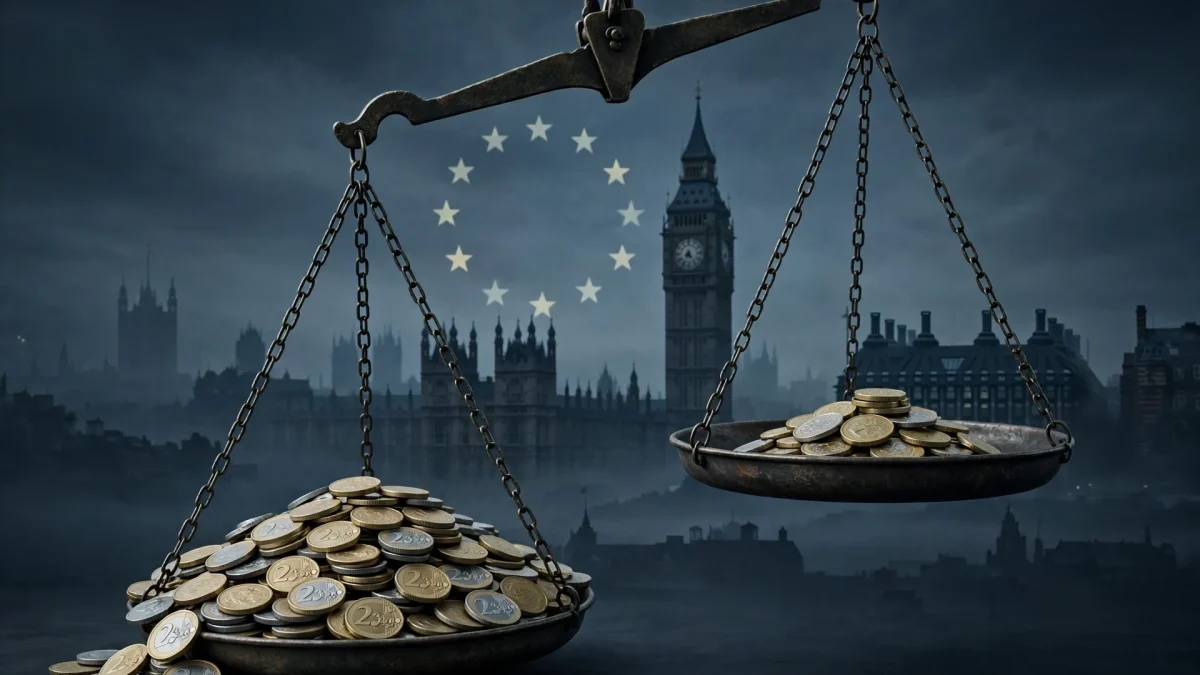
EUR GBP is trading around 0.8377–0.8378 on Friday, November 20, 2026, after sterling pulled back from a 20-month high against the euro. On Thursday the euro rose 0.23% to 83.65 pence, having touched 83.20 pence on Wednesday — its lowest level since March 28, 2025. In reverse, one pound now buys €1.19, still close to the best rate for sterling in nearly two years.
The retreat is small so far, and the bigger picture has not changed: the pound remains near multi-month highs against the single currency even as it slides against the dollar. But banks are starting to warn that sterling’s rally is stretched, and Friday brings a UK–EU summit in Brussels that could shift the tone. The EUR GBP exchange rate today sits at an interesting crossroads — a euro trying to bounce, a pound that has run a long way, and two central banks both under pressure to raise rates.
In this article
Key Takeaways
- EUR GBP traded around 0.8377–0.8378 on Friday after the euro rose 0.23% to 83.65 pence on Thursday.
- Sterling had hit a 20-month high against the euro on Wednesday, when the euro fell to 83.20 pence, its lowest since March 28, 2025.
- UK inflation hit a 12-month high of 3.6% in October, keeping pressure on the Bank of England to raise rates again.
- UK retail sales beat expectations on Friday, rising 0.7% month on month in October against a flat reading expected.
- ING and Goldman Sachs both forecast GBP/EUR retreating to 1.1630 by the end of 2027, warning sterling’s rally is stretched.
- A UK–EU reset summit takes place in Brussels on Friday, with hopes of a youth experience programme and a food trade deal.
EUR GBP: The Numbers
EUR/GBP — the price of one euro in British pounds — has been drifting lower for most of the year, which means sterling has been strengthening against the euro. Finnhub’s daily candles show Thursday, November 19 opening at 0.83466, trading as high as 0.83844 and as low as 0.83434, and closing at 0.83796. Wednesday’s close was 0.83455 and Tuesday’s 0.83273. The week’s low of 83.20 pence on Wednesday is effectively the same level as Finnhub’s 52-week low of 0.83198, dated November 17 — the two differ by a fraction of a pip and describe the same trough, not two separate lows.
The longer trend is clear from the numbers. EUR GBP is up 0.46% over five days — the current rebound — but down 0.07% over one month and down 3.87% so far in 2026. The 52-week high of 0.88314 dates from November 20, 2025, so the pair has fallen roughly five pence from its peak over the past year. Looked at the other way, GBP/EUR reached €1.2010 on October 30 — an 18-month high at the time — and started November at €1.1965, up 2.2% on the beginning of October, according to Currencies Direct.
Thursday’s move was a pullback, not a reversal. Sterling fell 0.2% to $1.31475 against the dollar on the same day it retreated versus the euro, according to Reuters — the pound is weak against the dollar but still near multi-month highs against the euro. That split tells its own story: sterling’s strength this year has been a euro story more than a pound story, driven by the euro’s weakness as much as by anything happening in Britain. Our report on EUR/USD falling to its lowest since April 2025 covers the euro’s side of that trade in detail.
Why Sterling Climbed So High
Why is the pound strong against the euro? The main reason is interest rates — or, more precisely, the expectation that the Bank of England will keep raising them while the European Central Bank stays on hold. The Bank of England raised Bank Rate to 4.00% on November 5, its latest decision before this week, and the debate has now shifted to whether policymakers deliver another increase in December or wait until February. Deputy Governor Clare Lombardelli has said both meetings remain possible, which keeps the market guessing — and guessing in sterling’s favour.
UK inflation is the reason the Bank cannot relax. UK CPI hit a 12-month high of 3.6% in October, in data released on Wednesday, November 18, and the Bank of England said it “will continue to set interest rates to make sure inflation returns to the 2% target.” High inflation plus a central bank willing to act on it is a combination that usually supports a currency, and sterling has been the beneficiary all autumn.
The economy is holding up better than expected, too. UK retail sales beat expectations on Friday, rising 0.7% month on month in October against a flat reading expected, according to the Office for National Statistics. Strong consumer spending gives the Bank of England more room to raise rates without fearing an immediate downturn — and it helped sterling extend its recovery from yearly lows against the dollar, even as the pound eased back against the euro. Our full report on sterling’s dollar slide is at GBP/USD hits one-year low as sterling slides below $1.31.
The other side of the pair has been doing sterling’s work for it. The ECB held its three key rates unchanged at its October 29 meeting, with the deposit facility rate at 2.50%, even as eurozone inflation reached 4.0% in October. ECB chief economist Philip Lane has said a December rate increase may be necessary if current conditions persist, but the market is not convinced — and a central bank that holds rates while inflation runs at twice its target is not a recipe for a strong currency. ING’s Chris Turner points to another drag on the euro: “Some of that is probably down to a risk premium in the euro on the back of French budgetary risk.” French fiscal concerns pressured the euro all week, and key elections across Europe in 2027, including the French presidential election, are a headwind for the single currency.
Is the Pound’s Rally Running Out of Steam?
Sterling’s climb has been impressive, but a growing number of banks think it has gone too far, too fast. ING and Goldman Sachs both forecast GBP/EUR retreating to 1.1630 by the end of 2027 — a significant pullback from current levels near 1.19–1.20. ING says EUR GBP trades 2.6–2.8% below its short-term fair value, meaning the pair is stretched to the downside and due a correction. ANZ put it bluntly: EUR/GBP “has fallen to around 0.834, well below its key daily moving averages… we would not chase EUR/GBP downside from current levels.” In plain terms, the banks are saying the easy money in selling the euro against the pound has already been made.
Not everyone agrees the rally is over. Rabobank’s Jane Foley expects “the euro/pound to hold around the 0.83 area on a 1-month view but see scope for a move down to the 0.82 area in the approach to the French Presidential election.” And ING’s Chris Turner argues that “a more hawkish Bank of England relative to the ECB over the coming months and PM Andy Burnham’s efforts to get closer to Europe are two factors which should keep euro/pound offered” — offered meaning under selling pressure, in traders’ language. The quote reflects the political backdrop in the source material; what matters for the pair is the substance behind it: closer UK–EU ties tend to support sterling.
The Brussels Summit and What It Means for Sterling
That brings the story to Friday’s main event. The UK–EU reset summit takes place in Brussels today, with hopes of a youth experience programme, a food trade deal and closer cooperation on carbon emissions, according to Reuters and Currencies Direct. A successful summit would reinforce the “closer to Europe” story that has supported sterling; a disappointing one could take some of the shine off the pound. Either way, the pound to euro forecast now depends as much on politics as on interest rates — and the EUR GBP rate will be one of the first places the market’s verdict shows up.
For travellers and businesses, the current levels are still very favourable for sterling. One pound buys €1.19, close to the best rate in nearly two years, and anyone converting pounds to euros is getting roughly 4% more than at the start of the year. Whether that lasts depends on whether the Bank of England follows through with another hike — and whether the ECB finally decides to act on 4% inflation.
Facts and Figures
| Metric | Value (as of November 20, 2026) |
|---|---|
| EUR/GBP (Friday) | ~0.8377–0.8378 |
| EUR/GBP (Thu close) | 0.83796 |
| Finnhub 19 Nov range | 0.83434–0.83844 |
| 18 Nov close | 0.83455 |
| 17 Nov close | 0.83273 |
| Week’s low (Wed 18 Nov) | 83.20 pence (lowest since 28 Mar 2025) |
| Thursday move | Euro +0.23% to 83.65 pence |
| 52-week low | 0.83198 (17 Nov 2026) |
| 52-week high | 0.88314 (20 Nov 2025) |
| 5-day change | +0.46% |
| 1-month change | −0.07% |
| Year-to-date change | −3.87% |
| GBP/EUR | ~€1.19 (£1 = €1.19) |
| GBP/EUR (30 Oct) | €1.2010 (18-month high at the time) |
| GBP/EUR (start of Nov) | €1.1965 (+2.2% on start of Oct) |
| UK CPI (Oct) | 3.6% (12-month high) |
| Bank of England Bank Rate | 4.00% (raised 5 Nov) |
| UK retail sales (Oct) | +0.7% month on month (flat expected) |
| ECB deposit facility rate | 2.50% (held 29 Oct) |
| Eurozone inflation (Oct) | 4.0% |
| GBP/USD (Thu) | $1.31475 (−0.2%) |
| ING / Goldman Sachs GBP/EUR forecast | 1.1630 by end-2027 |
| ING fair-value gap | EUR/GBP 2.6–2.8% below short-term fair value |
| UK–EU reset summit | Brussels, Fri 20 Nov |
What to Watch Next
First, watch the outcome of Friday’s UK–EU summit in Brussels. Hopes are centred on a youth experience programme, a food trade deal and closer cooperation on carbon emissions. A summit that delivers concrete agreements would support the “closer to Europe” story behind sterling’s rally and could push EUR GBP back toward the week’s lows. A summit that ends in vague promises would do the opposite, giving the euro room to extend its rebound.
Second, watch the December central bank meetings. The Bank of England’s next decision is the key date for sterling: Deputy Governor Clare Lombardelli has said both December and February remain possible for the next hike, and the market will be watching every speech and data release for a steer. The ECB decides on December 17, and chief economist Philip Lane has said a December rate increase may be necessary if current conditions persist. If the ECB hikes and the BoE waits, the rate gap narrows and the euro could recover further; if the BoE hikes and the ECB holds, sterling’s rally likely resumes.
Third, watch the 0.83 level. Rabobank expects the pair to hold around 0.83 on a one-month view, with scope for a move down to 0.82 as the French presidential election approaches. A break below 0.83 would confirm that sterling’s rally still has momentum; a sustained move back above 0.84 would suggest the EUR GBP correction banks have been warning about is under way. The French budget debate and the run-up to Europe’s 2027 elections will keep the euro under background pressure in the meantime.
Frequently Asked Questions
Q: What is the EUR GBP rate today?
EUR GBP is trading around 0.8377–0.8378 on Friday, November 20, 2026. The euro rose 0.23% to 83.65 pence on Thursday after sterling hit a 20-month high against the euro on Wednesday, when the euro fell to 83.20 pence. One pound currently buys about €1.19.
Q: Why is sterling strong against the euro?
Sterling is strong mainly because the Bank of England raised Bank Rate to 4.00% in November and may hike again in December or February, while the ECB has held its rates steady despite eurozone inflation hitting 4.0%. French fiscal concerns and the risk premium on the euro have added to the pound’s advantage.
Q: What is UK inflation now?
UK CPI hit a 12-month high of 3.6% in October 2026, in data released on November 18. The Bank of England said it “will continue to set interest rates to make sure inflation returns to the 2% target,” which is why markets expect another rate rise in December or February.
Q: Will the pound keep rising against the euro?
Not everyone thinks so. ING and Goldman Sachs both forecast GBP/EUR retreating to 1.1630 by the end of 2027, and ING says EUR/GBP trades 2.6–2.8% below its short-term fair value. Rabobank, however, sees scope for the pair to fall toward 0.82 as the French presidential election approaches. This article is not financial advice.
Q: What is the UK–EU summit about?
The UK–EU reset summit takes place in Brussels on Friday, November 20, 2026, with hopes of a youth experience programme, a food trade deal and closer cooperation on carbon emissions. Closer UK–EU ties are one of the factors analysts say has supported sterling against the euro.
Q: How does EUR GBP affect travellers?
At current levels, £1 buys about €1.19 — close to the best rate for sterling in nearly two years. A UK traveller changing £500 into euros gets roughly €595, about 4% more than at the start of the year, purely because of the exchange rate. The reverse applies to eurozone visitors to Britain.
Related Articles
- US Dollar Near 19-Month High as Euro Falls to Lowest Since April 2025
- Fed December Rate Hike Bets Rattle Crypto as Waller Calls for 50 Basis Points
- Bitcoin Price Today: BTC Falls to $61,300, Lowest Since July, as Asian Markets Crash
- EUR/USD Falls to Lowest Since April 2025 as Eurozone Inflation Hits 4%
Disclaimer: This article is for news and information purposes only and is not financial advice. Currency prices are volatile and can move sharply in either direction. Do your own research before making any investment decision. All prices and figures are as of November 20, 2026.




Leave a Reply