
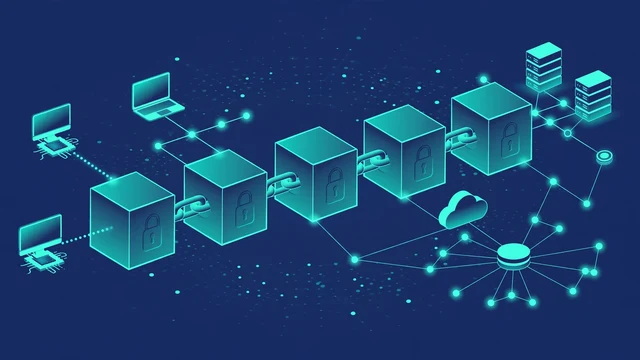
How does blockchain work? At its heart, a blockchain is a shared record book that thousands of computers hold copies of — and that nobody can secretly rewrite. Every transaction is grouped into a “block”, each block is cryptographically linked to the one before it, and the whole network agrees on the same version of history without any bank, company or government in charge.
That simple idea has turned out to be one of the most consequential inventions of the internet era. It powers Bitcoin and every other cryptocurrency, but it is also used for supply chains, digital identity, voting pilots and tokenised financial assets. This guide explains the technology step by step: what a block actually is, how hashes chain everything together, how strangers reach agreement, and — just as importantly — what blockchains are bad at.
In this article
- Key Takeaways
- What Is a Blockchain, Really?
- Blocks, Hashes and the Chain
- How a Transaction Travels Through the Network
- Consensus: How Thousands of Strangers Agree
- Public, Private and Hybrid Blockchains
- What Blockchains Are Good At — and What They're Not
- Facts and Figures
- What to Watch Next
- Frequently Asked Questions
- Related Articles
Key Takeaways
- A blockchain is a distributed ledger: a shared record book copied across thousands of computers, with no central authority.
- The core idea dates to 1991, when Haber and Stornetta proposed cryptographically linked time-stamps; Bitcoin made it work in 2009.
- Each block contains a hash of the previous block, so changing one record would require rewriting every block after it.
- Transactions are verified by nodes, bundled into blocks, and confirmed through consensus — proof of work or proof of stake.
- Bitcoin adds a block about every 10 minutes and handles roughly 3–7 transactions per second; Ethereum adds a block about every 12 seconds.
- Blockchains are tamper-resistant and transparent, but slow, hard to change, and a poor fit for many ordinary databases.
What Is a Blockchain, Really?
The easiest way to understand a blockchain is to start with the problem it solves. When you pay someone through a bank, the bank’s ledger is the source of truth: it records that money left your account and entered theirs. You trust the bank to keep that record honestly. That works well — until the bank is corrupt, hacked, censored, or simply unavailable.
A blockchain technology explained in one sentence is this: instead of one organisation keeping the ledger, thousands of independent computers each keep an identical copy, and they follow shared rules to agree on every update. There is no master copy to falsify and no single point of failure to attack. The record is public, permanent and verifiable by anyone.
The word itself describes the structure. Transactions are grouped into blocks. Each block is linked to the one before it, forming a chain. Once a block is added, it is extraordinarily difficult to change, because every block after it is built on top of it. The chain is the history, and the history is the security.
The idea is older than most people think. In 1991, researchers Stuart Haber and W. Scott Stornetta published “How to Time-Stamp a Digital Document”, proposing a cryptographically secured chain of records so that nobody could backdate or alter a document’s history unnoticed. In 1992, working with Dave Bayer, they added Merkle trees — a way of summarising many records into a single code — so many documents could be bundled into one block. Those two ideas, chaining and Merkle trees, are still at the core of every blockchain today.
What was missing for seventeen years was a way to run the system without a trusted operator. Haber and Stornetta’s design still relied on a central time-stamping service. Bitcoin’s breakthrough, published by Satoshi Nakamoto on October 31, 2008, was to combine the chained ledger with proof of work and a network of volunteers, so the system could agree on one history with no central authority at all. The Bitcoin network went live on January 3, 2009, and it has run continuously ever since.
A useful analogy: imagine a notebook passed around a room of a thousand people. Anyone can propose a new page of entries, but the group only accepts a page if it follows the rules and everyone can check it. Each page starts by copying a fingerprint of the previous page, so if someone later alters page 50, pages 51 onwards no longer match — the tampering is immediately obvious to everyone holding a copy.
Blocks, Hashes and the Chain
To see how the security actually works, you need three concepts: blocks, hashes and nodes.
Blocks. A block is a batch of transactions plus some metadata. On Bitcoin, a block contains a list of recent transactions, a timestamp, a reference to the previous block, and a number called a nonce that miners adjust while competing to add the block. Blocks are produced on a schedule set by the protocol: Bitcoin targets one block every ten minutes, Ethereum about every twelve seconds, Solana about every 0.4 seconds. Faster blocks mean faster confirmations, but also more chances for the network to disagree about which block came first — one of the fundamental trade-offs in blockchain design.
Hashes. A hash is a fingerprint for data. Feed any amount of information into a hash function and you get a fixed-length string of characters — Bitcoin uses SHA-256, which produces a 64-character code. Two properties matter. First, the same input always produces the same hash. Second, changing even one character of the input produces a completely different hash. So a block’s hash is a unique fingerprint of everything inside it.
Each block stores the hash of the previous block in its header. That is the “chain” in blockchain: block 500,000 contains the fingerprint of block 499,999, which contains the fingerprint of block 499,998, all the way back to the genesis block. If an attacker altered a transaction in an old block, that block’s hash would change, which would break the link to the next block, and the next, and the next. To rewrite history, you would have to redo the work for every block since the one you changed — and do it faster than the honest network keeps adding new blocks. On a large network, that is practically impossible.
Merkle trees. Inside each block, transactions are organised into a Merkle tree, named after Ralph Merkle, who described hash trees in 1979. Transactions are hashed in pairs, those hashes are hashed in pairs, and so on, until a single code remains: the Merkle root, stored in the block header. This lets anyone verify that a specific transaction is in a block by checking a handful of hashes, rather than downloading every transaction.
Nodes. The computers that hold copies of the blockchain and enforce its rules are called nodes. Full nodes download the entire history and check every transaction and block against the protocol’s rules, rejecting anything invalid. Anyone can run a full node — that is the point. On Bitcoin there are tens of thousands of them, run by individuals, businesses and enthusiasts around the world, and no single node has authority over the others.
How a Transaction Travels Through the Network
How blockchain works step by step is best understood by following one payment from start to finish. Suppose Alice wants to send 0.1 BTC to Bob.
1. Alice creates and signs the transaction. In her wallet, Alice enters Bob’s address and the amount. Her wallet builds a transaction — essentially a message saying “move 0.1 BTC from Alice’s address to Bob’s address” — and signs it with Alice’s private key. That digital signature proves Alice authorised the payment and locks the transaction’s details: if anyone changed the amount or the recipient, the signature would no longer match.
2. The transaction is broadcast. Alice’s wallet sends the signed transaction to the nodes it is connected to, which relay it across the network. Within seconds, most nodes have seen it.
3. Nodes validate it. Every node that receives the transaction checks it against the rules: is the signature valid? Does Alice actually have 0.1 BTC to spend? Has she already spent these particular coins? If the transaction fails any check, nodes drop it. If it passes, it waits in the mempool — a waiting room of unconfirmed transactions — until a miner or validator picks it up.
4. A block is created. On Bitcoin, miners gather pending transactions from the mempool, verify them again, and bundle them into a candidate block. They then compete to solve a computational puzzle: find a nonce that makes the block’s hash fall below a target value. This is proof of work. The first miner to find a valid hash broadcasts the block to the network, and other nodes verify it in milliseconds. The winning miner earns the block reward — currently 3.125 BTC per block, plus the transaction fees in the block.
5. The block is added, and confirmations pile up. Once nodes accept the block, Alice’s transaction has one confirmation. Each new block built on top adds another. For everyday purchases one or two confirmations may be enough; for large transfers, six confirmations — about an hour on Bitcoin — is the conventional standard, because by then rewriting the chain would require an attacker to outpace the entire network for an hour.
6. Bob can spend the funds. Once confirmed, the 0.1 BTC is Bob’s. He can hold it, send it on, or exchange it. The whole process took minutes, crossed no borders in any legal sense, and involved no bank.
Consensus: How Thousands of Strangers Agree
The hardest problem in a decentralised system is agreement. Thousands of computers, owned by strangers who may not trust each other, must converge on a single version of history — and reject anyone who tries to cheat. The mechanism that does this is called consensus, and there are two main kinds.
Proof of work (PoW) is Bitcoin’s method, and the original. Miners compete to solve a puzzle that is expensive to solve but trivial to verify — like a lottery where buying more tickets (computing power) improves your odds. The winner adds the next block and earns the reward. Attacking the network would require controlling more than half of all the computing power, an endeavour so expensive that the cost would exceed any possible gain — and the attacker would be destroying the value of the very asset they were trying to steal. Proof of work’s weakness is energy use; its strength is simplicity and a seventeen-year track record.
Bitcoin also has a self-correcting mechanism called the difficulty adjustment. Every 2,016 blocks — roughly every two weeks — the network recalculates how hard the puzzle should be, based on how long the last 2,016 blocks actually took. If miners joined and blocks arrived too fast, the puzzle gets harder; if miners left and blocks slowed, it gets easier. The result is that block times stay close to ten minutes regardless of how much computing power is pointed at the network. Mining difficulty stood at 134.82 trillion in November 2026, after a 9.13% downward adjustment as high power prices pushed some miners offline — the system adjusting itself exactly as designed.
Proof of stake (PoS) is the alternative used by Ethereum since The Merge on September 15, 2022. Instead of miners burning electricity, validators lock up — “stake” — coins as collateral. The protocol picks validators to propose and confirm blocks, roughly in proportion to their stake, and rewards them with fees and newly issued coins. If a validator cheats, part of its stake is destroyed, a penalty called slashing. The Merge cut Ethereum’s energy use by about 99.95%, and removed mining entirely. Critics argue proof of stake concentrates power among the wealthy, since more stake means more influence; supporters counter that it aligns incentives better, because attackers must own the asset they would be attacking.
There are other consensus designs — delegated proof of stake, proof of authority, proof of history on Solana — each trading off security, speed and decentralisation differently. None is universally best. The right question is not “which consensus is best?” but “what is this network optimising for, and what is it giving up?”
A related concept is the 51% attack: if a single party controlled more than half of a network’s mining power or staked coins, it could in theory rewrite recent history and double-spend. This has happened to small proof-of-work coins, but never to Bitcoin or Ethereum, where the cost of acquiring that much power is prohibitive.
Public, Private and Hybrid Blockchains
Not all blockchains are open to everyone. The spectrum matters because “blockchain” means very different things in different contexts.
Public blockchains — Bitcoin, Ethereum, Solana — are permissionless. Anyone can run a node, send transactions, or build on them, with no approval needed. They are fully transparent: every transaction is visible to anyone with a block explorer. Their security comes from decentralisation and economic incentives. This is what most people mean by “blockchain”, and it is the only kind that delivers the full promise of censorship resistance.
Private blockchains are run by a single organisation or a small group. Access is restricted, participants are known, and one party controls who can write to the ledger. They keep some blockchain features — an append-only, tamper-evident record — but they sacrifice decentralisation, which is the property that makes a public blockchain trustworthy without a trusted operator.
Consortium and hybrid blockchains sit in between. A group of organisations — banks in a trade-finance network, for instance — jointly operate the chain, with agreed governance. Transactions may be visible to members but not to the public. These are the most common form in enterprise pilots, precisely because businesses want shared infrastructure without broadcasting their data to the world.
For a beginner, the practical distinction is simple: if you can use it without asking anyone’s permission, it is public. If you need an invitation, it is private or consortium-run, and you should judge it by the trustworthiness of its operators, not by the word “blockchain” in its marketing.
What Blockchains Are Good At — and What They’re Not
Blockchains are powerful, but they are not a universal solution — and much of the hype around them ignores their real limitations. An honest assessment is more useful than either cheerleading or dismissal.
What they do well. Blockchains excel where trust is scarce and a shared, tamper-resistant record matters. Digital money is the obvious case: Bitcoin has settled trillions of dollars of value without a central operator. Supply chains use blockchains to trace goods from factory to shelf, because every participant can verify the same record. Tokenised assets — stocks, bonds, property shares represented as blockchain tokens — are growing fast, because settlement that once took days can happen in minutes. And in countries with weak institutions, a public blockchain offers something no local database can: a record that no government or company can quietly alter.
What they do poorly. Speed is the first limitation. Bitcoin manages 3–7 transactions per second on its base layer; Visa’s network handles tens of thousands. Layer-2 systems like the Lightning Network and rollups help enormously, but they add complexity. Cost is second: on a busy network, fees spike. Immutability cuts both ways: a mistaken or fraudulent transaction cannot be reversed, and a bug in a smart contract cannot simply be patched. Energy use remains a live debate for proof-of-work chains, though proof-of-stake chains use a tiny fraction of the power. Finally, blockchains are bad at storing large amounts of data — they are ledgers, not filing cabinets.
The right mental model is a specialist tool, not a replacement for everything. You would not use a blockchain to run a company intranet, and you would not use a spreadsheet to run a currency. The technology earns its keep precisely where decentralisation, transparency and tamper-resistance are worth paying for in speed and complexity.
Facts and Figures
| Item | Detail (as of 21 November 2026) |
|---|---|
| First blockchain concept | 1991 — Haber and Stornetta, “How to Time-Stamp a Digital Document” |
| Merkle trees added | 1992 — Haber, Stornetta and Bayer |
| Bitcoin whitepaper | 31 October 2008 |
| Bitcoin genesis block | 3 January 2009 |
| Ethereum launched | 30 July 2015 |
| Ethereum Beacon Chain (PoS) launched | 1 December 2020 |
| Ethereum Merge to proof of stake | 15 September 2022 |
| Energy cut from The Merge | ~99.95% |
| Bitcoin block time target | ~10 minutes |
| Bitcoin difficulty adjustment | Every 2,016 blocks (~2 weeks) |
| Bitcoin mining difficulty | 134.82 trillion (after 9.13% fall, Nov 2026) |
| Bitcoin base-layer throughput | ~3–7 transactions per second |
| Bitcoin blocks per day | ~144 |
| Ethereum block time | ~12 seconds |
| Solana block time target | ~0.4 seconds |
| Bitcoin block reward | 3.125 BTC (since 20 April 2024) |
| Next Bitcoin halving | ~April 2028 (block 1,050,000) |
| Bitcoin max supply | 21 million (exact final total 20,999,999.9769 BTC) |
| Bitcoin in circulation | ~20.11 million (~95.8% of cap) |
| Standard Bitcoin confirmations | 6 (~60 minutes) for large transfers |
| 1 BTC in satoshis | 100,000,000 |
What to Watch Next
First, watch scaling. The biggest engineering effort in blockchain today is making networks faster and cheaper without sacrificing security. Ethereum’s rollup ecosystem, Bitcoin’s Lightning Network, and faster layer-1 chains are all competing answers to the same question — and the next Ethereum upgrade, Glamsterdam, is in testnet with no confirmed mainnet date after reports it could slip to May 2027. How these scale will decide whether blockchains can handle mainstream payment volumes.
Second, watch tokenisation. Real-world assets on blockchains — tokenised stocks, bonds, funds and money-market products — are moving from pilots to live products, with volumes growing sharply through 2026. If settlement on public blockchains becomes standard for traditional finance, the technology’s centre of gravity shifts from speculation to infrastructure.
Third, watch regulation and quantum computing. Regulators in the UK, EU and US are writing the rules that will decide which chains and applications can operate legally, and those rules are still settling. On a longer horizon, the industry is also preparing for quantum computers that could one day threaten current cryptography — a distant risk, but one that blockchain developers are already planning for, because a ledger designed to last forever needs cryptography that lasts too.
Frequently Asked Questions
Q: How does blockchain work in simple terms?
A blockchain is a shared record book copied across thousands of computers. Transactions are grouped into blocks, each block is linked to the previous one with a cryptographic fingerprint called a hash, and the network agrees on new blocks through consensus rules. Changing an old record would require rewriting every block after it, which is why the ledger is tamper-resistant.
Q: What is a block in a blockchain?
A block is a batch of transactions plus metadata: a timestamp, the hash of the previous block, and a Merkle root summarising all the transactions inside it. Bitcoin produces a block about every ten minutes; Ethereum about every twelve seconds. Once a block is accepted by the network and more blocks are built on top of it, its transactions are considered settled.
Q: What is the difference between proof of work and proof of stake?
Proof of work, used by Bitcoin, has miners compete to solve computational puzzles; the winner adds the next block and earns a reward. Proof of stake, used by Ethereum since September 2022, has validators lock up coins as collateral and take turns confirming blocks, with cheaters punished by losing part of their stake. Proof of stake uses roughly 99.95% less energy; proof of work has the longer track record.
Q: Is blockchain the same as Bitcoin?
No. Bitcoin is one application of blockchain technology — a digital currency running on the first blockchain. A blockchain is the underlying ledger technology, which can also run other cryptocurrencies, smart contracts, supply-chain records and tokenised assets. Saying blockchain is Bitcoin is like saying the internet is email.
Q: Can a blockchain be hacked?
A large public blockchain like Bitcoin has never had its ledger rewritten by an attacker — doing so would require controlling more than half of the network’s mining power, at enormous cost. What does get hacked are the things around the blockchain: exchanges, wallets, smart contracts and individual users. Smaller blockchains with little mining power have suffered 51% attacks, which is why security scales with network size.
Q: Why is blockchain so slow?
Public blockchains deliberately trade speed for security and decentralisation: every node must verify every transaction, and blocks are produced on a fixed schedule. Bitcoin handles about 3–7 transactions per second on its base layer, compared with tens of thousands for a card network. Layer-2 systems like the Lightning Network and rollups process most transactions off the main chain and settle in batches.
Related Articles
- What Is Cryptocurrency? A Beginner’s Guide to Digital Money
- What Is Bitcoin? How BTC Works, Explained Simply
- Bitcoin Mining Difficulty Falls 9.13% to 134.82T as Texas Power Prices Force Miners Offline
- DeFi TVL Falls to $67 Billion as Ethereum, Base and Solana Shed Billions in a Week
- CFTC On-Chain Exchanges: Hyperliquid Must Register or Partner, Selig Sets Out the Rules
Disclaimer: This article is for information purposes only and is not financial advice. Cryptocurrency prices are volatile and can move sharply in either direction. Do your own research before making any investment decision. All prices and figures are as of November 21, 2026.




Leave a Reply