
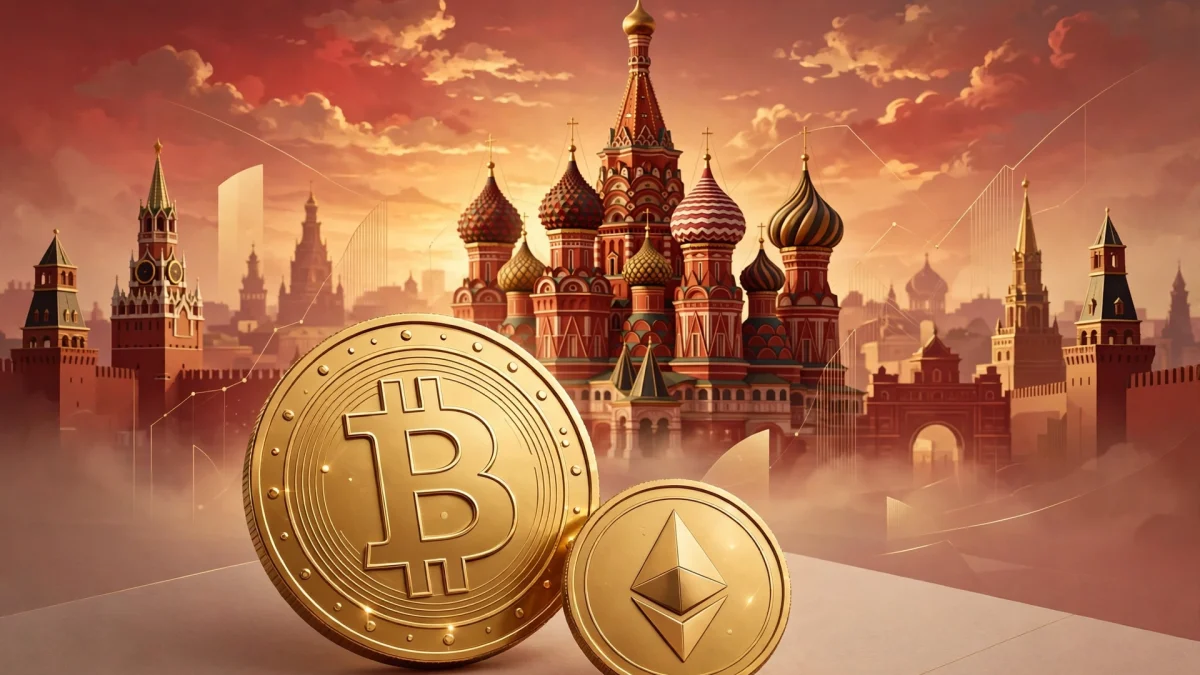
The russia crypto retail market is about to open up — with strict limits. From Tuesday, November 17, 2026, ordinary Russian investors will be able to buy cryptocurrency through regulated intermediaries for the first time under new Bank of Russia rules, but the russia crypto retail regime comes with a tight cap: no more than 300,000 rubles per year, roughly $3,600 to $3,700, per intermediary, and only three coins are allowed — bitcoin, ether and the USDT stablecoin. Anyone who wants to buy must first pass a mandatory knowledge test.
The rules are a landmark for a country that has spent years debating whether ordinary citizens should be allowed anywhere near crypto. Russia has long banned the use of cryptocurrency to pay for goods and services, and that ban stays in place. But the new russia crypto retail framework, which builds on Federal Law No. 282-FZ that came into force on September 1, 2026, creates a legal, regulated path for retail investors to own crypto — in small amounts, through licensed firms, and under the central bank’s watchful eye.
In this article
Key Takeaways
- The russia crypto retail rules take effect on Tuesday, November 17, 2026.
- Retail investors may buy only bitcoin, ether and USDT — no other cryptocurrencies.
- Purchases are capped at 300,000 rubles per year, about $3,600 to $3,700, per intermediary.
- Every retail buyer must pass a mandatory knowledge test before trading.
- Qualified investors face no cap and may buy other cryptocurrencies.
- Organised exchange trading may start on November 22, but only after the Bank of Russia approves each exchange’s rules; the Moscow Exchange plans to start on December 1.
Russia Crypto Retail: What Ordinary Investors Can Now Buy
Under the new rules, a non-qualified investor — the legal term for an ordinary retail investor — may buy only three digital assets: bitcoin, ether and USDT. Bitcoin is the world’s largest cryptocurrency, trading near $64,268 on Monday, November 16, 2026. Ether, the token of the Ethereum network, is trading near $1,809 to $1,835. USDT, issued by Tether, is a stablecoin, which means it is designed to hold a steady value of about one US dollar, backed by reserves held by its issuer.
Under the russia crypto retail rules, the 300,000-ruble annual cap applies per intermediary, which means the limit is set separately for each broker or platform a person uses. In practice, the cap is small: about $3,600 to $3,700 a year is a modest sum for an investment, and it underlines that the central bank sees retail crypto as a toe in the water, not a mainstream savings product. The cap is also a consumer protection measure. If an investor loses money on a small, capped position, the damage is limited — and that is exactly the point.
Before buying anything under the russia crypto retail rules, retail investors must pass a mandatory knowledge test. The test is designed to check that buyers understand what they are buying, including the risks of volatility and the fact that crypto prices can fall sharply. Bitcoin itself is a reminder of that risk: it is down roughly 12% to 13.7% over the past week and about 20.5% over the past 30 days, after falling to between $62,006 and $62,112 over the weekend. Anyone buying under the new russia crypto retail rules should understand that the assets they are allowed to buy can lose a fifth of their value in a month.
Who Counts as a Qualified Investor?
The russia crypto retail rules draw a sharp line between retail investors and qualified investors. Qualified investors — typically people with large portfolios, high incomes or professional financial experience — face no annual cap and may buy cryptocurrencies beyond bitcoin, ether and USDT. The distinction is common in financial regulation around the world: the idea is that wealthier, more experienced investors can be trusted to take bigger risks with their own money, while ordinary savers need guardrails.
For most Russians, the qualified investor category will be out of reach, which means the 300,000-ruble cap and the three-coin limit of the russia crypto retail regime will define their entire crypto experience. That makes the knowledge test and the cap the two most important features of the new russia crypto retail regime for the vast majority of potential buyers.
How the New Market Will Work
The russia crypto retail rules are only one part of a wider framework. Organised trading of cryptocurrencies on exchanges may begin on November 22, but only after the Bank of Russia approves each exchange’s trading rules individually. That approval step gives the central bank a veto over which venues can operate and how they run their markets.
The Moscow Exchange, Russia’s largest stock exchange, plans to start crypto trading on December 1. Its entry would give the new market a familiar, established venue, and it signals that the biggest players in Russian finance are preparing to take part. Two of the country’s largest banks, Sberbank and VTB, have already secured digital-asset registrations, which positions them to offer crypto-related services as the market opens.
The framework builds on Federal Law No. 282-FZ, which came into force on September 1, 2026. That law set the legal foundations for digital assets in Russia, and the Bank of Russia’s new rules fill in the practical details: who can buy, what they can buy, how much they can spend, and what tests they must pass.
One thing the russia crypto retail rules do not change is the ban on paying for goods and services with cryptocurrency. Russians still cannot use bitcoin or any other crypto to buy things in shops or online, and that restriction is not expected to lift. The new russia crypto retail regime is about investment, not about crypto as a currency. For context on how other countries are approaching the same questions, see our report on the Trump administration’s SEC and CFTC nominations, which could shape US crypto regulation in 2027.
The July 2027 Deadline for Peer-to-Peer Trading
The russia crypto retail rules also set a hard deadline for the informal side of the Russian crypto market. Direct peer-to-peer crypto transactions between individuals will be banned from July 1, 2027. Peer-to-peer trading — where one person sells crypto directly to another, often through messaging apps or informal platforms — has been one of the main ways Russians have bought and sold crypto until now.
The ban gives the market about seven and a half months to move from informal, person-to-person deals into the new regulated channels. After July 1, 2027, the only legal way for an ordinary Russian to buy crypto should be through a licensed intermediary under the new rules, within the 300,000-ruble cap. That is a significant change for a market that has operated largely outside formal regulation, and enforcement will be one of the big questions to watch next year.
Why Russia Is Opening Up Now
Russia’s move comes at a time when governments around the world are settling on their own approaches to retail crypto access. Some countries have embraced it, others have restricted it, and most have landed somewhere in between — allowing investment with limits, as Russia is now doing. The Bank of Russia’s approach is on the cautious end of that spectrum: a small cap, a short list of allowed coins, a knowledge test and a central bank veto over exchanges.
What the Cap Means for Bitcoin, Ether and USDT
The practical effect of the russia crypto retail rules on global crypto prices is likely to be small, at least at first. A cap of 300,000 rubles — about $3,600 to $3,700 — per person per year means that even if tens of thousands of Russians buy the maximum allowed, the total flows would be a tiny fraction of daily global crypto trading volumes. Bitcoin alone trades about $19.7 billion to $34.4 billion per day, depending on the data source, so Russian retail demand under the cap will not move the global price.
But the symbolic effect matters more. Russia is a large economy with a long history of scepticism toward crypto, and a formal, regulated path for retail investors is a signal that even cautious central banks now accept that crypto ownership is here to stay. The three coins allowed — bitcoin, ether and USDT — are also a signal: regulators around the world are converging on the same short list of assets they consider acceptable for ordinary investors.
For bitcoin specifically, the rules add one more country to the list of places where ordinary people can buy it legally through regulated firms. Bitcoin is trading near $64,268 on Monday, after a weekend low of $62,006 to $62,112, and it is down about 25% since October 21. Our full price report is at Bitcoin holding near $64,300 after the weekend crash. For ether, which is trading near $1,809 to $1,835 after hitting $1,711 on November 15, its inclusion in the allowed list is a vote of confidence from a major central bank — see our report on Ethereum rebounding to $1,835.
Facts and Figures
| Metric | Value (as of November 16, 2026) |
|---|---|
| Rules take effect | Tuesday, November 17, 2026 |
| Annual cap for retail investors | 300,000 rubles (~$3,600–$3,700) per intermediary |
| Coins retail investors may buy | Bitcoin, ether, USDT only |
| Knowledge test | Mandatory for all retail buyers |
| Qualified investors | No cap; may buy other cryptocurrencies |
| Organised exchange trading may start | November 22 (after Bank of Russia approves each exchange’s rules) |
| Moscow Exchange planned start | December 1 |
| Peer-to-peer ban | From July 1, 2027 |
| Paying for goods/services with crypto | Still barred |
| Legal framework | Federal Law No. 282-FZ (in force September 1, 2026) |
| Banks with digital-asset registrations | Sberbank, VTB |
| Bitcoin price (Monday) | ~$64,268 |
| Ether price (Monday) | ~$1,809–$1,835 |
| USDT+USDC balances | ~$244B (Nov 14), down from ~$270B in early May |
| Stablecoin supply change (30 days) | −$14.2B (sharpest since June 2022) |
| Total crypto market cap | ~$2.17T (−1.95% in 24h) |
| Crypto Fear and Greed Index | 10 — Extreme Fear |
What to Watch Next
The first test of the russia crypto retail rules comes on Tuesday, November 17, when they take effect. Watch for announcements from Russian brokers and platforms about how they will implement the knowledge test and the cap, and whether the first retail buyers report a smooth experience or teething problems. The practical details — how the test works, how the cap is tracked across intermediaries, and how quickly accounts can be opened — will determine whether ordinary Russians actually use the new system.
Second, watch November 22, the earliest date for organised exchange trading. The Bank of Russia must approve each exchange’s rules before trading can begin, so the question is which exchanges get approval first and on what terms. The Moscow Exchange’s planned December 1 launch is the date to circle: if the country’s biggest exchange starts trading crypto on schedule, it will be the clearest sign that the new market is real.
Third, watch the enforcement question. Peer-to-peer trading remains legal until July 1, 2027, but the direction of travel is clear. How the authorities handle the transition — and whether informal trading shrinks as regulated channels open — will show whether the new framework can actually bring the Russian crypto market into the open.
Finally, watch the global reaction. For a full rundown of this week’s events, including the Russia rules, see CoinDesk’s crypto week ahead. If other cautious central banks follow the russia crypto retail model — small caps, short coin lists, knowledge tests — it could become a template for how large economies open crypto to retail investors without opening the floodgates.
Frequently Asked Questions
What are the new russia crypto retail rules?
The russia crypto retail rules take effect on Tuesday, November 17, 2026. They allow ordinary Russian investors to buy cryptocurrency through regulated intermediaries, but only bitcoin, ether and USDT, capped at 300,000 rubles per year — about $3,600 to $3,700 — per intermediary, and only after passing a mandatory knowledge test.
How much crypto can a retail investor in Russia buy?
A retail investor may buy up to 300,000 rubles of cryptocurrency per year, per intermediary — roughly $3,600 to $3,700. The cap applies separately to each broker or platform, and it covers all purchases combined. Qualified investors face no cap.
Which cryptocurrencies can Russian retail investors buy?
Only three: bitcoin, ether and the USDT stablecoin. Retail investors may not buy any other cryptocurrency under the new rules. Qualified investors may buy other cryptocurrencies, with no annual cap.
Do Russian retail investors need to pass a test to buy crypto?
Yes. Every retail buyer must pass a mandatory knowledge test before trading. The test is designed to check that buyers understand what they are buying, including the risks of price volatility and losses.
Can Russians pay for things with cryptocurrency?
No. Paying for goods and services with crypto is still barred in Russia, and the new rules do not change that. The new regime covers investment only — buying and holding crypto through regulated intermediaries — not using it as a currency.
When does peer-to-peer crypto trading get banned in Russia?
Direct peer-to-peer crypto transactions between individuals will be banned from July 1, 2027. Until then, the new regulated channels are opening alongside the existing informal market, with organised exchange trading able to start from November 22, 2026, and the Moscow Exchange planning to begin on December 1.
Disclaimer: This article is for news and information purposes only and is not financial advice. Cryptocurrency prices are volatile and can move sharply in either direction. Do your own research before making any investment decision. All prices and figures are as of November 16, 2026.




Leave a Reply