
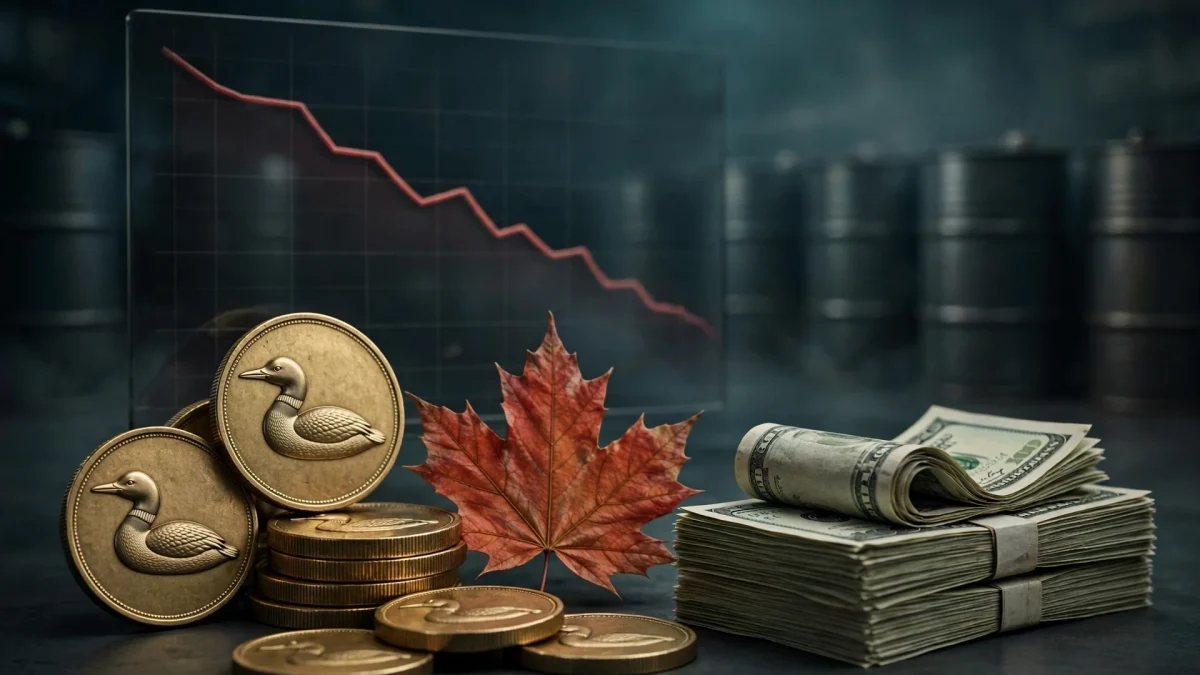
USD CAD is trading around 1.4325 on Friday, November 20, 2026, steadying a touch after the loonie touched its weakest level since April 2025 the day before. On Thursday the pair reached 1.43575 intraday — a 19-month low for the Canadian dollar — before easing back. Friday’s trading range of 1.4300 to 1.43465 left the loonie at 69.81 US cents, and the currency is on track for its third straight weekly decline, down about 0.3% on the week.
The slide is not really a Canadian story on its own. A global equity selloff is pushing money toward the safety of the dollar, oil — one of Canada’s biggest exports — is sliding again, and the gap between US and Canadian interest rates keeps widening. Even a Bank of Canada that has just started raising rates again has not been enough to hold the line. The USD CAD exchange rate today tells the story in one number: US$100 now costs about C$143.25.
In this article
Key Takeaways
- USD CAD traded around 1.4325 on Friday after touching 1.43575 on Thursday — the loonie’s weakest level since April 2025.
- The loonie is heading for a 0.3% weekly decline, its third straight weekly fall, as a global stock market selloff deepens.
- The Bank of Canada raised its policy rate to 2.50% on October 28, its first hike in three years.
- Canada’s October inflation came in at 3.1% year over year, below the 3.2% forecast, cutting December hike odds.
- The US 2-year yield sits 148.5 basis points above Canada’s, pulling capital south of the border.
- US crude fell 0.6% to $82.75 a barrel on Friday, adding to its weekly decline after Thursday’s brief bounce to $83.84.
USD CAD: The Numbers
USD/CAD — the price of one US dollar in Canadian dollars — has been grinding higher all week, and the daily candles show it. Finnhub’s data has Thursday, November 19 opening at 1.43269, trading as high as 1.43576 and as low as 1.42869, and closing at 1.43394. Wednesday’s close was 1.43274 and Tuesday’s 1.42986, so the pair has climbed steadily through the week even before Friday’s session. The 52-week high now stands at 1.43576, while the 52-week low of 1.34818 dates back to January 29, 2026. Over the past month the pair is up 1.88%, and it is up 4.27% so far in 2026.
The one-pip difference between Reuters’ Thursday intraday high of 1.43575 and Finnhub’s 1.43576 is a rounding and feed artefact — the two are effectively the same level, and both mark the loonie’s weakest point since April 2025. What matters is not the last digit but the direction: the Canadian dollar has now fallen for three weeks running, and each week the low has been lower than the one before.
The equity backdrop has been brutal. The TSX shed 737 points on Wednesday, November 18 — its worst day since June — as gold and oil slid and the loonie hit its 19-month low, according to CoinCompass. Miners fell 5.4%, energy stocks dropped 3.8% and banks lost 2.2%. The same risk-off mood that hammered Canadian stocks is lifting the US dollar against almost everything, and the loonie — a currency closely tied to commodities and global growth — is taking the hit. Gold’s slide this week, covered in our report on gold falling to $3,551, is part of the same broad selloff.
Why the Loonie Keeps Falling
Why is the Canadian dollar falling? The short answer is the interest rate gap. The longer answer is that almost everything that usually supports the loonie is working against it at the same time: oil is down, stocks are down, and the US dollar is near its strongest in 19 months. When all three line up against a currency, even a hawkish central bank struggles to hold it up.
The rate gap is doing the damage
The main driver is the difference between what investors can earn holding US dollars versus Canadian dollars. The US 2-year yield is 148.5 basis points above Canada’s, having widened about 21 basis points since early November, according to Dollars and Sense citing Reuters data. When the gap widens, money flows toward the higher-yielding currency — and right now that flow is pulling capital south across the border.
The gap exists because the two central banks are on different paths. The Federal Reserve is openly debating further rate rises, with markets pricing a near-certain December hike, while the Bank of Canada has raised once and is now facing softer inflation data that makes a second hike less certain. Our full report on the Fed’s stance is at Fed December rate-hike bets rattle crypto. As long as the Fed looks more aggressive than the BoC, the USD CAD rate has a built-in reason to keep drifting higher.
Oil is no help this week
Oil, one of Canada’s major exports, added to its weekly decline on Friday. US crude futures traded 0.6% lower at $82.75 a barrel, on strong exports from the Middle East, according to Reuters. Thursday had brought a brief bounce — oil rose 0.7% to $83.84 on reports of tanker disruptions in the Strait of Hormuz — but the rally did not last, and Reuters notes that oil “has pulled back sharply from its October peak.”
For the loonie, the oil price matters because energy is such a large part of Canada’s export earnings. When crude falls, less money flows into the country, and the currency tends to weaken with it. The link is not one-to-one — the rate gap matters more right now — but a falling oil price removes one of the loonie’s usual supports at exactly the wrong moment.
A Global Rush Into the Dollar
The third factor is the simplest: when stock markets fall hard, investors buy dollars. The global equity selloff deepened this week, and the dollar index is near a 19-month high as money seeks safety. The loonie is a risk-sensitive currency — it tends to fall when investors are nervous — so a week of heavy selling in stocks is almost always a bad week for the Canadian dollar.
For ordinary Canadians, the move is already showing up in everyday costs. At current levels, US$100 of online shopping or travel costs about C$143.25, and US$500 equals about C$716.25. Anyone planning a trip south or buying from a US website is paying roughly 4% more than at the start of the year, purely because of the exchange rate.
Bank of Canada: Hawkish but Not Enough
The Bank of Canada is not standing still. On October 28 it raised its policy rate to 2.50%, its first hike in three years, in a move that was meant to signal the bank is serious about inflation. A rate rise normally supports a currency, because it makes holding that currency more rewarding. But the loonie has fallen anyway — and the reason is that the market’s focus has already moved on to the next decision.
That next decision comes on December 9, and the odds of another hike have swung wildly through the week. Canada’s October CPI rose 3.1% year over year, against a 3.2% forecast, in figures released by Statistics Canada on November 16. The soft print cut December hike odds to 38% from 54%, according to Vantage. But the market’s view kept moving: the same measure was put at around 60% on November 18, at 67% on Thursday, and at roughly 50% on Friday, according to Reuters. The honest summary is that traders genuinely do not know whether the BoC will hike again in December — the odds have swung between about 38% and 67% in the space of a few days.
Domestic data is not helping the hawks. Canadian retail sales figures for September were due on Friday, with economists expecting a 0.7% month-over-month increase — but Reuters described the preliminary data as “downbeat” without giving a figure. Weak consumer spending would make it harder for the Bank of Canada to justify another rate rise, and the market knows it. Canada’s 10-year government bond yield fell 10.6 basis points to 3.703% on Friday, its lowest level since November 12, which is another sign that investors are trimming their expectations for Canadian rates.
Put it together and the Canadian dollar forecast is genuinely mixed. As one analyst quoted by Reuters put it on Friday: “CAD prospects remain somewhat mixed as investors balance USD and equity market volatility plus softer crude oil and commodities against BoC hawkishness and signs that the US and Canada may be closer to making progress on trade.” The hawkish BoC and possible trade progress are real positives — but right now they are losing the argument against a strong dollar, weak oil and falling stocks. The Bank of Canada interest rate decision on December 9, followed by the Fed’s decision the next day, will settle the argument one way or the other.
Facts and Figures
| Metric | Value (as of November 20, 2026) |
|---|---|
| USD/CAD (Friday) | ~1.4325 |
| Friday trading range | 1.4300–1.43465 |
| Loonie in US cents | 69.81 |
| Thursday intraday high | 1.43575 (weakest since April 2025) |
| Finnhub 19 Nov close | 1.43394 |
| Finnhub 19 Nov range | 1.42869–1.43576 |
| 18 Nov close | 1.43274 |
| 17 Nov close | 1.42986 |
| 52-week high | 1.43576 |
| 52-week low | 1.34818 (29 Jan 2026) |
| 1-month change | +1.88% |
| Year-to-date change | +4.27% |
| Weekly change | ~−0.3% (third straight weekly decline) |
| Bank of Canada policy rate | 2.50% (raised 28 Oct, first hike in 3 years) |
| Canada CPI (Oct) | +3.1% year over year (forecast 3.2%) |
| BoC December hike odds | ~50% (Reuters, Fri; ranged 38–67% during the week) |
| US–Canada 2-year yield gap | 148.5bp (widened ~21bp since early Nov) |
| US crude (Fri) | $82.75 (−0.6%); Thu $83.84 (+0.7%) |
| Canada 10-year yield | 3.703% (−10.6bp Fri, lowest since 12 Nov) |
| TSX (Wed 18 Nov) | −737 points (worst day since June) |
| US$100 in Canadian dollars | ~C$143.25 |
| Next BoC decision | 9 Dec (9:45am ET); next Fed decision 10 Dec |
What to Watch Next
First, watch Friday’s retail sales print. Economists expected September sales to rise 0.7% month over month, but Reuters has already described the preliminary data as downbeat. A weak number would strengthen the case against a December rate hike and likely push the loonie lower; a better-than-expected reading would give the Bank of Canada’s hawks something to work with and could steady the currency. The USD CAD exchange rate today will react to the release within minutes, so it is the first thing to check.
Second, watch the 1.43575 level. That was Thursday’s intraday high and the loonie’s weakest point since April 2025. A daily close above it would confirm that the downtrend in the Canadian dollar is still intact and open the way to fresh multi-year lows. A hold below it, followed by a move back under 1.4300, would be the first sign that sellers are tiring after three straight weeks of declines.
Third, watch the December central bank meetings. The Bank of Canada decides on December 9 at 9:45am ET, and the Federal Reserve follows the next day. If the BoC hikes and the Fed holds, the rate gap narrows and the loonie could recover some ground. If the BoC holds and the Fed hikes, the gap widens further and USD CAD likely pushes higher still. Oil prices and any news on US–Canada trade talks will matter in between, but those two December decisions are the events that will decide where the pair spends the end of the year.
Frequently Asked Questions
Q: What is the USD CAD rate today?
USD CAD is trading around 1.4325 on Friday, November 20, 2026, after touching 1.43575 intraday on Thursday — the loonie’s weakest level since April 2025. The pair moved in a range of 1.4300 to 1.43465 on Friday, leaving the Canadian dollar at 69.81 US cents.
Q: Why is the Canadian dollar falling?
The loonie is falling mainly because of the gap between US and Canadian interest rates — the US 2-year yield is 148.5 basis points above Canada’s. Falling oil prices and a global stock market selloff are adding to the pressure, as investors buy US dollars for safety and sell risk-sensitive currencies like the Canadian dollar.
Q: What did the Bank of Canada do in October?
The Bank of Canada raised its policy rate to 2.50% on October 28, 2026, its first interest rate hike in three years. The move was meant to signal the bank is serious about inflation, but the loonie has fallen anyway because markets are focused on whether a second hike will follow in December.
Q: Will the Bank of Canada raise rates in December?
It is genuinely uncertain. Markets put the odds of a December hike at roughly 50% on Friday, but the same measure swung between about 38% and 67% during the week after Canada’s October inflation print came in softer than expected at 3.1%. The decision comes on December 9.
Q: How does the oil price affect the loonie?
Oil is one of Canada’s major exports, so when crude prices fall, less money flows into the country and the currency tends to weaken. US crude fell 0.6% to $82.75 a barrel on Friday and has pulled back sharply from its October peak, removing one of the loonie’s usual supports.
Q: What is the USD CAD forecast?
No forecaster can be certain, and this article is not financial advice. Analysts quoted by Reuters describe the outlook as mixed: BoC hawkishness and possible progress on US–Canada trade support the loonie, while the rate gap, weak oil and falling stocks push against it. The December 9 BoC decision and the Fed’s decision the next day are the key events that will shape where USD CAD goes next.
Related Articles
- Fed December Rate Hike Bets Rattle Crypto as Waller Calls for 50 Basis Points
- Bitcoin Price Today: BTC Falls to $61,300, Lowest Since July, as Asian Markets Crash
- AUD/USD Hits 11-Month Low as Jobs Shock Ends RBA Hike Bets
- USD/INR: Rupee Breaks Past 93 to Seven-Month High on Record FII Inflows
Disclaimer: This article is for news and information purposes only and is not financial advice. Currency prices are volatile and can move sharply in either direction. Do your own research before making any investment decision. All prices and figures are as of November 20, 2026.




Leave a Reply