
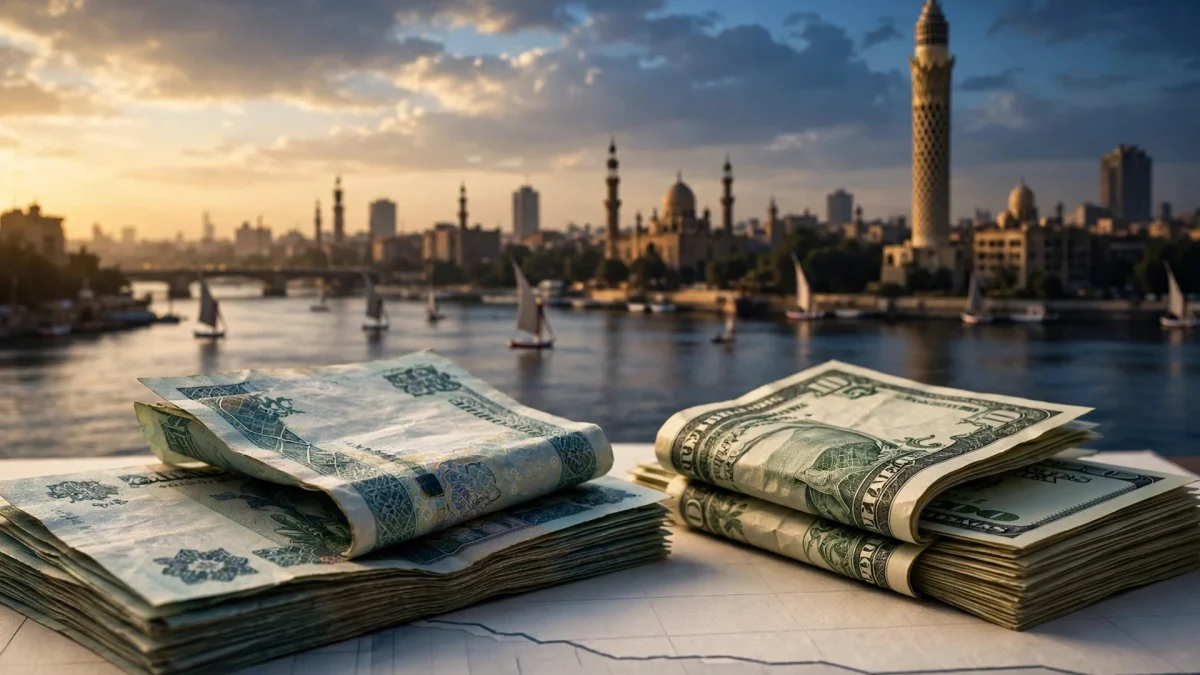
USD EGP is trading around 53.81 on Friday, November 20, 2026, barely moving on the day after one of the most dramatic months in the Egyptian pound’s recent history. The pair closed Thursday at 53.82 and has drifted in a narrow band all week — 53.68 on Monday, 53.72 on Tuesday, 53.75 on Wednesday — a striking change of pace for a currency that crashed through 56 to the dollar less than a month ago.
The calm has two explanations, both recent. On October 29 the Central Bank of Egypt raised interest rates by a full percentage point, its first hike since March 2024. Then on November 18–19 the International Monetary Fund reached a staff-level agreement on the final review of Egypt’s loan programme, a deal that would unlock about $2.3 billion before the programme expires on December 15. Together they have steadied a currency that looked badly wounded in late October — though the Egyptian pound to dollar exchange rate still shows the pound down about 13% over the past year.
In this article
Key Takeaways
- USD EGP traded around 53.81 on Friday, essentially flat on the day after closing Thursday at 53.82.
- USD EGP has recovered from a record low above 56 in late October, when the pound lost about 7% in a single month.
- The CBE raised its overnight deposit rate to 20% on October 29, its first hike since March 2024.
- The IMF reached a staff-level deal on November 18–19 that would release about $2.3 billion before the programme expires on December 15.
- Annual urban inflation fell to 12.7% in October, a nine-month low, from 13.9% in September.
- Egypt’s economy grew 5.1% in the 2025/26 financial year, beating the IMF’s earlier forecast of 4.6%.
USD EGP: The Numbers
USD/EGP — the price of one US dollar in Egyptian pounds — is ending the week almost exactly where it started it. Finnhub’s latest quote put the pair at 53.81 late on Friday and the previous session’s close was 53.813, so the day’s move rounds to nothing. On the week the pair is up just 0.74% from 53.42.
That stillness in USD EGP is remarkable given where the pair has been. November’s range runs from 53.32 to 56.00, and the month is still down 3.90% — the pound has clawed back ground since the start of the month. October was the mirror image: the pair averaged 53.80 but spiked to 56.26, a monthly rise of nearly 7%.
The longer view puts the damage in perspective. USD EGP opened 2026 at 47.71 and is up 12.60% so far this year, with a 2026 high of 56.27 and a low of 46.60. Back in late February, before the escalation of the US–Iran war, the official rate was about 47.72 per dollar. The pound’s slide since then tracks the war’s shockwaves — higher oil prices, rattled investors, and a rush for dollars. The difference for Egypt is that the slide turned into a rout in October, and the rout is what forced the central bank to act.
For ordinary Egyptians, US$100 now costs about EGP 5,381. Anyone paying for imports or studying abroad is paying roughly 13% more than a year ago purely because of the exchange rate — before Egypt’s own 12.7% inflation is added on top.
The October Rout That Forced the CBE’s Hand
Why did the Egyptian pound fall so far in October? Foreign investors ran for the exit. The regional war pushed oil prices up and made investors nervous about every currency in the region, and in late October the selling turned into a stampede.
The record low
The pound’s slide accelerated sharply in the second half of October. On October 22 the dollar passed EGP 55 at Egyptian banks for the first time. Four days later, on Monday October 26, the dollar exceeded 56 pounds at the central bank for the first time — a record low for the pound, which the IMF puts at 56.39. By the end of that week the pound stood at 56.00 to the dollar, down 7% in a single month, and the market was openly asking how much further USD EGP could rise.
The $2 billion exit
The trigger for the central bank’s response was the scale of the selling. Foreign investors sold around $2 billion of local debt in the week before the October 29 decision, according to NBK. On October 26 alone, foreign and Arab investors recorded net sales of about $664 million of Treasury bills and bonds, according to Zawia3. That is the kind of outflow that forces a central bank to defend its currency.
The CBE chose to defend it. On Thursday October 29 its Monetary Policy Committee raised all four policy rates by 100 basis points — the overnight deposit rate to 20% from 19%, the overnight lending rate to 21% from 20%, and the main operation and discount rates to 20.5% from 19.5%. No part of the surveyed consensus expected a hike; markets had priced a sixth consecutive hold. It was the bank’s first increase since the 600-basis-point rise of March 2024, and it reversed the easing cycle that began in April 2025.
The decision was not cheap. The real interest rate — the policy rate minus inflation — rose to around 6% from 5%, tightening financial conditions. Each extra percentage point on rates costs the state about EGP 150 billion, or roughly $2.7 billion, in additional debt service, according to Mohamed El-Damati of the Federation of Egyptian Industries. But the alternative — a pound in freefall — was worse. Within days of the hike, the pound began to recover: it closed at 55.35 on November 2, 53.89 on November 5, and 53.31 on November 10.
The IMF Deal Changes the Story
If the rate hike stopped the bleeding, the IMF deal may be what starts the healing. On November 18–19 the Fund announced a staff-level agreement with Egypt on the eighth and final review of its loan programme, the arrangement Egypt entered in December 2022. Subject to approval by the IMF’s Executive Board, Egypt would receive about $1.5 billion under its Extended Fund Facility and up to $800 million under the Resilience and Sustainability Facility — about $2.3 billion in total, taking combined payouts under the two facilities to roughly $9.6 billion, and a direct support for USD EGP.
The timing is tight. Both arrangements expire on December 15, and no date has yet been announced for the board’s decision. The mission, led by Amine Mati, held talks in Cairo from October 25 to November 5 — right through the worst of the currency rout — and continued virtually from November 7 to 15.
The Fund’s assessment was more upbeat than many expected. Real GDP grew 5.1% in the 2025/26 financial year, which ended on June 30, beating the IMF’s own July forecast of about 4.6%, driven by a recovery in Suez Canal and petroleum activity alongside manufacturing, tourism and communications.
There is also good news from the Suez Canal, one of Egypt’s most important sources of foreign currency. Evergreen resumed canal transits on November 8 after nearly three years of suspension, followed by Ocean Network Express on November 15, and Shell started natural gas production from the Mina West field on November 15. If the shipping recovery holds, it would ease one of the pressures that has weighed on the pound all year. On the budget, Egypt beat its end-of-September targets for the primary surplus and tax revenue, and the government remains committed to a primary surplus of 5% of GDP in 2026/27.
A 20% Rate Meets Falling Inflation
The most encouraging number in Egypt’s data this month is not the exchange rate at all — it is inflation. Annual urban headline inflation slowed to 12.7% in October from 13.9% in September, a nine-month low, and core inflation eased to 13.1% from 14.1%. The IMF had forecast in July that inflation would rise to 16.7% in the second half of 2026; instead it has kept falling.
That does not mean the job is done. Monthly core inflation picked up to 1.2% in October, and monthly headline inflation had accelerated to 1.3% in September — the renewed monthly price pressure was one reason the CBE hiked despite the falling annual rate. Deutsche Bank has flagged the risk that inflation could “accelerate again given high FX pass-through”: the pound’s fall makes imports dearer, and those prices eventually reach shop shelves.
The CBE’s target is inflation of 7%, plus or minus two percentage points, on average in the fourth quarter of 2027 — a timeline it pushed back from the second half of 2027 when it hiked in October. With the deposit rate at 20% and inflation at 12.7%, the real rate of around 6% gives the bank room to hold at its final meeting of the year on December 17. That real-rate cushion is what keeps foreign money in Egyptian debt — and keeps USD EGP stable.
For the Egypt pound forecast, the honest answer is that the next month matters more than the next year. If the IMF board approves the $2.3 billion before December 15, the pound has a cushion of fresh dollars and a vote of confidence from the world’s lender of last resort. If approval slips past the expiry date, the market will ask harder questions. The December 17 rate decision comes two days after the programme expires, which makes that week the most important of the year for the pound. The global backdrop will not help: the dollar index is near a 19-month high, as covered in our report on the dollar’s surge, and markets price a near-certain Fed hike in December.
Facts and Figures
| Metric | Value (as of November 20, 2026) |
|---|---|
| USD/EGP (Friday) | ~53.81 |
| Previous close (Thu 19 Nov) | 53.813–53.8202 |
| Daily change (Friday) | ~0.00% (essentially flat) |
| Weekly change | +0.74% (from 53.424) |
| November range | 53.3180–56.0030 (avg 54.0557) |
| Record low (Oct 2026) | 56.39 (IMF); dollar first passed 56 on 26 Oct |
| 2026 year-to-date change | +12.60% (opened 47.71) |
| 1-year pound depreciation | ~13% (IMF) |
| CBE overnight deposit rate | 20.0% (hiked 100bp, 29 Oct) |
| Annual urban inflation (Oct) | 12.7% (Sep: 13.9%) |
| CBE inflation target | 7% ±2pp, on average Q4 2027 |
| IMF final-review deal | ~$2.3bn (EFF ~$1.5bn + RSF up to $0.8bn) |
| IMF programme expiry | 15 December 2026 |
| Real GDP growth FY2025/26 | 5.1% (IMF forecast in Jul: 4.6%) |
| Next CBE MPC meeting | 17 December 2026 |
| US$100 in Egyptian pounds | ~EGP 5,381 |
What to Watch Next
First, watch the IMF board. The staff-level agreement is done, but the money only moves when the Executive Board approves it — and no date has been announced. Both facilities expire on December 15, so the window is less than four weeks. Approval would release about $2.3 billion; a delay past the expiry would leave the market guessing, and the USD EGP rate would be the first place the doubt shows up.
Second, watch the CBE’s final meeting of the year on December 17. With inflation falling to 12.7% and the real rate around 6%, the case for a hold is strong — but the bank surprised everyone in October. The November inflation print, due in early December, will shape the decision.
Third, watch the Suez Canal and the dollar. The return of Evergreen and ONE is good news for Egypt’s foreign-currency earnings, but the canal’s recovery depends on Red Sea security holding. If the Fed hikes in December as markets expect, the pressure on the pound will rise again. The CBE interest rate decision on December 17, two days after the IMF programme expires, will show how much of October’s crisis is truly behind Egypt.
Frequently Asked Questions
Q: What is the USD EGP rate today?
USD EGP is trading around 53.81 on Friday, November 20, 2026, essentially flat on the day after closing Thursday at 53.82. The pair has moved in a narrow range all week, between 53.68 and 53.82.
Q: Why did the Egyptian pound fall to a record low in October?
The pound crashed through 56 to the dollar in late October after foreign investors sold around $2 billion of Egyptian debt in a single week, including $664 million on October 26 alone. The selling was driven by regional war uncertainty, rising oil prices and a global rush into dollars.
Q: What did the Central Bank of Egypt do in October?
The CBE surprised markets by raising all four policy rates by 100 basis points on October 29, taking the overnight deposit rate to 20% — its first hike since March 2024. The move was aimed at anchoring inflation expectations and stabilising the pound.
Q: What is the IMF deal with Egypt?
On November 18–19 the IMF reached a staff-level agreement on the final review of Egypt’s loan programme, which would release about $2.3 billion — $1.5 billion under the Extended Fund Facility and up to $800 million under the Resilience and Sustainability Facility. The IMF Executive Board must still approve it, and both facilities expire on December 15.
Q: What is Egypt’s inflation rate now?
Annual urban headline inflation fell to 12.7% in October 2026 from 13.9% in September, a nine-month low, and core inflation eased to 13.1% from 14.1%. The CBE targets inflation of 7%, plus or minus two points, on average in the fourth quarter of 2027.
Q: What is the outlook for the Egyptian pound?
No forecaster can be certain, and this article is not financial advice. The near-term outlook hinges on IMF board approval before December 15 and the CBE’s December 17 rate decision. USD EGP has stabilised near 53.81, but the pound remains about 13% weaker than a year ago, and a strong dollar is a headwind for emerging-market currencies.
Related Articles
- Fed December Rate Hike Bets Rattle Crypto as Waller Calls for 50 Basis Points
- Crypto Market Today: Total Cap Falls to $2.21 Trillion as Fear Stays Extreme
- USD ILS Surges Past 3.34 to 52-Week High as Shekel Slides Before Bank of Israel Decision
- USD NGN Official Rate Near 1,353 as Parallel Gap Widens to ₦80
Disclaimer: This article is for news and information purposes only and is not financial advice. Currency prices are volatile and can move sharply in either direction. Do your own research before making any investment decision. All prices and figures are as of November 20, 2026.




Leave a Reply