
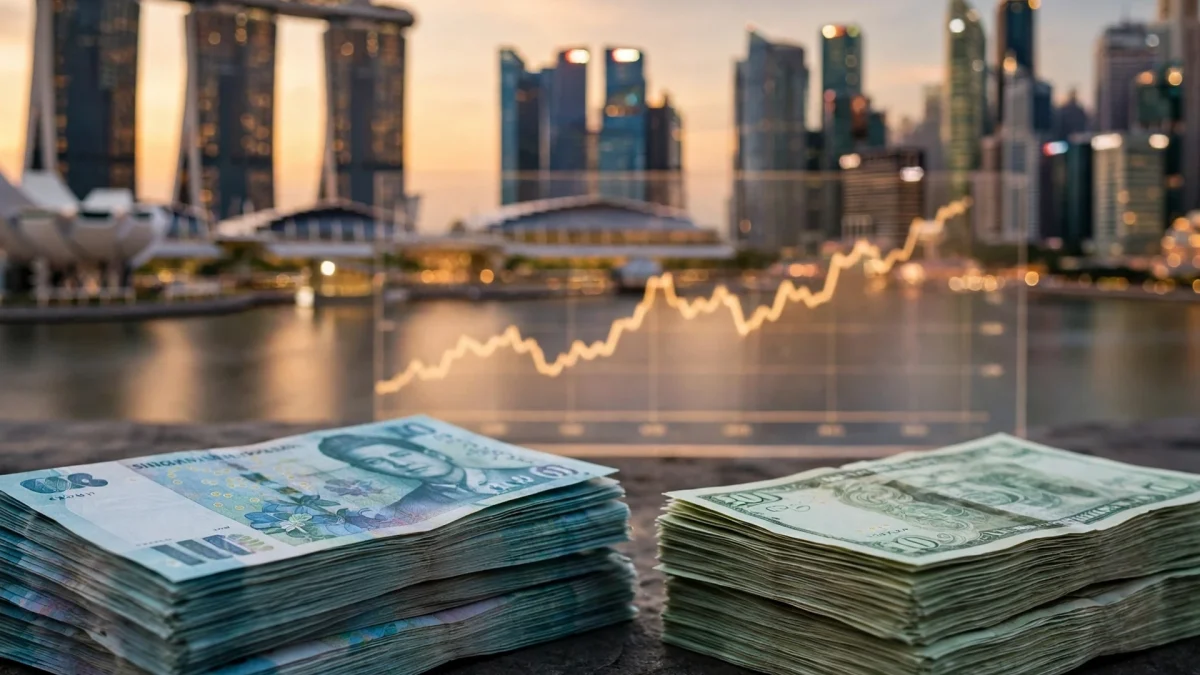
USD SGD is trading around 1.29 on Friday, November 20, 2026, holding steady in a week when most currencies have been knocked around by a surging dollar. The pair closed at 1.29194 on Thursday after trading in a tight range of 1.28878 to 1.29228, and Friday’s prints clustered around the same level — Finnhub’s latest rate was 1.2903, with one Singapore dollar worth about 77.5 US cents.
The calm is no accident. Singapore’s economy is running hot: exports surged nearly 80% in October, growth is tracking close to 6% for the year, and the central bank — the Monetary Authority of Singapore — is deliberately guiding its currency to keep strengthening at a gentle pace. While the Australian dollar hit an 11-month low this week and the yen pressed toward 160, the Singapore dollar has barely budged. The USD SGD exchange rate today sits almost exactly where it started the year, up just 0.27% in 2026 — a picture of stability in a week short of it.
In this article
Key Takeaways
- USD SGD traded around 1.29 on Friday, closing Thursday at 1.29194 after a tight 1.28878–1.29228 range.
- Singapore’s non-oil exports surged 79.8% year on year in October, the eighth straight month of double-digit growth.
- Commerzbank expects USD/SGD to trade in a 1.28–1.30 range near term, with the pair back at 1.29 on a firmer dollar.
- MAS left all three settings of its S$NEER policy band unchanged at its October 14 review.
- Singapore’s economy grew 5.4% year on year in the third quarter, with Q4 growth forecast at around 5.6%.
- Headline inflation was 2.2% in September, with core inflation easing to 2.0%; October figures are due November 23.
USD SGD: The Numbers
USD/SGD — the price of one US dollar in Singapore dollars — has been remarkably range-bound, and the daily candles tell the story. Thursday’s session opened at 1.2895, traded as high as 1.29228 and as low as 1.28878, and closed at 1.29194. Friday’s mid-market prints ranged from 1.2890 to 1.2906 through the day.
The longer view is just as calm. The 52-week range runs from 1.25861, set on January 27, to 1.30966 a year ago — a band of barely 5 cents, which is narrow for a major currency pair. Over the past month the pair is up 0.92%, over six months up 0.9%, and year to date up just 0.27%. Over the past year it is actually down 1.39%, meaning the Singapore dollar has strengthened slightly against the greenback over twelve months. The USD SGD rate is a long way from either end of its yearly range, sitting almost exactly in the middle.
That stability is the point. In other words, even a dollar at a 19-month high has only managed to push this pair to the middle of its range. For anyone converting money, US$100 now buys about S$129, and S$100 buys about US$77.50 — almost the same as at the start of the year.
An Export Boom Is Doing the Heavy Lifting
Why is the Singapore dollar so stable? The biggest reason is sitting in the trade numbers. Singapore’s non-oil domestic exports — known as NODX — surged 79.8% year on year in October, smashing the Bloomberg consensus forecast of 37.7% and accelerating from an upwardly revised 68.3% in September. It was the eighth consecutive month of double-digit growth, and it lifted export growth to 33.6% for the first ten months of 2026.
The details are worth a look, because the headline flatters the picture slightly. Non-electronics exports jumped 81.9% year on year, led by exceptionally strong shipments of structures of ships and boats, pharmaceuticals — up a remarkable 253% — and specialised machinery, up 57.3%. Ships and pharmaceuticals are lumpy, one-off-heavy categories, and Commerzbank is careful to note that excluding ship and boat structures, exports still rose a very substantial 51.6% year on year. Non-oil re-exports grew 48.1%, including a 69.1% jump in electronics, underlining Singapore’s role as a regional technology and distribution hub. As Commerzbank’s analysts put it, the strength “extends beyond one-off shipments.”
What is driving it is the same force reshaping economies across Asia: artificial intelligence. Worldwide spending on AI is keeping factories and trade busy, and Singapore — with its semiconductor plants, precision engineering and logistics hub — is squarely in the path of that spending. The bank says it “could see an upward revision to 5.5–6.0%” when the final Q3 GDP figures are released on November 24.
For the currency, strong exports matter in a straightforward way: they bring foreign currency into the country, and that inflow supports the Singapore dollar. It is the same dynamic that has kept USD SGD pinned near 1.29 even as the dollar index climbed to a 19-month high. When a country’s exporters are earning this much, its currency rarely falls far.
MAS: The Central Bank That Doesn’t Set Interest Rates
Singapore’s central bank works differently from almost every other major one, and understanding that is the key to understanding the currency. The Monetary Authority of Singapore does not set an interest rate. Instead, it manages the Singapore dollar’s nominal effective exchange rate — the S$NEER — which is the Sing dollar measured against a basket of its trading partners’ currencies, weighted by trade.
The way it works is that MAS sets a policy band for the S$NEER, with three settings: the pace at which the band rises over time (the slope), the width of the band, and the level it is centred on. At its October 14 review, MAS left all three unchanged — the slope at an estimated 1.25% pace of appreciation, with no change to the width or the centre. It was a decision that surprised ING and much of the market, which had expected a modest tightening. MAS said the currency is trading in the top half of the band, having gained a little ground since July, when it slightly increased the rate of appreciation.
The MAS monetary policy stance is best described as gently hawkish. Keeping the upward slope lets the S$NEER keep rising gradually, which MAS argues will push back against the imported inflation it expects in the near term. ING puts the currency at around 1.6% above the midpoint of its ±2% band, which means there is limited room for further appreciation within the current settings — but the bank still expects the Singapore dollar to keep outperforming its regional peers on the strength of the economy.
Inflation is the reason for the caution. Headline inflation was 2.2% year on year in September, down from 2.3% in August, and core inflation — which excludes accommodation and private transport costs — eased to 2.0% from 2.2%, according to MAS and METI figures. But core inflation had climbed to 2.1% in July and August, up from 1.5% in the second quarter, and electricity and gas prices are up 8.7% on a year ago. MAS forecasts core inflation averaging 1.5% to 2.0% this year and headline inflation around 2.0%, with both measures at 1.5% to 2.5% next year. The risks, it says, remain tilted to the upside.
Whether MAS tightens again is now the main debate. ING argues that resilient growth, a positive output gap and lingering upside inflation risks mean the bank is “likely not done with tightening, and tightening in Jan is likely if the risks to inflation materialise.” Commerzbank disagrees, saying the strong export performance “may not necessarily prompt another round of tightening by MAS when it meets in January 2027.” The next MAS statement is due by January 29, 2027 — and the October inflation figures, out on November 23, will be the first real test of which view is right.
A Steady Currency in a Volatile Week
Put the Singapore dollar next to its neighbours this week and the contrast is stark. The Australian dollar hit an 11-month low after a jobs shock ended rate-hike bets — covered in our report on AUD/USD — and the yen is pressing toward 160 as intervention risk grows. The Singapore dollar, by contrast, has moved less than a cent all week. The Singapore dollar exchange rate is doing exactly what MAS designed it to do: absorbing global shocks quietly while the real economy keeps growing.
Part of the reason is that Singapore’s fundamentals give traders little to worry about. Growth above 5%, inflation around 2%, a current account surplus swollen by the export boom, and a central bank with a clear, credible framework — that combination is rare in Asia right now, and it is why ING expects the currency to keep outperforming its regional peers even with limited room for further gains inside its policy band.
The dollar side of the equation matters too, of course. The Fed is heading toward a December hike that markets price as near-certain, and a stronger dollar has already lifted USD/SGD from around 1.277 in late October to 1.29 today. Our full report on the Fed’s December hike bets explains why. But the move has been orderly and modest for USD SGD — about 1% in a month — where other currencies have fallen several times that. The S$NEER framework acts as a shock absorber: as the dollar rises against the basket, the managed appreciation of the Singapore dollar cushions the blow.
For crypto traders watching from the sidelines, the Singapore dollar is a useful barometer of Asian stability. The city-state is one of the region’s main crypto and finance hubs, and a steady SGD is one sign that the dollar’s surge is not yet turning into a regional crisis. Our crypto market roundup shows total capitalisation at $2.21 trillion with sentiment in extreme fear — and in that context, a currency that barely moves is doing more work than it looks.
Facts and Figures
| Metric | Value (as of November 20, 2026) |
|---|---|
| USD/SGD (Friday) | ~1.29 (Finnhub 1.2903 at 21:16 UTC) |
| 19 Nov close | 1.29194 |
| 19 Nov range | 1.28878–1.29228 |
| 18 Nov close | 1.28938 |
| 17 Nov close | 1.2883 |
| 52-week high | 1.30966 (20 Nov 2025) |
| 52-week low | 1.25861 (27 Jan 2026) |
| 5-day change | +0.07% |
| 1-month change | +0.92% |
| Year-to-date change | +0.27% |
| 1-year change | −1.39% |
| Commerzbank near-term range | 1.28–1.30 |
| NODX (Oct, year on year) | +79.8% (consensus 37.7%) |
| NODX (Sep, year on year) | +68.3% (revised) |
| NODX Jan–Oct 2026 | +33.6% |
| NODX ex-ships (Oct) | +51.6% year on year |
| Pharmaceuticals exports (Oct) | +253% year on year |
| Non-oil re-exports (Oct) | +48.1% year on year |
| Q3 GDP growth | +5.4% year on year |
| Q4 GDP growth forecast | ~5.6% (Commerzbank) |
| 2026 GDP forecast | ~5.9% (Commerzbank); official 4.5–5.5% |
| Headline inflation (Sep) | 2.2% year on year |
| Core inflation (Sep) | 2.0% year on year |
| Electricity and gas prices | +8.7% year on year |
| S$NEER position | ~1.6% above band midpoint |
| MAS policy band slope | ~1.25% appreciation pace |
| Next MAS statement | By 29 Jan 2027 |
| October inflation release | 23 Nov 2026 |
| Final Q3 GDP release | 24 Nov 2026 |
| US$100 in Singapore dollars | ~S$129 |
What to Watch Next
First, watch Monday’s inflation print. October’s consumer price figures come out on November 23, and they are the first real test of whether core inflation is easing as MAS expects or re-accelerating as ING fears. A hotter-than-expected number would strengthen the case for MAS tightening in January; a soft one would back Commerzbank’s view that the bank can stay on hold. The USD SGD rate will react to the release, though the S$NEER framework means the move is likely to be measured rather than dramatic.
Second, watch Tuesday’s GDP release. Final third-quarter GDP figures land on November 24, along with the official growth forecasts for 2026 and 2027. Commerzbank expects the 2026 forecast to be revised up to 5.5%–6.0% from 4.5%–5.5%. An upgrade would confirm the export boom is feeding through to the broader economy and would support the Singapore dollar; a downgrade would be a genuine surprise.
Third, watch the Fed. The December 8–9 FOMC meeting is the main event for every dollar pair, and a 25-basis-point hike would push USD/SGD toward the top of Commerzbank’s 1.28–1.30 range.
Frequently Asked Questions
Q: What is the USD SGD rate today?
USD SGD is trading around 1.29 on Friday, November 20, 2026. Finnhub’s latest rate was 1.2903, and Thursday’s close was 1.29194 after a tight range of 1.28878 to 1.29228. One Singapore dollar is worth about 77.5 US cents.
Q: Why is the Singapore dollar so stable?
Singapore’s economy is strong — exports surged 79.8% in October and GDP grew 5.4% in the third quarter — and the central bank manages the currency against a trade-weighted basket rather than letting it float freely. That framework, plus a current account surplus from the export boom, keeps the currency steady even when the dollar surges.
Q: What is the S$NEER and how does MAS use it?
The S$NEER is the Singapore dollar nominal effective exchange rate: the Sing dollar measured against a basket of its trading partners’ currencies, weighted by trade. MAS manages it within a policy band, setting the pace of appreciation, the band’s width and its centre. Because trade is more than 300% of GDP, MAS says the exchange rate is a more effective tool than interest rates for keeping prices stable.
Q: Will MAS tighten policy in January 2027?
Analysts disagree. ING says tightening in January is likely if inflation risks materialise, pointing to resilient growth and a positive output gap. Commerzbank says strong exports may not necessarily prompt another round of tightening. The next MAS statement is due by January 29, 2027, and October’s inflation figures on November 23 will shape the debate.
Q: What is the USD SGD forecast?
Commerzbank expects USD/SGD to trade in a 1.28–1.30 range near term. ING expects the Singapore dollar to keep outperforming its regional peers on strong fundamentals, though with limited room for further gains inside its policy band. This article is not financial advice.
Q: How does the Singapore dollar compare with other Asian currencies?
The Singapore dollar has been far steadier than its neighbours this week. While the Australian dollar hit an 11-month low and the yen pressed toward 160, USD/SGD moved less than a cent. The pair is up just 0.27% this year, against much larger moves in most other Asian currencies.
Related Articles
- Fed December Rate Hike Bets Rattle Crypto as Waller Calls for 50 Basis Points
- Crypto Market Today: Total Cap Falls to $2.21 Trillion as Fear Stays Extreme
- USD JPY Near 160 as Japan Core Inflation Holds at 2.2% and Intervention Risk Grows
- USD CNY Near 6.67 as Yuan Rebounds From One-Month Low on Corporate Demand
- NZD USD Hits Six-Year Low as Kiwi Slides Below 55 US Cents
Disclaimer: This article is for news and information purposes only and is not financial advice. Currency prices are volatile and can move sharply in either direction. Do your own research before making any investment decision. All prices and figures are as of November 20, 2026.




Leave a Reply