
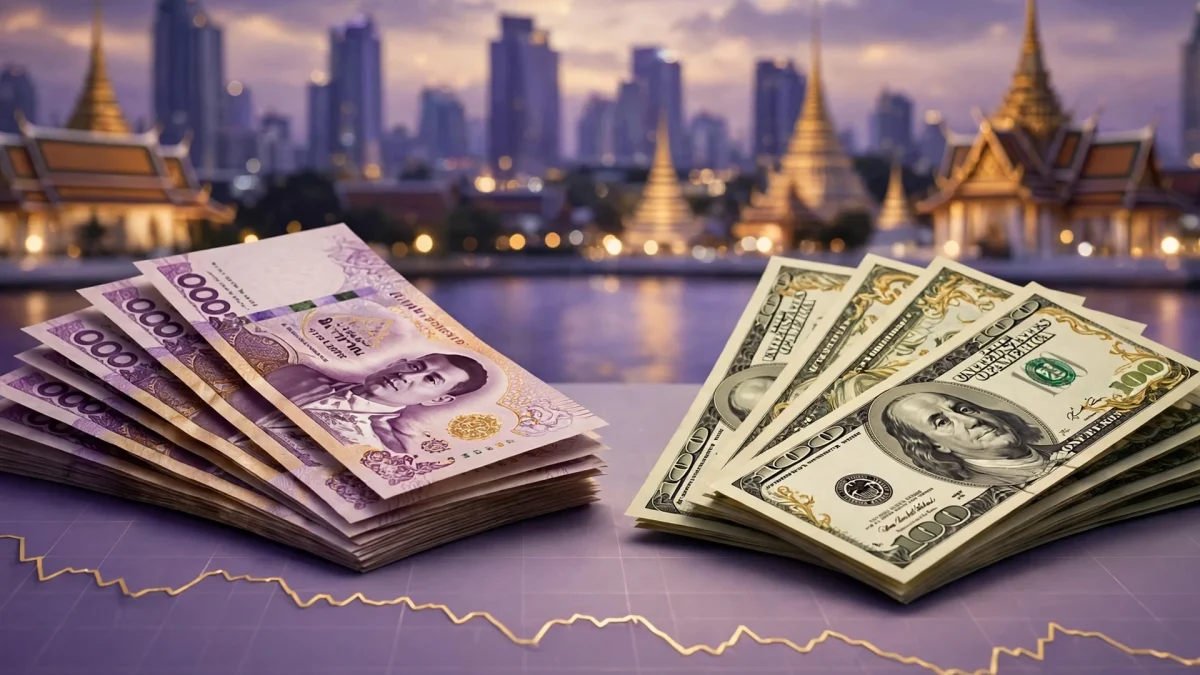
USD THB is trading around 33.98 on Friday, November 20, 2026, after touching 33.99 during the session — a whisker away from the 34 level and the weakest the Thai baht has been against the dollar in 19 months. The pair has been grinding higher all week, closing at 33.82 on Monday, 33.97 on Tuesday, 33.97 on Wednesday and 33.91 on Thursday, near its 52-week high of 34.024, set two days ago.
The baht’s problem is not that Thailand’s economy is collapsing. Far from it: exports jumped 23.6% in the third quarter, GDP grew 2.9%, and the current account swung back into surplus. The problem is that everything else is going wrong at once. Tourism — the industry that brings in the dollars — is shrinking as the crucial winter high season begins. The Bank of Thailand is holding its policy rate at just 1% while the US Federal Reserve’s sits near 4%. And the dollar itself is near a 19-month high, crushing almost every currency in its path.
In this article
Key Takeaways
- USD THB traded around 33.98 on Friday after touching 33.99, near the 52-week high of 34.024 set on November 18.
- USD THB is at its highest in 19 months, with the baht down 6.7% against the dollar since the start of 2026.
- The Bank of Thailand held its policy rate at 1.00% on October 28, a fourth consecutive hold; the Fed’s range is 3.75–4%.
- Thailand’s economy grew 2.9% in Q3, with exports up 23.6% to $106.4 billion, but tourism arrivals fell 5.0%.
- Foreign arrivals in January–October were 25.46 million, down 4.59%, and the annual target has been cut to 31.5 million.
- MUFG and Kasikorn both flag 34.10 as the key end-of-year level for the pair.
USD THB: The Numbers
USD/THB — the price of one US dollar in Thai baht — has spent the week knocking on the door of 34. Finnhub’s latest quote put the pair at 33.9815 late on Friday, and exchange-rates.org printed between 33.95 and 33.99 through the day. The daily candles from Finnhub’s OANDA feed show a market pressing higher for days: Thursday opened at 33.969, traded as high as 33.995 and as low as 33.904, and closed at 33.91. Wednesday’s high of 34.024 is now the 52-week high for the pair.
The trend is unmistakable on any timeframe. The pair is up 0.05% over five days, 0.98% over one month, 3.97% over six months, 7.58% year to date and 4.67% over one year. The 52-week range runs from a low of 30.862, set on January 27, to this week’s high of 34.024. YCharts’ market-daily series puts Friday at 33.91, up from 32.42 one year ago.
The weekly picture is just as clear. The Bank of Thailand’s weighted-average interbank rate stood at 33.859 on Friday November 13, compared with 33.503 on November 6 — a 1.1% weekly decline that gave back all the gains the baht had made in early November, as US Treasury yields climbed. This week the pair has pushed further, and the Thai baht to dollar exchange rate is now within a few hundredths of 34.
For anyone travelling to Thailand, the move is already visible in everyday prices. US$100 now costs about 3,398 baht, and one baht buys 0.02943 US dollars. A tourist arriving in Bangkok this winter gets roughly 7% more baht for their dollars than a year ago — good news for visitors.
A 19-Month Low, Built Slowly
Why is the Thai baht falling? The short answer is the dollar. The longer answer is that the baht has been weakening all year, and this week’s 19-month low for USD THB is the accumulation of months of pressure rather than a single shock. The baht is down 6.7% against the dollar since the start of 2026, according to figures cited by Kasikorn Research Centre — a slow bleed that has accelerated in November as US yields rose and the dollar surged.
The global backdrop is the dominant force. The dollar index is near a 19-month high, as covered in our report on the dollar’s surge, driven by a global equity selloff and markets pricing a near-certain Fed rate hike in December — see our Fed rate-hike report. The Korean won, covered in our USD KRW report, is under the same pressure, and the whole Asian currency bloc has been sliding together.
What makes the baht’s slide notable is that Thailand’s own economy is not the problem. GDP grew 2.9% year-on-year in the third quarter, up from a revised 2.4% in the second, according to the National Economic and Social Development Council. Merchandise exports jumped 23.6% in the quarter to $106.377 billion, led by computer parts and chips linked to data centres, and the current account swung back to a surplus of $1.4 billion.
But strong exports have not been enough to hold the currency up, for a simple reason: the dollars earned from exports are being outweighed by the dollars leaving through other channels. Tourism, the other great earner of foreign currency, is shrinking. Portfolio investors, faced with a 1% policy rate in Bangkok and nearly 4% in Washington, have little reason to hold baht. And oil — which Thailand imports — has stayed expensive, draining dollars out of the country.
Tourism Is the Soft Spot
If exports are Thailand’s bright spot, tourism is its worry — and the timing could hardly be worse. The country is entering its key winter high season, and the numbers are going the wrong way. Foreign arrivals fell 5.0% to 7.061 million in the third quarter, even though tourism receipts rose 11.7% — fewer visitors, spending more each, but not enough to make up the difference.
The year-to-date figures are worse. Thailand recorded 25.46 million international arrivals from January to October 2026, down 4.59% from the same period in 2025, and foreign tourism revenue fell 2.85% to about 1.24 trillion baht. On November 18, Tourism and Sports Minister Surasak Phancharoenworakul confirmed that the annual arrivals target had been cut to 31.5 million.
The Bank of Thailand has already marked down its own expectations: it now sees 32 million foreign visitors in 2026 and 34.5 million in 2027, a million fewer in each year than it forecast before, against 33 million arrivals in 2025. The central bank linked the expected decline to higher oil prices, which raise airfares and squeeze travellers’ budgets.
Tourism matters for the baht because it is one of the largest sources of foreign currency flowing into Thailand. Every hotel room, meal and tour booked by a foreign visitor brings dollars, euros and yuan into the country and converts them into baht. When arrivals fall, that inflow shrinks — and USD THB feels it directly. The Thailand tourism arrivals slump is not just a problem for hoteliers; it is one of the reasons the baht is at a 19-month low.
There are domestic strains too. The Bank of Thailand notes that tourism and private consumption remain constrained by higher oil prices, elevated household debt and weak purchasing power. Overall credit growth has picked up, led by large corporates, but lending to small and medium-sized businesses continues to contract — the two-speed economy the central bank has been warning about all year.
A 1% Rate Against a 4% Dollar
The deepest reason for the baht’s weakness is the interest-rate gap. On October 28 the Bank of Thailand’s Monetary Policy Committee voted unanimously, 6–0 with one member absent, to hold its policy rate at 1.00% for a fourth consecutive meeting. All 26 economists in a Reuters poll had forecast a hold, and the baht was largely unchanged after the announcement.
The BOT has cut rates six times between October 2024 and February 2026, by a combined 150 basis points, to support a weak domestic economy. Most economists polled by Reuters see the rate staying at 1% through the end of 2027. The next decision is due on December 23, and UOB expects another hold.
Compare that with the United States, where the Federal Reserve’s benchmark range stands at 3.75–4%, according to ttb analytics — roughly three percentage points above the Thai rate, with markets pricing another hike in December. When investors can earn nearly 4% holding dollars and 1% holding baht, money flows toward the dollar, and USD THB rises. It is the same mechanism driving currencies lower across Asia, and it explains why Thailand’s strong exports have not saved the currency: the rate gap is simply too wide.
The Bank of Thailand knows this, but it has its reasons for holding. Inflation is low and falling: the bank expects headline inflation to average 2.1% this year and 1.3% in 2027, and says it may dip briefly below zero in 2027 as oil prices fall. The Finance Ministry and the BOT will meet in the week beginning November 23 to agree the 2027 inflation target.
MUFG’s Lloyd Chan is cautious on the baht precisely because of the low yield: the bank keeps its USD THB forecast of 34.10 by end-2026, “with risks tilted towards further THB weakness should the oil shock intensify”. Kasikorn Research Centre identifies the same 34.10 level. UBS expects the pair to finish 2026 at 34.0, then strengthen to 33.0 in 2027 and 32.0 in 2028.
Facts and Figures
| Metric | Value (as of November 20, 2026) |
|---|---|
| USD/THB (Friday) | ~33.98 |
| Friday intraday touch | 33.99 |
| Finnhub latest (21:31 UTC) | 33.9815 |
| YCharts market-daily (20 Nov) | 33.91 (year ago 32.42) |
| 19 Nov close | 33.91 (range 33.904–33.995) |
| 18 Nov close | 33.972 (range 33.852–34.024) |
| 17 Nov close | 33.969 (range 33.808–33.992) |
| 52-week high | 34.024 (18 Nov 2026) |
| 52-week low | 30.862 (27 Jan 2026) |
| 1-month change | +0.98% |
| Year-to-date change | +7.58% |
| 1-year change | +4.67% |
| Baht change since start of 2026 | −6.7% (Kasikorn) |
| BOT interbank rate (13 Nov) | 33.859 (6 Nov: 33.503; −1.1% w/w) |
| Bank of Thailand policy rate | 1.00% (held 28 Oct, 4th hold) |
| US Fed funds range | 3.75–4.00% |
| Thailand GDP growth (Q3) | +2.9% y/y (Q2 revised: +2.4%) |
| Q3 merchandise exports | +23.6% to $106.377bn |
| Q3 current account | +$1.4bn surplus |
| Jan–Oct arrivals | 25.46m (−4.59% y/y) |
| 2026 arrivals target (cut 18 Nov) | 31.5m |
| BOT headline inflation forecast | 2.1% in 2026, 1.3% in 2027 |
| MUFG / Kasikorn end-2026 level | 34.10 |
| UBS forecast | 34.0 end-2026; 33.0 in 2027; 32.0 in 2028 |
| Next BOT decision | 23 December 2026 |
| US$100 in Thai baht | ~3,398 baht |
What to Watch Next
First, watch the 34 level. USD THB touched 33.99 on Friday and set a 52-week high of 34.024 on Wednesday, so the pair is already testing the round number. A daily close above 34.024 would confirm the breakout and put the MUFG/Kasikorn target of 34.10 squarely in view for the end of the year.
Second, watch the high-season tourism numbers. November and December are Thailand’s most important tourism months, and the Tourism Authority’s target of six million visitors across the two months is the number to beat. Strong arrivals would bring in the foreign currency the baht needs and could slow — or even reverse — the slide. Weak arrivals would confirm the year’s trend and remove one of the last supports for the currency.
Third, watch the December central bank meetings on both sides of the Pacific. The Bank of Thailand decides on December 23, and the market expects another hold at 1.00%. The Federal Reserve decides on December 9–10, and markets price a hike as near-certain. If the Fed hikes and the BOT holds, the rate gap widens past three percentage points and the baht forecast for early 2027 gets weaker still.
Frequently Asked Questions
Q: What is the USD THB rate today?
USD THB is trading around 33.98 on Friday, November 20, 2026, after touching 33.99 during the session. That is near the 52-week high of 34.024 set on November 18, and the weakest the baht has been against the dollar in 19 months.
Q: Why is the Thai baht falling?
The baht is falling mainly because of the gap between Thai and US interest rates — the Bank of Thailand’s rate is 1.00% while the US Federal Reserve’s range is 3.75–4% — and the dollar is near a 19-month high. Falling tourism and high oil prices add pressure.
Q: What is the Bank of Thailand’s interest rate?
The Bank of Thailand’s policy rate is 1.00%, held unchanged at its October 28 meeting — a fourth consecutive hold, voted unanimously. The bank cut six times between October 2024 and February 2026. The next decision is due December 23.
Q: How is Thailand’s economy doing?
Thailand’s economy grew 2.9% year-on-year in the third quarter of 2026, with exports up 23.6% to $106.4 billion on AI-related demand. But tourism is weak: arrivals fell 5.0% in Q3 and are down 4.59% in the year to October.
Q: What is the forecast for USD THB?
MUFG and Kasikorn Research Centre both flag 34.10 as the key end-of-2026 level. UBS expects the pair to finish 2026 at 34.0 and then strengthen to 33.0 in 2027 and 32.0 in 2028. Forecasts differ, and none is a certainty.
Q: What is the outlook for the baht?
No forecaster can be certain, and this article is not financial advice. The near-term outlook depends on whether the pair breaks above 34, how the winter tourism season performs, and the December decisions of the Bank of Thailand and the US Federal Reserve. USD THB is up 7.58% this year, and the rate gap with the US remains the dominant headwind.
Related Articles
- Fed December Rate Hike Bets Rattle Crypto as Waller Calls for 50 Basis Points
- Crypto Market Today: Total Cap Falls to $2.21 Trillion as Fear Stays Extreme
- USD MYR Holds Near 4.11 as Strong GDP Meets Fed Hike Fears
- USD KRW Holds Near 1,336 as KOSPI Plunge Tests the Won’s Two-Year Highs
Disclaimer: This article is for news and information purposes only and is not financial advice. Currency prices are volatile and can move sharply in either direction. Do your own research before making any investment decision. All prices and figures are as of November 20, 2026.




Leave a Reply