
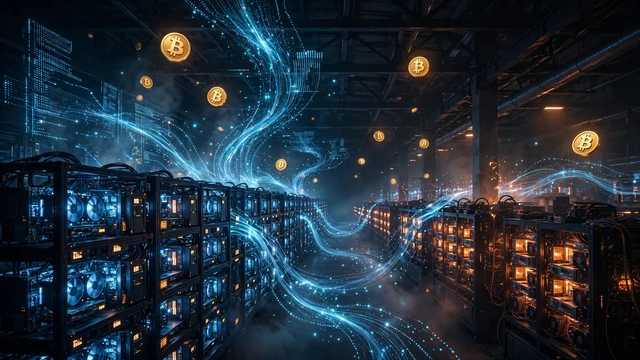
How does bitcoin mining work? In short, specialised computers around the world race to solve a cryptographic puzzle, and the winner gets to add the next block of transactions to the Bitcoin blockchain — earning newly created bitcoin plus transaction fees for the trouble. That race is what secures the network: it is the reason nobody can spend the same bitcoin twice or rewrite history. Mining is how new bitcoin enters circulation, and it is how a network with no central authority agrees on a single version of the truth.
The scale is hard to overstate. The Bitcoin network now performs around 1,000 exahashes per second — a million trillion trillion guesses every second, spread across warehouses of machines on every continent. Yet the rules have not changed since Satoshi Nakamoto mined the first block on a desktop computer in January 2009. This guide explains what bitcoin mining is, how the puzzle works, what miners earn, and what it costs.
In this article
- Key Takeaways
- What Is Bitcoin Mining?
- The Puzzle: SHA-256 and Proof of Work
- Mining Difficulty: The Network's Thermostat
- What Miners Earn: Rewards, Fees and Halvings
- The Machines: From Laptops to ASIC Warehouses
- Mining Pools: Why Almost Nobody Mines Alone
- The Costs: Electricity, Heat and Thin Margins
- Facts and Figures
- What to Watch Next
- Frequently Asked Questions
- Related Articles
Key Takeaways
- Bitcoin mining is proof of work: computers compete to find a SHA-256 hash below a target, and the winner adds the next block.
- The network targets one block every 10 minutes; difficulty adjusts every 2,016 blocks (about two weeks) to hold that pace.
- Miners currently earn 3.125 BTC per block plus fees; the next halving, around April 2028, cuts that to 1.5625 BTC.
- About 20.11 million of the 21 million bitcoin have been mined; the last fraction arrives around 2140.
- Network hashrate is around 1,000 EH/s, and the top four mining pools find about 72% of all blocks.
- Mining is an electricity business: the network uses an estimated 138 TWh a year, and profitability turns on the price of power.
What Is Bitcoin Mining?
What is bitcoin mining, exactly? Despite the name, nobody is digging anything up. Mining is the process by which transactions are verified, grouped into blocks and added to the Bitcoin blockchain — and the mechanism by which new bitcoin is created. Every ten minutes or so, miners collect pending transactions, bundle them into a candidate block, and compete to be the one whose block is accepted.
The competition is the security. To rewrite Bitcoin’s history — to reverse a payment, say — an attacker would need to redo all the computational work that went into every block since, faster than the rest of the network combined. That is what “proof of work” means: the ledger is trustworthy because altering it would cost an enormous, measurable amount of energy. There is no central server to hack and no administrator to bribe. The rules are enforced by mathematics and economics, not by an institution.
Mining also solves a problem that defeated every attempt at digital cash before Bitcoin: the double-spend. Digital files can be copied endlessly, so how do you stop someone spending the same coin twice? Bitcoin’s answer is that the network agrees on a single ordering of transactions, recorded in blocks, and the proof-of-work race is how it reaches that agreement without a referee. A transaction buried under several blocks is, for practical purposes, final.
When Satoshi Nakamoto launched Bitcoin on January 3, 2009, mining ran on an ordinary desktop CPU, and the whole network’s hashrate was measured in megahashes per second. That era lasted about eighteen months. As bitcoin gained value, miners adopted faster hardware — first graphics cards, then specialised chips — and mining became an industry. Today it is a global business of warehouses, power contracts and publicly listed companies. But the core loop is unchanged: bundle transactions, solve the puzzle, win the reward, repeat.
The Puzzle: SHA-256 and Proof of Work
The puzzle miners solve is built on SHA-256, a cryptographic hash function designed by the US National Security Agency and published in 2001. A hash function takes any input and produces a fixed-length output — a 256-bit number — that looks random. Change one character of the input and the output changes completely and unpredictably. Crucially, there is no shortcut: the only way to find an input that produces a particular kind of output is to try inputs, one after another, as fast as possible.
Here is how a miner uses it. A block header contains the hash of the previous block, a summary of the block’s transactions, a timestamp, and a number called a nonce. The miner hashes the header. If the resulting hash is below the network’s current target — in practice, if it starts with a long run of zeros — the block is valid. If not, the miner changes the nonce and tries again. A modern ASIC miner performs this loop 270 trillion times a second. There is no skill involved, only speed and luck: finding a valid hash is a lottery where every guess is a ticket.
The difficulty of the puzzle is set by the target. The lower the target, the fewer hashes qualify, and the harder the puzzle. Bitcoin expresses this as “difficulty,” a number that says how much harder mining is today than it was at the very beginning. As of November 2026, difficulty stands at 134.82 trillion — meaning a miner must perform, on average, roughly 134.82 trillion hashes to find a single valid block.
Why go to all this trouble? Because the puzzle’s cost is what makes the ledger honest. Each block represents a measurable amount of real-world work — electricity converted into security. An attacker who wanted to rewrite the chain would need to spend more on electricity and hardware than the entire honest network. Proof of work aligns self-interest with network security: the rational move is to play by the rules.
Mining Difficulty: The Network’s Thermostat
Bitcoin mining difficulty is the network’s self-correcting mechanism, and it is one of the most elegant parts of Bitcoin’s design. The protocol wants one block every ten minutes, on average. But miners join and leave constantly — new warehouses come online, old machines are retired, power prices spike — so the total computing power is always changing. Without an adjustment, blocks would arrive faster when hashrate rises and slower when it falls.
The fix is simple. Every 2,016 blocks — roughly every two weeks — the network looks at how long those blocks actually took. If they arrived faster than the 20,160-minute target (2,016 blocks × 10 minutes), the puzzle gets harder. If they arrived slower, it gets easier. The adjustment is automatic, built into the code, and needs no committee or vote. It is a thermostat: whatever the weather outside, the block time stays near ten minutes.
The mechanism was on full display in 2026. Difficulty fell 11.16% in February and another 7.76% in late March as miners capitulated and hashrate came offline, and in November it dropped 9.13% to 134.82 trillion as high power prices in Texas forced miners to curtail — a story we covered in our report on bitcoin mining difficulty. Each drop made mining cheaper for the miners who stayed, restoring profitability and stabilising the network.
What Miners Earn: Rewards, Fees and Halvings
Miners are paid in two ways: the block subsidy — newly created bitcoin — and the transaction fees from the transactions they include. The subsidy is the big one. When Bitcoin launched, each block paid 50 BTC. Every 210,000 blocks, roughly every four years, that payment halves: 25 BTC in November 2012, 12.5 in July 2016, 6.25 in May 2020, and 3.125 in April 2024, at block 840,000. The next halving arrives at block 1,050,000, estimated around April 12, 2028, when the subsidy falls to 1.5625 BTC and daily issuance drops from about 450 BTC to about 225.
This schedule is what makes Bitcoin’s supply predictable. Add up every halving era and the total converges just under 21 million coins — 20,999,999.9769 BTC, to be exact, because rewards round down to whole satoshis. As of November 21, 2026, about 20.11 million bitcoin have been mined, roughly 95.8% of the cap, leaving around 885,000 still to come. Annual issuance is now about 164,250 BTC, an inflation rate of roughly 0.83% — and the last fraction of a bitcoin will not be mined until around 2140.
Transaction fees are the second income stream, and currently a small one. On November 20, 2026, miners collected just 4.26 BTC in fees against 456.3 BTC in subsidy — fees were under 1% of total revenue. That balance will have to change: as halvings shrink the subsidy toward zero, fees must eventually pay for security on their own. Whether they will is one of the longest-running debates in Bitcoin. For a fuller picture of the halving schedule and what it means, see our guide to the bitcoin halving.
Is bitcoin mining profitable in late 2026? Barely, for most. The industry’s standard yardstick is hashprice — revenue per unit of hashrate — which stood at $0.0274 per TH/s per day on November 21, 2026. At that hashprice, a top-tier Antminer S21 XP breaks even at an electricity price of about $0.085 per kWh before pool fees; an older S19 XP needs power below $0.053. With bitcoin trading near $58,000–$60,000 and difficulty near record levels, miners without cheap power are underwater — which is exactly why difficulty has been falling as weaker operators switch off.
The Machines: From Laptops to ASIC Warehouses
The history of mining hardware is a story of specialisation. In 2009–10, miners used ordinary CPUs. By late 2010, miners discovered that graphics cards (GPUs) could run SHA-256 far faster, because their thousands of small cores are built for parallel work; a single high-end GPU could outperform dozens of CPUs. FPGAs — reconfigurable chips — followed in 2011, offering better efficiency, but their reign was brief.
The decisive break came in January 2013, when Canaan shipped the Avalon, the first commercially available Bitcoin ASIC — an application-specific integrated circuit designed to do one thing only: compute SHA-256 hashes. Bitmain’s Antminer series followed within months, and the GPU era ended almost overnight. Each ASIC generation roughly doubled energy efficiency while raising hash output, and mining moved from spare bedrooms to warehouses to industrial data centres.
Today’s state of the art is the Antminer S21 XP: 270 terahashes per second at 3,645 watts, or 13.5 joules per terahash — the most efficient air-cooled miner of its generation, selling for roughly $3,200–$3,800. Bitmain’s newer S23 Hydro pushes further, to 580 TH/s at 9.5 J/TH with liquid cooling, the first ASIC family under 10 J/TH. Compare that with the 2016-era Antminer S9 at around 98 J/TH, or the first 2013 ASICs at roughly 1,000 J/TH: a 70-fold efficiency improvement in thirteen years.
But the machines are only half the operation. A modern mining facility is an exercise in power engineering: high-voltage connections, industrial cooling, noise management (an S21 XP runs at about 76 decibels — louder than a vacuum cleaner), and increasingly sophisticated strategies for buying electricity. The largest miners negotiate directly with power producers, run demand-response programmes with grid operators — switching off when the grid is stressed, as Texas miners did in November 2026 — and site facilities next to cheap or stranded energy: hydroelectric dams, wind farms, even flare gas at oil fields.
Mining Pools: Why Almost Nobody Mines Alone
With the network running at around 1,000 exahashes per second, a single miner’s odds of winning a block are vanishingly small. Take a top-of-the-line Antminer S21 XP at 270 TH/s — about 0.000027% of the network. At 144 blocks a day, it would expect to find a block roughly once every 70 years. Solo mining is a lottery ticket with a lifetime between draws.
That is why almost all miners join mining pools. A pool combines the hashrate of thousands of miners, finds blocks regularly, and splits the rewards in proportion to each miner’s contribution, minus a fee — typically 1–2.5%. The individual miner trades the chance of a rare jackpot for a steady, predictable income. The pool operator builds the block template, distributes the work, and handles payouts.
The trade-off is concentration. As of November 21, 2026, the largest pool, Foundry USA — backed by Digital Currency Group — controls about 25.8% of network hashrate. AntPool, operated by Bitmain, holds about 19.7%, and F2Pool about 18.4%. The top four pools together find roughly 72% of all blocks, and the Nakamoto coefficient — the number of entities that would need to collude to control a majority — is just 3. That concentration worries many in the community: pools decide which transactions go into blocks, and a small number of operators wield outsized influence over the network.
The counterargument is that miners can switch pools in minutes, and pools that misbehave lose their hashrate quickly. There is also a technical fix in progress: Stratum V2, a new mining protocol, lets individual miners construct their own block templates instead of accepting the pool’s. Seven of the largest pools, representing nearly 75% of global hashrate, joined the Stratum V2 working group in May 2026.
The Costs: Electricity, Heat and Thin Margins
Mining is, at heart, an electricity business with a bitcoin wrapper. The machines convert power into hashes, and hashes into bitcoin — so the cost of electricity decides who survives. The Cambridge Centre for Alternative Finance estimates the network consumes about 138 terawatt-hours of electricity a year, roughly 0.5% of global consumption; the Digiconomist index puts the figure higher, at about 204 TWh. The honest answer is a range, not a single number, because nobody can directly measure the network. What is not in doubt is the scale: Bitcoin uses more electricity than most countries.
The energy mix is more nuanced than the headlines suggest. Cambridge’s April 2025 industry report — a survey of 49 mining companies across 23 countries covering about 48% of global hashrate — found that 52.4% of mining electricity comes from zero-emission sources (42.6% renewables plus 9.8% nuclear), up from 37.6% in 2022. Natural gas is the single largest source at 38.2%, while coal has fallen to 8.9%. Cambridge puts network emissions at about 39.8 million tonnes of CO2 equivalent a year.
Geography follows power prices. The United States is now the largest mining country, with roughly 36–38% of global hashrate, having absorbed much of the industry after China banned mining in 2021; Russia holds around 18%, and China itself still accounts for an estimated 12–21% through underground operations despite the ban. Within the US, Texas dominates, thanks to its deregulated grid, abundant wind and solar, and demand-response programmes that pay miners to switch off at peak times.
For anyone considering mining, the arithmetic is unforgiving. A new S21 XP costs several thousand dollars, draws 3.6 kW continuously — about 87 kWh a day — and at November 2026 hashprice earns roughly $7.41 a day before costs. At $0.10 per kWh, electricity alone costs $8.75 a day: the machine loses money. At $0.05, it clears about $3 a day before pool fees, cooling, maintenance and the cost of the hardware itself. Home mining is, for most people in most places, a hobby — not a business. The professionals survive on industrial power rates, scale and efficiency.
Facts and Figures
| Item | Detail (as of November 21, 2026) |
|---|---|
| Hash function | SHA-256 (double SHA-256 of the block header) |
| Consensus | Proof of work |
| Block time target | 10 minutes (~144 blocks/day) |
| Difficulty | 134.82 trillion (after a −9.13% adjustment) |
| Difficulty adjustment | Every 2,016 blocks (~2 weeks) |
| Network hashrate | ~1,000 EH/s (7-day average 976–1,033 EH/s) |
| Block height | ~976,931 |
| Block subsidy | 3.125 BTC |
| Last halving | Block 840,000, 20 April 2024 (00:09 UTC) |
| Next halving | Block 1,050,000, ~12 April 2028 → 1.5625 BTC |
| Daily issuance | ~450 BTC (~164,250 BTC/year, ~0.83% inflation) |
| Circulating supply | ~20.11M BTC (~95.8% of the 21M cap) |
| Left to mine | ~885,000 BTC; last fraction ~2140 |
| Largest pool | Foundry USA, ~25.8% of hashrate |
| Second pool | AntPool, ~19.7% |
| Third pool | F2Pool, ~18.4% |
| Top 4 pools combined | ~72% of blocks; Nakamoto coefficient 3 |
| Hashprice | $0.0274 per TH/s per day |
| Top air-cooled ASIC | Antminer S21 XP: 270 TH/s, 3,645 W, 13.5 J/TH |
| Most efficient ASIC | Antminer S23 Hydro: 580 TH/s, 9.5 J/TH |
| Annual electricity use | ~138 TWh (Cambridge); ~204 TWh (Digiconomist) |
| Sustainable energy share | 52.4% (Cambridge, April 2025) |
| Largest mining country | United States, ~36–38% of hashrate |
| Solo odds (one S21 XP) | One block roughly every ~70 years |
What to Watch Next
First, watch hashprice and the April 2028 halving. The halving will cut daily issuance from about 450 BTC to about 225, and miners’ subsidy income with it. Every halving so far has triggered a wave of consolidation: inefficient operators switch off, difficulty falls, and the survivors — those with the cheapest power and newest machines — take a bigger share.
Second, watch the pool concentration debate and Stratum V2. With three pools able to command a majority of hashrate between them, the pressure for miners to build their own block templates is growing. If Stratum V2 adoption accelerates through 2027, it would decentralise transaction selection even while hashrate stays pooled — a meaningful improvement in Bitcoin’s resilience.
Third, watch energy policy. Mining’s future is increasingly a political question: grid operators, regulators and climate policymakers all have views on 138-plus terawatt-hours of demand. Texas demand response, US federal energy policy, and the fate of China’s underground miners will shape where hashrate lives. And watch the hardware cycle: the S23 generation’s sub-10 J/TH efficiency is resetting the breakeven for the whole industry.
Frequently Asked Questions
Q: How does bitcoin mining work?
Bitcoin mining is a competition. Miners collect pending transactions into a block, then repeatedly hash the block’s header with SHA-256, changing a number called the nonce each time, until they find a hash below the network’s target. The first miner to find one broadcasts the block, the network verifies it, and the miner earns the block reward — currently 3.125 BTC plus transaction fees. The process both creates new bitcoin and secures the network, because rewriting history would require redoing all that computational work.
Q: What is bitcoin mining difficulty?
Mining difficulty measures how hard it is to find a valid block hash, relative to the easiest it ever was. It adjusts every 2,016 blocks — about every two weeks — to keep the average block time at 10 minutes: if blocks arrive too fast, difficulty rises; too slow, it falls. As of November 2026, difficulty is 134.82 trillion, after a 9.13% drop as miners curtailed operations during high Texas power prices.
Q: How much do bitcoin miners earn?
A miner who finds a block earns 3.125 BTC in subsidy plus the block’s transaction fees — at recent prices, roughly $180,000–$190,000 per block. But almost no one mines solo: most join pools and earn a share proportional to their hashrate. The industry yardstick is hashprice, about $0.0274 per TH/s per day in November 2026, so a 270 TH/s machine earns roughly $7.41 a day before electricity and fees.
Q: Is bitcoin mining profitable?
It depends almost entirely on electricity price. At November 2026 hashprice, a top-tier Antminer S21 XP breaks even at about $0.085 per kWh before pool fees; older machines need power below $0.053. At residential electricity rates in most countries, mining loses money. Industrial miners with cheap power, efficient hardware and scale can still profit.
Q: How much electricity does bitcoin mining use?
Estimates vary because the network cannot be measured directly. The Cambridge Centre for Alternative Finance estimates about 138 TWh a year — roughly 0.5% of global electricity consumption — while the Digiconomist index puts it near 204 TWh. Cambridge’s 2025 survey found 52.4% of mining electricity comes from zero-emission sources, up from 37.6% in 2022.
Q: What happens when all 21 million bitcoin are mined?
The last fraction of a bitcoin will be mined around 2140, when the block subsidy rounds down to zero. Miners will then be paid entirely from transaction fees. Whether fees alone can fund enough security is one of Bitcoin’s longest-running debates — fee revenue is currently under 1% of miner income, but it spikes sharply during busy periods. The transition will be gradual: the subsidy halves every four years, giving the fee market decades to develop.
Related Articles
- What Is Bitcoin? How BTC Works, Explained Simply
- Bitcoin Halving Explained: Dates, History and What Comes Next
- How Does Blockchain Work? A Plain-English Guide
- Bitcoin Mining Difficulty Falls 9.13% to 134.82T as Texas Power Prices Force Miners Offline
- Bitcoin Price Prediction: Wall Street Still Sees $100,000 as Traders Bet on $50,000
Disclaimer: This article is for information purposes only and is not financial advice. Cryptocurrency prices are volatile and can move sharply in either direction. Do your own research before making any investment decision. All prices and figures are as of November 21, 2026.

Leave a Reply