
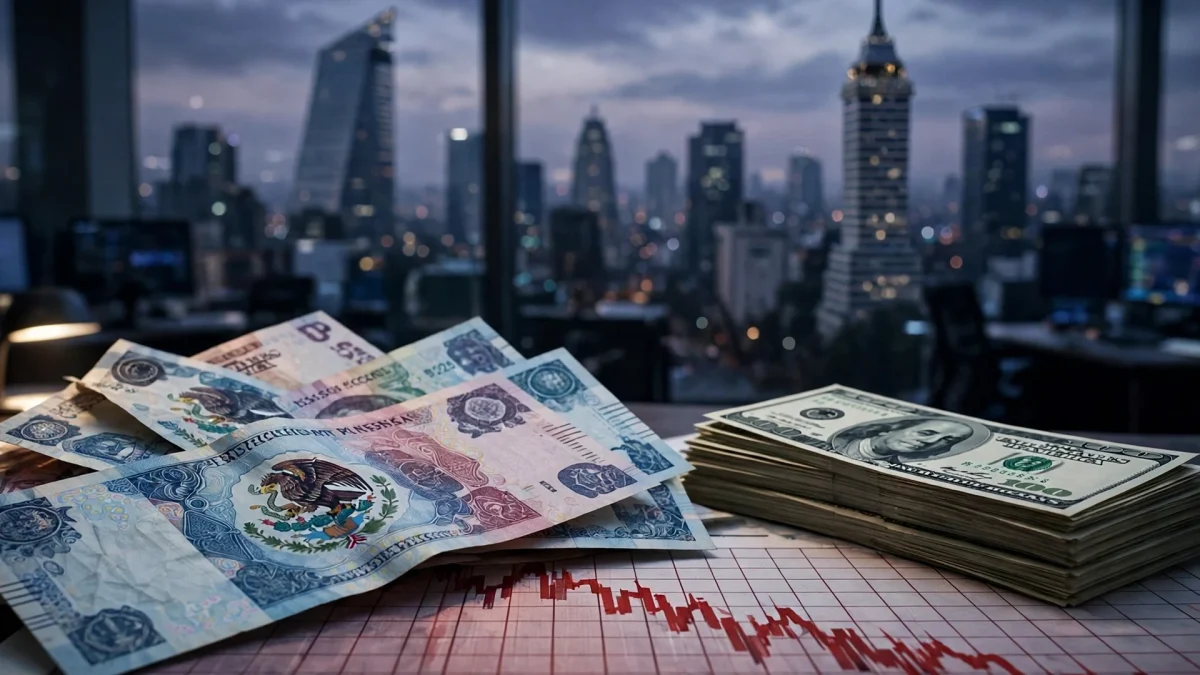
USD MXN is trading around 19.13 on Friday, November 20, 2026, holding above the 19-peso line it broke through the day before. On Thursday the pair reached 19.13638 intraday and closed at 19.08005, the peso’s weakest level since June 2025. Friday’s range of 18.9624 to 19.1896 kept the pair near those lows, and the peso is now down more than 10% since early September — one of the biggest falls among major emerging-market currencies this autumn.
The slide has been fast. Just two days earlier, on Wednesday, the peso suffered its worst single day since April 2025, dropping 2.26% in one session. The trigger was a familiar one: the US Federal Reserve signalling more rate hikes while Mexico’s own central bank moves the other way. The Mexican peso exchange rate today tells the story in one number: US$100 now costs about 1,907 pesos, roughly 3.3% more than it did a week ago.
In this article
Key Takeaways
- USD MXN traded around 19.13 on Friday after breaking through 19 on Thursday — the peso’s weakest level since June 2025.
- The peso fell 2.26% on Wednesday, its worst daily drop since April 2025, closing at 18.8456 per dollar.
- Banxico cut its policy rate to 6.25% on November 5 in a split 3–2 vote, narrowing the rate gap with the Fed to a record-low 225 basis points.
- Mexico’s October inflation accelerated to 3.75% year over year, beating every forecast in a Bloomberg survey.
- The minutes of Banxico’s November decision, released Thursday, showed most board members largely unconcerned about the weaker peso.
- Mexico’s IPC stock index fell about 1.8% on Wednesday, closing below 70,000 points for a fourth straight losing day.
USD MXN: The Numbers
USD/MXN — the price of one US dollar in Mexican pesos — has been climbing all week, and the daily candles show a market that changed gear on Wednesday. Finnhub’s data has Tuesday, November 17 closing at 18.4197, Wednesday closing at 18.8641 and Thursday closing at 19.08005 after trading as high as 19.13638. Friday’s session opened at 19.1198 and ran between 18.9624 and 19.1896, closing at 19.1656 according to Twelvedata. The 52-week high now stands at 19.15218, set on Thursday, while the 52-week low of 16.85701 dates back to September 3. Over the past five days the pair is up 2.87%, and it is up 5.9% so far in 2026.
The official numbers tell the same story with a slight lag. On the street, commercial quotes on Friday ranged from 18.6972 pesos to buy a dollar to 19.1633 to sell one. The small differences between feeds — YCharts puts Friday at 19.07, Adalytica at around 19.13 — come down to timing and methodology, but every source agrees on the direction: the peso has given back months of gains in a single week.
The peso’s fall has not happened in isolation. The dollar index is near a 19-month high as money seeks safety during a global equity selloff, and the same risk-off mood that hammered stocks this week is lifting the US dollar against almost everything. The peso, as one of the most traded emerging-market currencies in the world, tends to feel that mood first and hardest. For traders watching USD MXN, the speed of the move is the striking part: a currency that spent most of October trading calmly between 18.3 and 18.6 has jumped more than 4% in five sessions.
Why the Peso Keeps Falling
Why is the Mexican peso falling? The short answer is the interest rate gap. When that gap shrinks, one of the peso’s biggest attractions — the extra yield investors earn for holding it — fades with it.
The rate gap is doing the damage
The main driver is the difference between what investors can earn holding pesos versus dollars. Banxico’s surprise cut on November 5 brought Mexico’s policy rate down to 6.25%, while the Fed has held its range at 3.75%–4.00% since October and is openly debating further rises. Banco Base calculates that the gap between the two is now 225 basis points — the lowest on record. Banamex agrees, and notes the peso weakened to 18.94 per dollar the day after the cut as the differential hit that historic low.
The gap matters because of the carry trade — the strategy where investors borrow in a low-yielding currency and invest in a higher-yielding one, pocketing the difference. For years the peso was one of the world’s favourite carry-trade currencies, precisely because Banxico’s rate sat so far above the Fed’s. Every narrowing of that gap makes the trade less rewarding, and the November cut dented its appeal at exactly the moment the Fed was turning more hawkish. As one market summary put it, the cut “dented the appeal of carry trades, where investors borrow cheaply to invest in higher yielding markets.”
Then came the Fed minutes. The peso fell within minutes, and other emerging-market currencies — led by the South African rand — fell with it. Our full report on the Fed’s stance is at Fed December rate-hike bets rattle crypto. Banco Base has sketched out what comes next: if the Fed raises by 25 basis points in December and Banxico holds, the gap narrows to 200 basis points; under a 50-point hike it falls to 175, and the bank expects the exchange rate to reach 19.50 pesos per dollar in 2027.
Inflation is rising, not falling
The awkward part for Banxico is that it cut rates while inflation was accelerating. Mexico’s October consumer prices rose 3.75% from a year earlier, beating the Bloomberg survey’s 3.65% median and all 23 forecasts, up from 3.45% in September. Core inflation, which strips out volatile food and energy, measured 3.80%. Price gains were concentrated in a few items — electricity surged 18.51%, air transport jumped 26.36% and tomatoes rose 9.68% — but the direction was clear enough.
Banxico itself has acknowledged the problem. Alongside the cut it raised its forecast for headline inflation at the end of 2026 to 3.7% from 3.5%, and its core forecast to 3.7% from 3.6%, while keeping its view that inflation will only converge to the 3% target in the final quarter of 2027. For a central bank that just cut rates, raising its own inflation forecasts is an uncomfortable combination — and the market has noticed.
Banxico’s Split Board and the Minutes That Spooked Markets
The rate cut was never unanimous. The five-member board split 3–2, and the dissenters have not stayed quiet. Deputy Governor Jonathan Heath told Reuters on November 12 that the cut “confuses and sends the wrong message that we have seen clear progress on inflation, when the actual trend is upward.” Heath, whose eight-year term on the board ends in December, voted to keep rates unchanged. His warning landed days after the cut, just as the October inflation data confirmed his concern.
The minutes of the November 5 decision, released on Thursday, added to the market’s unease. According to Briefs, most board members “largely set aside worries about a weaker exchange rate” — a signal that the central bank is not about to defend the peso. Governor Victoria Rodríguez Ceja has called the move a one-time adjustment and said the peso’s moves have been orderly. Board member Galia Borja, who voted to hold, said Banxico is “highly likely” to keep rates steady at its December meeting.
It is worth remembering how far Banxico has already come. The policy rate has fallen five full percentage points from its 11.25% peak in March 2023, and the November cut came after three consecutive meetings without a change. But guidance only works if the market believes it, and with inflation rising and the Fed hiking, traders are pricing the peso for the risk that Banxico is boxed in either way: cutting again would weaken the currency further, while hiking would mean admitting the November cut was a mistake.
What the Weak Peso Means for Everyday Mexicans
For ordinary Mexicans, a weaker peso cuts both ways. On the one hand, it makes imports more expensive — and Mexico imports a great deal, from petrol to electronics to food. A dollar that costs 19.13 pesos instead of 18.42, where it traded on Tuesday, means every dollar-priced good costs about 4% more in peso terms than it did a week ago. For families buying imported goods or planning a trip north, the difference is real money: US$500 of shopping or travel now costs about 9,565 pesos, against roughly 9,210 a week earlier.
On the other hand, a weaker peso helps exporters and the millions of Mexicans who receive money from relatives working in the United States. Remittances sent home in dollars convert into more pesos, which cushions household budgets even as import prices rise. The peso’s fall, in other words, is not a verdict on Mexico’s economy — it is mostly a verdict on the interest-rate gap and the dollar’s global strength.
The stock market has felt the same pressure. Mexico’s IPC index fell about 1.8% on Wednesday and closed below 70,000 points, its fourth losing day in a row, with mining shares among the biggest losers. The same global selloff that sent the Dow down 1,101 points on Thursday is rippling through Mexican assets too. The USD MXN forecast from here depends less on Mexico than on Washington: if the Fed hikes in December, the peso likely tests higher levels; if the Fed surprises by holding, the record-narrow rate gap starts to look less threatening and the peso could steady.
Facts and Figures
| Metric | Value (as of November 20, 2026) |
|---|---|
| USD/MXN (Friday) | ~19.13 |
| Friday trading range | 18.9624–19.1896 |
| Twelvedata Friday close | 19.1656 (+0.24%) |
| YCharts Friday rate | 19.07 (prev. day 18.92) |
| Banxico FIX rate (Friday) | 19.0270 (prev. 18.6723) |
| Thursday close (Finnhub) | 19.08005 |
| Thursday intraday high | 19.13638 (weakest since June 2025) |
| Wednesday close | 18.8456 (−2.26%, worst day since Apr 2025) |
| Tuesday close | 18.4197 |
| 52-week high | 19.15218 (19 Nov 2026) |
| 52-week low | 16.85701 (3 Sep 2026) |
| 5-day change | +2.87% |
| 1-month change | +2.06% |
| 6-month change | +10.2% |
| Year-to-date change | +5.9% |
| Fall since early September | Over 10% |
| Banxico policy rate | 6.25% (cut 5 Nov, split 3–2 vote) |
| Banxico rate peak | 11.25% (March 2023) |
| Banxico–Fed rate gap | 225bp (lowest on record) |
| Mexico CPI (October) | +3.75% year over year (forecast 3.65%) |
| Mexico core CPI (October) | +3.80% year over year |
| Banxico inflation target | 3% ± 1 percentage point |
| Fed funds range | 3.75%–4.00% (held October, 10–2 vote) |
| IPC stock index (Wed) | −1.8%, closed below 70,000 |
| Mexico Q3 GDP | +0.9% quarter on quarter (+3.2% y/y) |
| US$100 in pesos | ~1,907 pesos |
| Next Banxico decision | 17 December; quarterly report 26 Nov |
What to Watch Next
First, watch the 19.00 level. The peso broke through it on Thursday and has held above it on Friday, but a round number like 19 is the kind of level markets test more than once. A daily close back below 19.00 would be the first sign that the week’s selling is exhausted; a push above Thursday’s high of 19.13638 would confirm the downtrend is intact and open the way toward 19.50, the level Banco Base expects in 2027 if the Fed hikes by 50 basis points. The USD MXN exchange rate today will react to any fresh Fed signal within minutes, so it is the first thing to check each morning.
Second, watch Banxico’s quarterly report on November 26. The report will show the bank’s updated forecasts for growth and inflation, and any shift in tone on the exchange rate will matter. If the bank sounds more worried about the peso or about inflation, markets may start pricing out the chance of further easing — which would support the currency. If it repeats that the peso’s moves are orderly, traders will take that as a green light to keep selling.
Third, watch the December central bank meetings. The Fed decides on December 8–9, and Banxico follows on December 17. If the Fed hikes and Banxico holds, the rate gap narrows to 200 basis points and the peso likely weakens further. If the Fed holds, the pressure eases at a stroke. Either way, those two decisions — plus any fresh inflation data in between — will decide where the pair spends the end of the year.
Frequently Asked Questions
Q: What is the USD MXN rate today?
USD MXN is trading around 19.13 on Friday, November 20, 2026, after breaking through the 19-peso level on Thursday. Banxico’s official FIX rate for Friday was 19.0270 pesos per dollar, and the pair traded in a range of 18.9624 to 19.1896 during the session.
Q: Why is the Mexican peso falling?
The peso is falling mainly because the interest-rate gap with the United States has narrowed to a record-low 225 basis points. Banxico cut its rate to 6.25% on November 5 while the Fed is signalling further hikes, which makes holding pesos less rewarding. A strong dollar globally and a stock market selloff are adding to the pressure.
Q: What did Banxico do in November?
Banco de México cut its benchmark interest rate by 25 basis points to 6.25% on November 5, 2026, in a split 3–2 vote that surprised markets. The bank signalled it expects to hold the rate at that level for an extended period, calling the move a one-time adjustment.
Q: What is the Banxico–Fed rate gap?
The gap between Banxico’s 6.25% policy rate and the Fed’s 3.75%–4.00% range is about 225 basis points, the lowest on record according to Banco Base. If the Fed raises rates by 25 basis points in December and Banxico holds, the gap would narrow to 200 basis points.
Q: How does a weak peso affect Mexicans?
A weaker peso makes imports more expensive — US$100 now costs about 1,907 pesos — but it helps exporters and boosts the peso value of remittances sent home from the United States. It also tends to push up inflation, since many goods Mexico buys are priced in dollars.
Q: What is the USD MXN forecast?
No forecaster can be certain, and this article is not financial advice. Banco Base expects the pair to reach 19.00 and rise to 19.50 in 2027 if the Fed hikes aggressively, while Banamex’s year-end forecast of 18.70 has already been overtaken. The Fed’s December 8–9 decision and Banxico’s December 17 decision are the key events that will shape where USD MXN goes next.
Related Articles
- Fed December Rate Hike Bets Rattle Crypto as Waller Calls for 50 Basis Points
- Crypto Market Today: Total Cap Falls to $2.21 Trillion as Fear Stays Extreme
- USD BRL Near R$5.95 as Real Slides After Central Bank’s $1 Billion Intervention
- Stock Market Today: Dow, S&P 500 and Nasdaq After Thursday’s 1,100-Point Rout
Disclaimer: This article is for news and information purposes only and is not financial advice. Currency prices are volatile and can move sharply in either direction. Do your own research before making any investment decision. All prices and figures are as of November 20, 2026.




Leave a Reply