
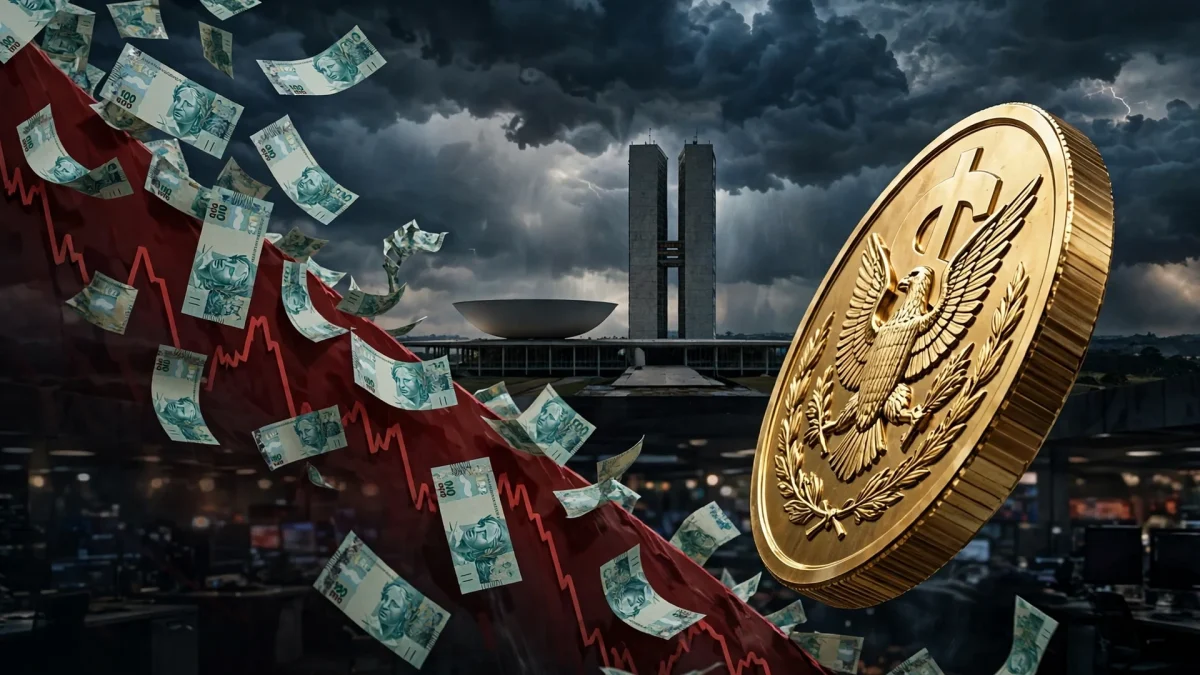
USD BRL is trading around R$5.94–R$5.95 on Friday, November 20, 2026, near its highest level in almost two years after a week in which Brazil’s currency crisis deepened despite direct intervention by the central bank. On Thursday the Banco Central do Brasil sold $1 billion in the foreign exchange market — its first outright spot-dollar sale since December 2024 — and the real fell anyway, closing at R$5.9344 for its sixth consecutive daily decline.
The numbers tell the story of a currency in freefall. The real has lost about 15% since Luiz Inácio Lula da Silva’s surprise re-election in October, sliding from near R$5.00 to almost R$5.95 in less than a month. The stock market has fallen with it: the Ibovespa is down from roughly 209,000 on October 9 to about 166,000 now. The USD BRL exchange rate today tells the story in one number: one US dollar now costs almost six Brazilian reais, a level that was unthinkable a month ago.
In this article
Key Takeaways
- USD BRL traded around R$5.94–R$5.95 on Friday, after Thursday’s close of R$5.9344 — the highest close since January 2025.
- The real has fallen about 15% since Lula’s re-election on October 25, its sixth straight daily decline on Thursday.
- Brazil’s central bank sold $1 billion in the spot FX market on Thursday, its first outright sale since December 2024.
- The Selic policy rate stands at 13.75%, among the highest real interest rates in the world — and it is not stopping the slide.
- Gross public debt is about 83% of GDP, and the fiscal package’s savings have shrunk from R$80 billion to R$50 billion.
- The Chamber of Deputies votes on the fiscal package on Monday, November 23; approval requires 257 votes.
USD BRL: The Numbers
USD/BRL — the number of Brazilian reais one US dollar buys — has been climbing almost every session since late October, and this week it accelerated. Thursday’s close of R$5.9344 was up 1.15% on the day, the sixth consecutive daily advance and the highest close since January 23, 2025. Wednesday’s close was reported at R$5.867, up 1.46%. Friday’s trading kept the pair in the same area, with quotes ranging from R$5.9381 in the morning to R$5.9483 in the afternoon, and the day’s range running from 5.90326 to 5.95110. A year ago the rate was 5.331 — the pair is up 11.31% over twelve months.
The shape of the move is what stands out. Morningstar charts show the rate sitting near 5.00 through late October, then jumping sharply around October 26–27 to about 5.35, then climbing steadily through early and mid-November to 5.94. The USD BRL rate has risen about 13% from its October 23 lows near 5.02, and roughly 15% since the election itself. In the other direction, one real now buys about US$0.168, and R$1,000 converts to roughly US$168 at the mid-market rate.
For ordinary Brazilians, the move is already showing up in everyday costs. Imported goods — machinery, electronics, medicines, fuel — are all invoiced in dollars, so a 15% fall in the real means a 15% rise in the local price of everything Brazil buys from abroad. The stock market tells the same story from the investor’s side: the Ibovespa fell 0.78% to 166,231.05 on Thursday, down about a fifth from its October 9 level near 209,000. When a currency and a stock market fall together, it is usually a sign that foreign money is leaving the country, not just repositioning within it.
Why the Real Keeps Falling
Why is the Brazilian real falling? The short answer is that investors have lost confidence in Brazil’s fiscal path since the election. Together, they changed the risk picture heading into December’s rate decisions.
The election was the trigger. Luiz Inácio Lula da Silva won the October 25 presidential runoff with 51.79% of valid votes, after both polls and prediction markets had leaned towards his opponent. On Monday, October 26, the real fell 10.5% against the dollar during the session, according to CNBC, and an automatic circuit breaker halted trading on Brazil’s stock exchange. Spot USD/BRL closed 8.79% higher that day — one of the biggest single-day moves in the currency’s history. The market had priced in one outcome and got the other, and it has been repricing ever since.
The external backdrop has not helped. US consumer prices rose 0.4% in October against a 0.3% consensus, lifting expectations for Federal Reserve tightening and pushing the dollar to a 19-month high — and USD BRL with it. Our report on the dollar’s strength is at US dollar index near a 19-month high. Emerging market currencies are always the first to feel a strong dollar, and the real — already weakened by domestic doubts — has felt it more than most. The Brazilian real forecast from the market is now openly split: the central bank’s own Focus survey still projects a year-end rate of R$5.40, more than R$0.50 below spot, while Blue3’s conditional forecast is R$6.10 if the current backdrop persists.
The $1 Billion Intervention That Did Not Work
Thursday’s intervention was the week’s big event — and its failure is the week’s big story. Brazil’s central bank entered the spot foreign exchange market and sold $1 billion in an extraordinary auction, with a reported cutoff rate of R$5.86, according to Open Chronicle. It was the bank’s first outright spot-dollar sale since December 2024, a tool it reaches for only when it judges the market to be disorderly. The real briefly steadied. Then it resumed its decline before the session ended, closing at R$5.9344.
That is the pattern of a confidence crisis rather than a liquidity crisis. When a currency falls because there are not enough dollars in the market, a central bank sale can fix it. When a currency falls because investors doubt the government’s fiscal plans, a $1 billion sale is a gesture — and the market treated it as one. As one market note put it, the short-lived response to the intervention suggests that expectations, rather than dollar liquidity alone, are driving the pressure. The central bank can influence short-term market conditions, but confidence in the fiscal trajectory ultimately depends on decisions made by the government and Congress.
The intervention also highlights an awkward fact: Brazil already has one of the highest interest rates in the world, and it is not working. The Selic rate stands at 13.75%, held unanimously by the Copom committee on November 4 after five consecutive quarter-point cuts from 15%. On paper, a 13.75% rate should be a currency’s best friend — it pays investors handsomely to hold reais. One model ranks Brazil’s real interest rate as the highest in the world. But high carry is supposed to be a shock absorber, and the real has weakened straight through it. When investors worry about fiscal sustainability, even a 13.75% yield is not enough to keep them in the currency. Our full report on the Fed’s stance, the other side of this pair, is at Fed December rate-hike bets rattle crypto.
The Fiscal Problem Behind the Currency Crisis
At the centre of investor concerns is Brazil’s fiscal outlook. Gross public debt is estimated at approximately 83% of GDP — 82.9% as of September — with gross interest expenses of R$107.5 billion. The government faces pressure to maintain social spending, support economic activity and fulfil political commitments while preventing public debt from rising too quickly. The market’s question is simple: does the government have a credible plan to stabilise the debt? So far, the answer it has been given has not convinced anyone.
The fiscal package is the immediate catalyst. A complementary bill targeting a primary surplus of 0.5% of GDP in 2027 was approved in its main text by the Senate on November 12, by 45 votes to 31, and the Senate completed its vote on November 18, rejecting three opposition amendments. But the estimated savings for 2027 have fallen from roughly R$80 billion in the original proposal to around R$50 billion under rapporteur Eduardo Braga’s version — a dilution of nearly 40% that the market has read as a sign the government cannot deliver what it promised, as Flamerzinho’s market note details.
Monday’s vote is the next test
The bill now heads to the Chamber of Deputies on Monday, November 23, for an extraordinary session called by Speaker Hugo Motta. Approval requires 257 votes. The most immediate domestic risk is further dilution or postponement of the package in the Chamber — and a dollar moving toward R$6 if the vote disappoints. The other big unknown is who will be the next finance minister, an appointment that remains undated and that traders see as the most important near-term political variable. Until that name is known, the market is guessing at the direction of economic policy.
Inflation is the other half of the problem. The Focus survey puts 2026 inflation at 5.11% and 2027 at 4.8%, both well above the 3.0% target, and the Copom minutes released on November 10 said unanchored inflation expectations called for tighter policy for longer. The bond market agrees: DI futures on Thursday morning priced January 2027 rates at 13.694%, January 2028 at 14.530% and January 2031 at 15.215% — a curve that slopes upward because investors expect rates to stay high for years. Nova Futura sees a meaningful possibility of a 25-basis-point Selic increase as early as December, when Copom meets on December 8–9 — the same days as the Fed. A hike would support the currency at the margin, but it would also raise the government’s borrowing costs on a debt pile of 83% of GDP. That is the trap Brazil is in: the medicine for the currency makes the fiscal problem worse.
Facts and Figures
| Metric | Value (as of November 20, 2026) |
|---|---|
| USD/BRL (Friday) | ~R$5.94–R$5.95 |
| Thursday close | R$5.9344 (+1.15%) |
| Thursday close (other reports) | R$5.931 / 5.93350 |
| Wednesday close | R$5.867 (+1.46%) |
| Friday range | 5.90326–5.95110 |
| Consecutive daily advances | 6 |
| Highest close since | 23 Jan 2025 |
| 1-year change | +11.31% |
| Rate one year ago | 5.331 |
| Rate 23 Oct 2026 (lows) | ~5.02 |
| Depreciation since election | ~15% |
| 26 Oct single-day move | +8.79% (intraday −10.5% for real) |
| BCB intervention (19 Nov) | $1bn spot sale (cutoff R$5.86) |
| Last outright spot sale before this | December 2024 |
| Selic policy rate | 13.75% (held 4 Nov, unanimous) |
| Gross public debt | ~83% of GDP (82.9% Sep) |
| Gross interest expenses | R$107.5bn |
| Fiscal package savings (2027) | ~R$50bn (was ~R$80bn) |
| Fiscal target | 0.5% of GDP primary surplus (2027) |
| Senate vote | 45–31 (12 Nov); completed 18 Nov |
| Chamber vote | Mon 23 Nov (257 votes needed) |
| Focus survey 2026 IPCA | 5.11% (target 3.0%) |
| Focus survey 2027 IPCA | 4.8% |
| Focus year-end 2026 USD/BRL | R$5.40 |
| Blue3 year-end forecast | R$6.10 |
| Ibovespa (Thu) | 166,231.05 (−0.78%) |
| Ibovespa (9 Oct) | ~209,000 |
| DI futures Jan 2027 / Jan 2031 | 13.694% / 15.215% |
| Next Copom meeting | 8–9 Dec 2026 |
What to Watch Next
First, watch Monday’s Chamber vote. The fiscal package needs 257 votes in the Chamber of Deputies, and the market’s reaction will depend on whether the bill survives intact or gets diluted further. Approval of the current text would be a modest positive — it would at least show the government can pass legislation. Dilution or postponement would likely push the USD BRL rate toward R$6.00, a level that would force the central bank to decide whether to intervene again, and more aggressively.
Second, watch for the finance minister appointment. Until Lula names the person who will run economic policy, traders are guessing — and markets hate guessing. A market-friendly name could stabilise the real quickly; a name associated with looser fiscal policy would do the opposite. The appointment is undated, which is itself part of the problem: every day without a name is another day of uncertainty.
Third, watch the December 8–9 meetings. Copom and the Fed decide on the same days, and both could move the pair. If Copom hikes the Selic to 14.0% while the Fed delivers its expected 25 basis points, the rate gap holds roughly steady. If the Fed goes bigger — Waller has opened the door to 50 basis points — the dollar strengthens further and the real’s slide deepens. The USD BRL rate will also react to November’s IPCA-15 inflation reading, due in the coming days. Until the fiscal picture clears, the pair’s direction is more likely to be set in Brasília’s Congress than in the central bank’s trading room.
Frequently Asked Questions
Q: What is the USD BRL rate today?
USD BRL is trading around R$5.94–R$5.95 on Friday, November 20, 2026, after closing Thursday at R$5.9344 — the highest close since January 2025. One US dollar buys about R$5.95, and one real is worth about US$0.168.
Q: Why is the Brazilian real falling?
The real is falling because investors have lost confidence in Brazil’s fiscal path since Lula’s surprise re-election on October 25. A fiscal package the market judged too small, questions over the next economic team, and a strong US dollar have combined to push the currency down about 15% in less than a month.
Q: What did Brazil’s central bank do this week?
On Thursday, November 19, the Banco Central do Brasil sold $1 billion in the spot foreign exchange market in an extraordinary auction — its first outright spot-dollar sale since December 2024. The relief was temporary: the real resumed its decline before the session ended.
Q: What is Brazil’s interest rate?
The Selic policy rate is 13.75%, held unanimously by the Copom committee on November 4 after five consecutive quarter-point cuts from 15%. It is among the highest real interest rates in the world, but it has not stopped the real’s slide because investors are worried about fiscal sustainability, not yield.
Q: Will USD BRL reach R$6.00?
It is possible. Blue3 forecasts R$6.10 by year-end if the current backdrop persists, and Monday’s Chamber vote on the fiscal package is the next trigger — dilution or postponement could push the pair toward R$6. The central bank’s Focus survey, by contrast, still projects R$5.40. This article is not financial advice.
Q: What is the USD BRL forecast?
Forecasts are split. The Focus survey sees R$5.40 by year-end, more than R$0.50 below spot, while Blue3 sees R$6.10. The direction depends on Monday’s fiscal vote, the finance minister appointment, and the December 8–9 Copom and Fed meetings. No forecaster can be certain, and this article is not financial advice.
Related Articles
- Fed December Rate Hike Bets Rattle Crypto as Waller Calls for 50 Basis Points
- Crypto Market Today: Total Cap Falls to $2.21 Trillion as Fear Stays Extreme
- USD MXN Breaks Past 19 as Peso Hits Weakest Since June 2025
- US Dollar Index Near 19-Month High as Euro Falls to Lowest Since April 2025
Disclaimer: This article is for news and information purposes only and is not financial advice. Currency prices are volatile and can move sharply in either direction. Do your own research before making any investment decision. All prices and figures are as of November 20, 2026.




[…] Second, Brazil. Luiz Inácio Lula da Silva’s re-election caught markets off guard, and the real fell nearly 9% from the runoff result while the Bovespa racked up an 18.2% weekly decline. The contagion onto Argentine assets was disproportionate: since the Federal Reserve’s September 16 meeting, Argentine country risk has risen 240 basis points, about 3.4 times the rise in a peer basket of similarly rated countries. Consulting firm LCG found the peso has appreciated 13% against the real since the runoff, its strongest since April 2025. Our report on the Brazilian currency covers the other side of that move: USD BRL near R$5.95 as real slides. […]