
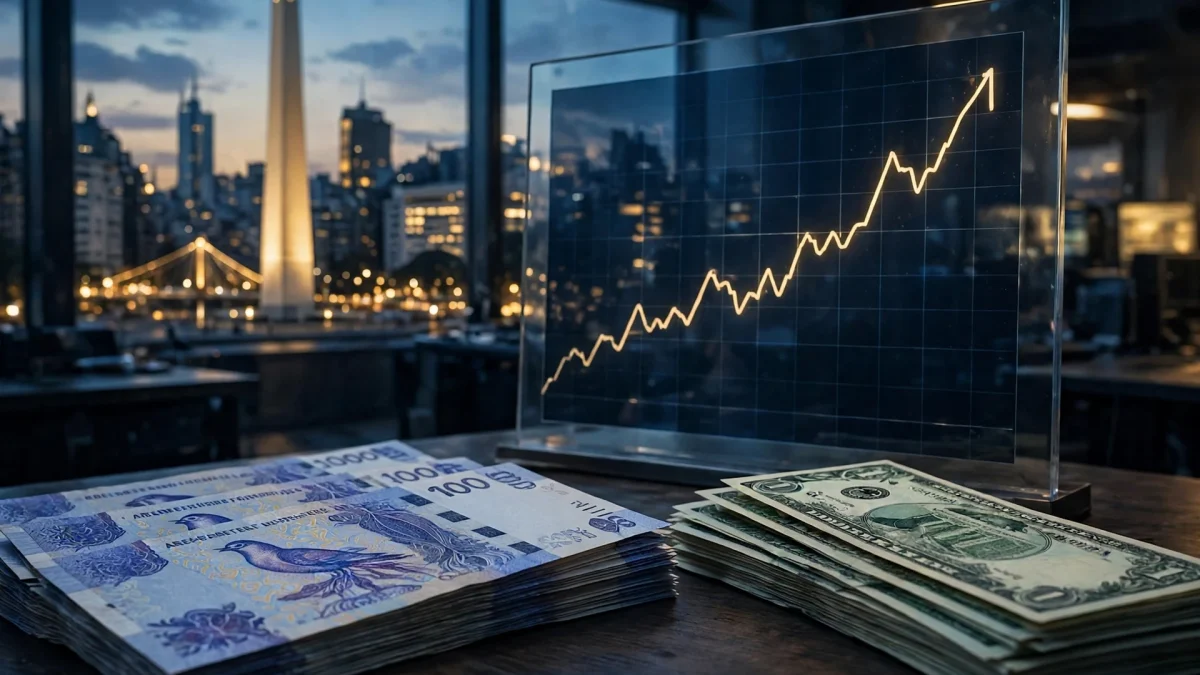
USD ARS is trading around 1,580 on Friday, November 20, 2026, with the market rate at 1,579.75 late in the day according to Finnhub. That number on its own looks calm — the official wholesale rate has barely moved all year, up only about 7% in 2026. But look one step sideways and the picture changes fast: the blue dollar, the informal cash rate Argentines actually use on the street, jumped 2.1% on Friday to a record 1,675 pesos per dollar.
The widening gap between Argentina’s many dollar prices is the real story of the week. Milei’s government lifted most currency controls in April 2025 and moved the peso into a managed band, and for months the official and parallel rates sat almost on top of each other. Now the spread is opening up again — to its widest since just before last year’s midterm elections — while inflation has ticked back up and growth has stalled ahead of the October 2027 presidential election.
In this article
Key Takeaways
- USD ARS traded around 1,579.75 on Friday, while the official retail dollar sold at 1,600.58 and the wholesale rate sat near 1,559.
- The blue dollar jumped 2.1% on Friday to a record 1,675, up 6.3% on the week and 17.5% year over year.
- The gap between the blue and official rates widened to 4.6%, and the CCL financial rate reached about 1,787.
- The peso floats inside a BCRA band whose ceiling is 1,989.12 for November, rising to 2,032.88 by end-December.
- October inflation rose to 2.2% month on month, above expectations, though core inflation fell to 1.5%, its lowest since July 2025.
- Country risk has more than doubled since July to around 830 basis points, and the Treasury faces a US$4.3 billion debt payment on January 9.
USD ARS: The Numbers
Argentina does not have one dollar price. It has several, and on Friday they told different stories. The market mid-rate for USD ARS was 1,579.75 late in the day. The official retail dollar — the rate banks quote to the public — sold at 1,600.58, up 0.9% from Thursday’s close of 1,585.62. The wholesale rate, the benchmark for foreign trade and dollar-bond pricing, sat near 1,559, having advanced only about 7% all year.
Then there are the rates that actually move. The blue dollar, the informal cash rate traded in downtown Buenos Aires exchange houses known as cuevas, closed Friday at 1,675 to sell and 1,655 to buy, according to dolarblue.ar. That is a record nominal high, up 35 pesos on the day, up 6.3% on the week and up 17.5% from 1,425 a year ago. The MEP dollar, the legal rate obtained through Argentine securities, rose 3.4% on the day to 1,697.86. The CCL dollar — contado con liquidación, the rate used to move money abroad — traded around 1,787, up 2% on the day.
Put the board together and the gap between the blue and official rates stands at about 4.6%. That is small by Argentina’s historic standards — during the strict control years the gap routinely topped 100% — but the direction is what matters. Now every parallel rate is pulling away from the official one at the same time, and the financial rates are leading the move. The Argentine peso to US dollar exchange rate is no longer one number. It is a whole board of them, and the board is starting to disagree with itself.
How Argentina’s Exchange-Rate Band Works
To understand why the peso behaves the way it does, you have to start with April 14, 2025. That was the day Milei’s government lifted most of the currency controls known as the cepo cambiario and moved the peso into a floating band, as part of a new financing agreement with the International Monetary Fund. The band launched at 1,000 to 1,400 pesos per dollar. At the same time, individuals were allowed to buy dollars at the official rate through banks without the old US$200 monthly cap, and the 30% tax withholding on those purchases was dropped.
The band is not fixed. Since January 1, 2026, its ceiling and floor have moved each month in line with the most recent monthly inflation figure, with a two-month lag, as BCRA Governor Santiago Bausili announced in December 2025. September’s 1.9% inflation reading set the November ceiling at 1,989.12 pesos. October’s hotter 2.2% reading will push the ceiling up to 2,032.88 by the end of December, according to el-fondo.com.
Here is the important part: the official USD ARS rate is nowhere near the ceiling. At roughly 1,547 to 1,559 wholesale, the peso sits about 27% below the top of the band. The band only forces the central bank to act if the rate reaches its edges — the BCRA would sell dollars to defend the ceiling or buy them at the floor. With more than 400 pesos of headroom, the band is currently a distant fence, not a live constraint.
That stability is deliberate. The government has leaned on a steady exchange rate to hold inflation down, and it has worked on that front: annual inflation has fallen from 211% in 2023 to about 33% now. But the trade-off is becoming visible. With the wholesale dollar up just 6% this year against cumulative inflation of 26%, the peso has appreciated sharply in real terms, and exporters are feeling the squeeze. The Argentina exchange rate band keeps the official USD ARS rate calm. It does not keep the economy competitive.
Why the Gap Is Widening Again
The gap between Argentina’s dollar rates is the USD ARS market’s stress gauge, and it is flashing amber. The Buenos Aires Herald reported this week that the CCL dollar has risen nearly 13% so far in 2026 to about 1,716, while the wholesale dollar has gained just 7%. Brokerage firm Portfolio Personal Inversiones says the gap is at its widest since just before the 2025 midterm elections, when it had exceeded 10%.
Why is it happening now? Three forces are converging. First, politics. Investors are already pricing uncertainty around Milei’s re-election prospects next year, and the extra yield demanded to hold Argentine debt has more than doubled from its July low. Country risk, measured by the JP Morgan index, closed last Friday at 830 basis points — still double the 410 of early July — after touching 939 on November 6.
The Brazil effect
Second, Brazil. Luiz Inácio Lula da Silva’s re-election caught markets off guard, and the real fell nearly 9% from the runoff result while the Bovespa racked up an 18.2% weekly decline. The contagion onto Argentine assets was disproportionate: since the Federal Reserve’s September 16 meeting, Argentine country risk has risen 240 basis points, about 3.4 times the rise in a peer basket of similarly rated countries. Consulting firm LCG found the peso has appreciated 13% against the real since the runoff, its strongest since April 2025. Our report on the Brazilian currency covers the other side of that move: USD BRL near R$5.95 as real slides.
Third, the global backdrop. The dollar is near a 19-month high and the Federal Reserve is heading for a near-certain December rate hike, which tightens financial conditions for every emerging market borrower. As our report on the Fed explains, December hike bets are rattling markets everywhere — and in Buenos Aires the rattle shows up in the dollar gap.
Inflation, Reserves and the January Debt Wall
October’s inflation print did not help the mood. Consumer prices rose 2.2% on the month, according to INDEC figures published November 12 — up from 1.9% in September, above the roughly 1.8–1.9% analysts expected, and the highest monthly reading since April’s 2.6%. The year-on-year rate did edge down to 33.1% from 33.4%, but the direction of the monthly numbers is the wrong way for a government whose signature achievement is disinflation.
There was a genuine bright spot. Core inflation — which strips out seasonal and regulated prices — fell to 1.5%, its lowest since July 2025. The headline jump was driven by regulated prices, which rose 2.9% after changes to the Cold Zone gas-subsidy regime left about 2.4 million users without their tariff discount, pushing housing and utilities up 4.2%.
Growth, meanwhile, has gone missing. The economy contracted in the second quarter, and economists surveyed by the central bank expect another decline in the third — a technical recession. They now forecast growth of just 0.7% for 2026, down from 3.2% at the start of the year, and the IMF has cut its own estimate from 3.5% to 2.1%.
Reserves tell a similar story of slowing momentum. Gross reserves stand at about US$49.46 billion. The BCRA bought around US$223–256 million so far in November — but its monthly purchases have fallen from an average of US$1.9 billion in the first half of the year to US$880 million between August and October. The BCRA’s benchmark overnight repo rate stands at 29%.
And then there is January 9. On that date the Treasury must pay US$4.3 billion in principal and interest on its Bonares and Globales bonds. Its dollar deposits at the central bank total just US$59 million, according to consultancy Quantum Finanzas. Dollar bond placements have been suspended since August because the government will not pay the rates the market demands — yields have risen from 9% mid-year to 13.5%.
Facts and Figures
| Metric | Value (as of November 20, 2026) |
|---|---|
| USD/ARS market rate (Finnhub, 21:31 UTC) | 1,579.75 |
| Official retail dollar, sell (Banco Nación) | 1,600.58 (+0.9% on day) |
| Wholesale official dollar | ~1,559 (+7% in 2026) |
| Blue dollar, sell (record high) | 1,675 (+2.1% on day) |
| Blue dollar, 1 week / 1 month / 1 year | +6.3% / +7.0% / +17.5% |
| MEP dollar, sell | 1,697.86 (+3.4% on day) |
| CCL dollar | ~1,787 (+2.0% on day; +13% in 2026) |
| Band ceiling, November | 1,989.12 |
| Band ceiling, end-December | 2,032.88 |
| October CPI, month on month | +2.2% (Sep +1.9%; expected ~1.8–1.9%) |
| October CPI, year on year | 33.1% (Sep 33.4%) |
| Core inflation, October | 1.5% (lowest since Jul 2025) |
| JP Morgan country risk | ~830bp (939 peak, 6 Nov; 410 in early Jul) |
| Gross reserves | ~US$49.46 billion |
| Debt due 9 January 2027 | US$4.3 billion |
| 2026 GDP growth forecast (BCRA survey) | 0.7% (was 3.2% at start of year) |
| Poverty rate, H1 2026 | 32.3% |
What to Watch Next
First, watch the gap, not the official rate. The official wholesale dollar barely moves — it is the blue, MEP and CCL rates that carry the information. If the blue-to-official gap pushes past 5% and toward the double-digit levels seen before last year’s midterms, that is the market voting that controls will tighten or the official rate will eventually have to move. The blue dollar rate today is the number Argentines check first.
Second, watch November’s inflation print, due in mid-December. October’s 2.2% was blamed on the Cold Zone subsidy change, and analysts warned the effect “may also be felt in November.” A second hot month would suggest the disinflation story is stalling rather than pausing.
Third, watch the January 9 debt payment. US$4.3 billion is due, the Treasury holds almost no dollars at the central bank, and external markets are closed at yields the government will accept. How Milei’s team funds that payment — reserves, a repo, an IMF discussion — will set the tone for Argentine assets into the election year. The USD ARS rate will not tell you the answer on its own. The gap, the reserves and the bond market will.
Frequently Asked Questions
Q: What is the USD ARS rate today?
USD ARS traded around 1,579.75 on Friday, November 20, 2026, according to Finnhub’s market rate. The official retail dollar sold at 1,600.58 at banks, the wholesale rate sat near 1,559, and the informal blue dollar closed at a record 1,675.
Q: What is the blue dollar in Argentina?
The blue dollar (dólar blue) is the US dollar traded on Argentina’s informal cash market — unlicensed exchange houses called cuevas and street dealers called arbolitos in downtown Buenos Aires. It is the price people actually pay for a cash dollar, with no bank, quota or registration in between. On Friday it sold at 1,675 pesos, a record high.
Q: Why are there different dollar rates in Argentina?
Because currency controls were only partly lifted. Since April 2025 individuals can buy dollars at the official rate without the old US$200 monthly cap, but restrictions remain on companies and on moving money abroad. That leaves several legal and informal USD ARS rates — official, wholesale, MEP, CCL and blue — coexisting, each reflecting a different channel with different rules.
Q: How does Argentina’s exchange-rate band work?
The peso floats inside a band set by the central bank (BCRA). Launched at 1,000–1,400 in April 2025, the ceiling and floor now move each month in line with the latest inflation figure, with a two-month lag. The November ceiling is 1,989.12 and it rises to 2,032.88 by end-December. The BCRA only intervenes if the rate reaches the edges; the official rate currently sits about 27% below the ceiling.
Q: Why is the gap between the blue and official dollar widening?
The gap is widening because demand for dollars in the parallel and financial markets is rising faster than in the official market. Drivers include uncertainty ahead of the October 2027 presidential election, contagion from Brazil’s real after Lula’s re-election, a strong global dollar, and October’s hotter-than-expected inflation print.
Q: What is the USD ARS forecast?
No forecaster can be certain, and this article is not financial advice. The BCRA’s Market Expectations Survey projects a November average of 1,558 and a December rate of 1,590.
Related Articles
- Fed December Rate Hike Bets Rattle Crypto as Waller Calls for 50 Basis Points
- Crypto Market Today: Total Cap Falls to $2.21 Trillion as Fear Stays Extreme
- USD BRL Near R$5.95 as Real Slides After Central Bank’s $1 Billion Intervention
- USD MXN Breaks Past 19 as Peso Hits Weakest Since June 2025
- USD TWD Holds Near 33.00 as TAIEX Suffers Worst Week Since 1990
Disclaimer: This article is for news and information purposes only and is not financial advice. Currency prices are volatile and can move sharply in either direction. Do your own research before making any investment decision. All prices and figures are as of November 20, 2026.




Leave a Reply