
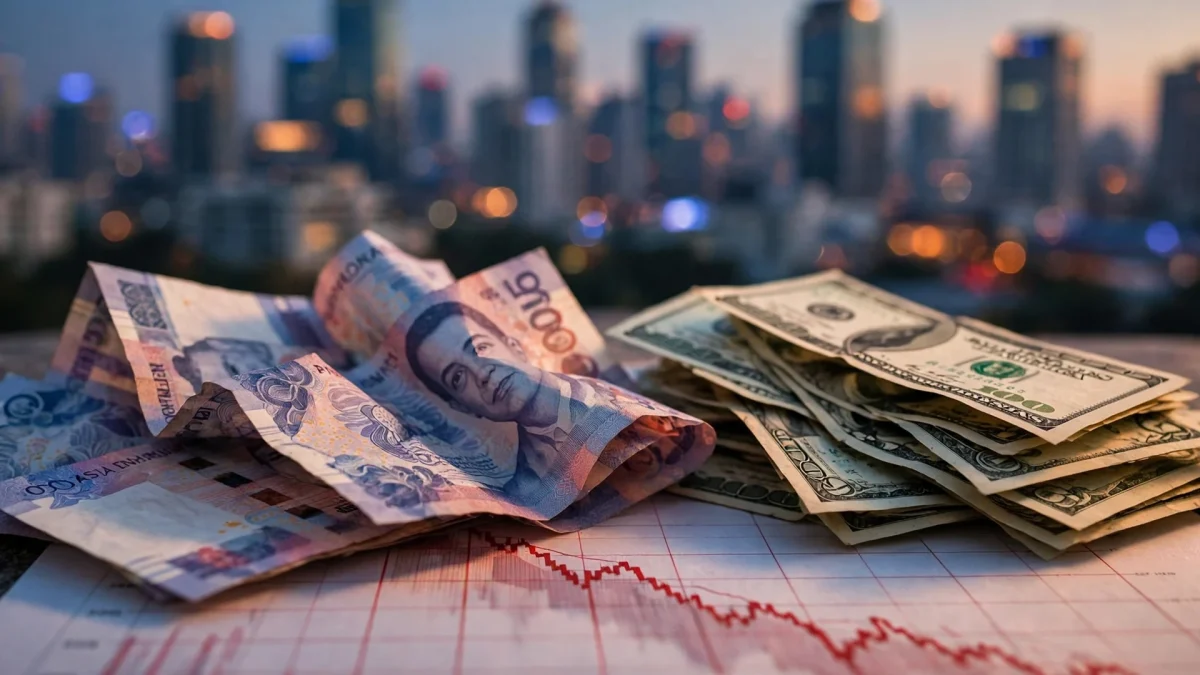
USD PHP closed weaker on Friday, November 20, 2026, with the peso ending at P63.81 against the US dollar, down from P63.665 on Thursday. The local currency opened at P63.77 and traded between P63.745 and P63.92 during the session, while the Bankers Association of the Philippines’ weighted average rate rose to P63.852 from P63.696. Offshore, the pair drifted higher still through the evening, with Finnhub’s latest print at 63.9781 and some feeds touching 64.00.
The move is small — about 15 centavos — but it keeps the peso firmly above the P63 line it first breached in October, in a week when the Philippines’ economic picture has darkened on almost every front. Inflation is running at 7.8%, growth has slowed to 2.1%, and the central bank is caught between prices it cannot control and an economy it cannot afford to squeeze much harder. The USD PHP exchange rate today is the price of that dilemma.
In this article
Key Takeaways
- USD PHP closed at P63.81 on Friday, weaker than Thursday’s P63.665, with a session range of P63.745–P63.92.
- Philippine inflation hit 7.8% in October, with core inflation at 5.4% — far above the BSP’s 2%–4% target.
- The BSP raised its policy rate by a surprise 50bp to 5.50% on October 22, its highest in nearly two years.
- GDP growth slowed to just 2.1% in Q3 2026, down from 2.4% in Q2 and 4% a year earlier.
- The peso hit a record low of P64.17 on October 27 and has lost 8.38% against the dollar in 2026.
- Cash remittances reached $23.424 billion in January–August, up 2.2%, with seasonal inflows due in November and December.
USD PHP: The Numbers
USD/PHP — the price of one US dollar in Philippine pesos — has spent the past month trapped above 63, and Friday’s session did nothing to change that. The peso opened at P63.77, drifted through a 17-centavo range, and closed at P63.81, its weakest finish in several sessions. The Bankers Association weighted average of P63.852 tells the same story from a different angle: whatever measure you use, the peso lost ground on Friday.
Offshore, the pair kept climbing after Manila closed: Finnhub’s latest rate was 63.9781 at 21:31 UTC and exchange-rates.org printed 64.001 in the evening. The BSP’s own reference rate was 63.040 as recently as November 11, against 58.934 a year earlier — a measure of how far the currency has travelled in twelve months.
October was the month that broke the peso: the pair breached both the 63 and 64 thresholds, fell 1.8% in the month and closed at a record P64.17 on October 27 — its 31st record low of the year by the Manila Standard’s count. The recovery since has been shallow: the USD PHP rate is still within a peso of its all-time low, and every rally has faded quickly.
For Filipino families, the arithmetic cuts both ways. At P63.81, US$100 is worth P6,381 — good news for the millions of households receiving money from relatives abroad. But the same rate makes imported fuel, food and medicine more expensive for everyone, and with inflation at 7.8%, those higher import costs are landing on households that are already squeezed.
Inflation Is the Story
Why is the peso falling? Start with inflation. Headline consumer prices rose 7.8% year on year in October, up from 7.2% in September and in line with Metrobank’s forecast. Core inflation — which strips out volatile food and fuel prices — accelerated to 5.4% from 4.7%, a sign that price pressures are spreading beyond the items that started the surge. Transport prices alone are up 20.1%, driven by expensive oil and a weaker currency feeding into fares.
The drivers read like a catalogue of bad luck: high oil prices, a super-strong El Niño disrupting food supply, a higher Metro Manila minimum wage and rising transport fares. The January-to-October average is now 5.6%, well above the BSP’s 2%–4% target, and the central bank expects 6.1% for the full year. Bank of America expects 6% this year and 5.2% next — prices stay above target until late 2027.
High inflation hurts a currency in a straightforward way: it erodes the real return on holding it. The BSP’s policy rate of 5.50% sits 2.3 percentage points BELOW October’s 7.8% inflation rate, which means anyone holding pesos is losing purchasing power in real terms even after earning the central bank’s rate. That negative real rate is the core of the peso’s problem, and it is why the currency keeps sliding even though the nominal rate looks high. The Philippine peso forecast from most banks assumes the slide continues until inflation turns — and nobody is confident about when that happens.
Growth is not coming to the rescue
If inflation is the peso’s main enemy, weak growth is its missing friend. GDP expanded just 2.1% in the third quarter, down from 2.4% in the second quarter and 4% a year earlier, according to the Philippine Statistics Authority. Metrobank has cut its full-year growth forecast to 2.4%. Public works have stalled, domestic demand is weak, and inflation has eaten into real incomes. A growing economy attracts investment and supports its currency; a stalling one does the opposite, and the Philippines is currently getting the worst of both worlds — high inflation and slow growth at the same time.
A Central Bank Caught in a Bind
The Bangko Sentral ng Pilipinas has not been idle. On October 22 it delivered a surprise 50-basis-point hike, lifting its target reverse repurchase rate to 5.50% — the highest in nearly two years — and raising the overnight deposit rate to 5.00% and the lending rate to 6.00%. The BSP has now raised rates by 125 basis points since April, an aggressive tightening cycle by any measure.
The day after the hike, the peso sank to a record 63.615 anyway — the central bank’s dilemma in one data point. Raising rates has not stopped the fall, because oil prices, a strong dollar and inflation expectations outweigh what a half-point move can offset. But not hiking would be worse: it would signal the BSP has given up on inflation, and that would accelerate the slide.
The market expects more tightening. Metrobank looks for another 25-basis-point hike at the December 17 Monetary Board meeting. HSBC expects a 25-point rise to 5.75% that would end the cycle, while Bank of America expects 25 points in December and another 25 in February 2027, taking the benchmark to 6%. The weak GDP print has reduced the chance of another aggressive 50-point move, but as BPI’s lead economist Emilio Neri Jr. warned, pausing too early could let inflation become entrenched and make the eventual recovery harder. The BSP interest rate decision on December 17 will be one of the most consequential of the year.
The external accounts add to the pressure. The BSP projects a $19.1 billion current-account deficit for 2026 and a $9.2 billion balance-of-payments deficit, after a $3.144 billion BoP shortfall in September alone. The current-account gap widened to 6.3% of GDP in the first half, from 3.5% in 2025, as energy imports swelled to 4.5% of GDP. A country that spends far more abroad than it earns must attract foreign capital to fund the difference — and capital is hardest to attract when the currency is falling.
Remittances: The Peso’s Best Friend
If the peso has one reliable friend, it is the millions of Filipinos working overseas. Cash remittances reached $23.424 billion in the first eight months of 2026, up 2.2% from $22.909 billion a year earlier, according to the BSP. August alone brought in $3.035 billion, down from $3.240 billion in July but still a substantial inflow. Remittance growth has slowed to its weakest pace in four years, yet the sheer scale of the flows — more than $23 billion in eight months — remains the single biggest support for the currency.
November and December are traditionally the strongest remittance months, as overseas workers send extra money home for Christmas and outsourcing employees receive bonuses. Metrobank notes the peso “may continue to get some support from relatively lower global oil prices, softening dollar strength and seasonal inflows.” ChinaBank’s Domini Velasquez has suggested a modest recovery toward P63 by year-end if the peso stabilises.
But seasonal help has limits. Remittances support the peso; they do not fix a 6.3%-of-GDP current-account deficit or bring inflation down from 7.8%. The dollar side of the equation matters too: the dollar index is near a 19-month high, and our report on Fed December rate-hike bets explains why the greenback is unlikely to weaken before the December 8–9 meeting. Citi expects the peso around 64 per dollar by March 2027, and Metrobank’s own end-2026 forecast is 63.70 — both suggesting that the USD PHP rate stays uncomfortably high well into next year.
Facts and Figures
| Metric | Value (as of November 20, 2026) |
|---|---|
| USD PHP (Friday close) | P63.81 (Thu: P63.665) |
| Friday open | P63.77 |
| Friday trading range | P63.745–P63.92 |
| BAP weighted average | P63.852 (Thu: P63.696) |
| Finnhub latest (21:31 UTC) | 63.9781 |
| Evening offshore print | 64.001 (exchange-rates.org) |
| Record low | P64.17 (27 October 2026) |
| BSP reference (11 Nov) | 63.040 (a year earlier: 58.934) |
| ECB reference (10 Nov) | 62.904 |
| October depreciation | −1.8% (breached 63 and 64) |
| Year-to-date change | Peso down 8.38% vs USD |
| BSP RRP rate | 5.50% (+50bp, 22 Oct) |
| Overnight deposit rate | 5.00% |
| Overnight lending rate | 6.00% |
| 2026 hikes so far | +125bp since April |
| Headline inflation (Oct) | 7.8% YoY (Sep: 7.2%) |
| Core inflation (Oct) | 5.4% (Sep: 4.7%) |
| Transport inflation | +20.1% |
| Jan–Oct average inflation | 5.6% |
| BSP inflation target | 2%–4% |
| GDP growth (Q3) | +2.1% (Q2: +2.4%; year ago: +4%) |
| Cash remittances (Jan–Aug) | $23.424bn (+2.2% YoY) |
| Current-account deficit (2026 proj.) | $19.1bn (6.3% of GDP in H1) |
| BoP deficit (2026 proj.) | $9.2bn (Sep: $3.144bn) |
| Gross international reserves | $97.4bn (end-Oct) |
| Next BSP meeting | 17 December 2026 |
| US$100 in pesos | ~P6,381 |
| Citi forecast (Mar 2027) | ~64 |
What to Watch Next
First, watch the November inflation print, due in early December. If November comes in higher than October’s 7.8% — ChinaBank’s Velasquez has warned it could approach 8% — the case for another BSP hike on December 17 becomes overwhelming. A cooler number, helped by the recent pullback in oil prices, would let the central bank move more gradually. Either way, the inflation data will decide the December meeting before it happens.
Second, watch remittance flows through December. The seasonal surge in overseas Filipino transfers is the peso’s most reliable source of support, and a strong holiday season could pull the pair back toward P63. But if remittance growth keeps slowing — it is already at its weakest pace in four years — the seasonal lift may be smaller than traders hope. The USD PHP exchange rate today is pricing in some of that help already; a disappointment would leave the peso exposed.
Third, watch the P64.17 level. That was October’s record low, and the pair has been creeping back toward it in offshore trading. A break above it would confirm that the peso’s decline is resuming after its brief November stabilisation. A hold below it, followed by a move back under P63.50, would be the first real sign that the combination of a 5.50% policy rate and seasonal remittances is finally putting a floor under the currency. With the Fed meeting on December 8–9 and the BSP deciding on December 17, the next four weeks will settle the Philippine peso forecast for the start of 2027.
Frequently Asked Questions
Q: What is the USD PHP rate today?
USD PHP closed at P63.81 on Friday, November 20, 2026, weaker than Thursday’s P63.665. The peso traded between P63.745 and P63.92 during the session, and offshore prints rose as high as 64.001 in the evening.
Q: Why is the Philippine peso falling?
The peso is falling mainly because inflation hit 7.8% in October, leaving the BSP’s 5.50% policy rate below inflation in real terms. A wide current-account deficit of $19.1 billion, slow 2.1% GDP growth, high oil prices and a US dollar near a 19-month high are all adding to the pressure.
Q: What did the BSP do in October?
The Bangko Sentral ng Pilipinas raised its benchmark rate by a surprise 50 basis points to 5.50% on October 22, the highest in nearly two years. The overnight deposit rate rose to 5.00% and the lending rate to 6.00%. The BSP has raised rates by 125 basis points since April.
Q: What is the peso’s record low?
The peso closed at a record P64.17 per US dollar on October 27, 2026. It had already set its 31st record low of the year at 63.615 on October 23. The currency has lost 8.38% against the dollar since the end of 2025.
Q: How much is US$100 in Philippine pesos?
At Friday’s closing rate of P63.81, US$100 is worth about P6,381. For families receiving remittances, each dollar now buys more pesos than at any point in the currency’s history.
Q: What is the USD PHP forecast?
No forecaster can be certain, and this article is not financial advice. Citi expects the peso around 64 per dollar by March 2027, while Metrobank forecasts 63.70 by end-2026. Seasonal remittances may offer support into Christmas, but the BSP’s December 17 meeting and November’s inflation print are the key events ahead.
Related Articles
- Fed December Rate Hike Bets Rattle Crypto as Waller Calls for 50 Basis Points
- Crypto Market Today: Total Cap Falls to $2.21 Trillion as Fear Stays Extreme
- USD IDR Hits Record Closing Low Near 18,270 Despite Bank Indonesia Hike
- USD VND Near 25,800 as Dong Tests Year-End Pressure Despite Record Trade Surplus
Disclaimer: This article is for news and information purposes only and is not financial advice. Currency prices are volatile and can move sharply in either direction. Do your own research before making any investment decision. All prices and figures are as of November 20, 2026.




Leave a Reply