
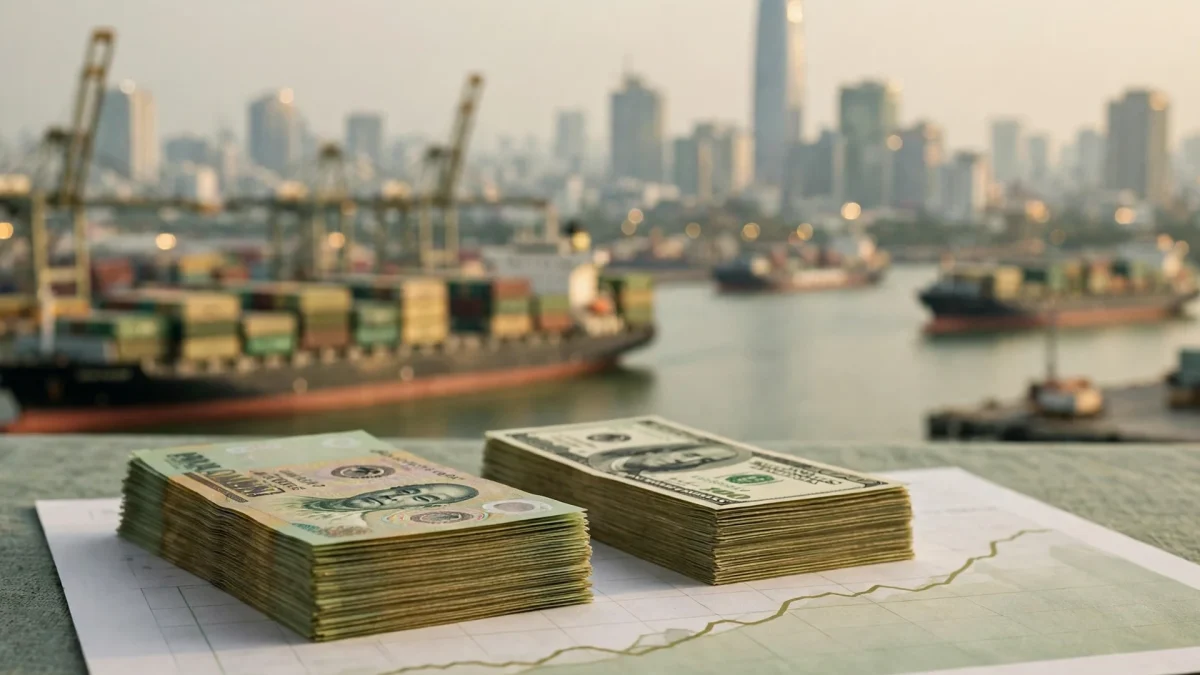
USD VND held near 25,802 on Friday, November 20, 2026, steady in the offshore market even as the State Bank of Vietnam nudged its daily central rate higher for another session. Finnhub’s latest print put the pair at 25,801.5, with the day’s mid-market range spanning roughly 25,759 to 25,811. The SBV set the central rate at 25,659 dong per dollar, up 13 dong from Thursday’s 25,646 — the latest in a slow, deliberate crawl that has taken the official rate up from 25,611 at the start of last week.
Vietnam’s currency story is unusual in a region full of sliding exchange rates. The dong is not crashing — it is managed, dong by dong, by a central bank that sets a daily reference rate and lets banks trade within a 5% band around it. The economy behind it is booming: GDP grew 9.95% in the third quarter, exports just posted the biggest monthly trade surplus on record, and foreign investment is pouring in. Yet the USD VND exchange rate today still sits near its highs for the year, because even the strongest economy in Southeast Asia cannot fully escape a dollar at a 19-month high.
In this article
Key Takeaways
- USD VND traded near 25,802 on Friday, with the SBV central rate at 25,659, up 13 dong from 25,646.
- Vietcombank listed the dollar at 25,530 (buy) / 25,940 (sell); the free-market rate was around 26,100–26,130.
- Vietnam’s October trade surplus hit a record $7.31 billion, the largest monthly surplus since 2009.
- Q3 GDP grew 9.95% year on year, the fastest since Q3 2022, lifting nine-month growth to 9.01%.
- October CPI was 5.09%, with the nine-month average of 4.52% at the government’s 4.5% ceiling.
- KBSV and Pinetree both forecast USD/VND around 26,300 by the end of 2026.
USD VND: The Numbers
USD/VND — the price of one US dollar in Vietnamese dong — is a pair with several different prices at once, and understanding it means knowing which one you are looking at. The offshore mid-market rate, the one Finnhub and XE quote, was around 25,802 on Friday. The SBV’s central rate, the official anchor published every morning, was 25,659. At Vietcombank, the country’s biggest foreign-exchange bank, a dollar cost 25,530 dong to buy and 25,940 to sell. And on the free market — the unofficial street rate — the dollar changed hands around 26,100 to 26,130.
Those gaps are not errors; they are how a managed currency works. The central rate is the anchor, banks trade within a ±5% band around it (24,376 to 26,942 on Friday), and the free market reflects what people actually pay when bank supply is tight. The interbank market closed Wednesday at 25,730, up 22 dong. The USD VND rate you see depends on where you stand — but all the measures have drifted higher together through November.
The crawl has been slow but steady: the central rate was 25,611 on November 11 and has risen 510 dong — about 2.03% — since the end of 2025. That is gentle by regional standards: the rupiah is down 9.35% this year and the peso 8.38%. For Vietnamese consumers the numbers are still large — US$100 costs about ₫2,580,200 — but the pace of change is what matters, and the pace has been controlled.
How Vietnam Manages Its Currency
How does Vietnam control the dong? Unlike most currencies, which float freely, the dong is managed through a daily central rate set by the State Bank of Vietnam. Each morning the SBV announces a reference rate — 25,659 on Friday — and banks may trade within 5% either side of it. The SBV also publishes its own desk rates: 25,500 to buy dollars and 26,891 to sell them. The system, in its current form since 2016 with the ±5% band set in October 2022, gives the central bank a firm grip on the pace of any move.
That grip is why the dong has not followed the rupiah or the peso into free fall. When dollar demand surges — as it has this year with the greenback near a 19-month high — the SBV can let the central rate crawl higher by a few dong a day rather than allow a sharp drop. The trade-off is that the official rate can drift from where the market would put it: at 26,100–26,130, street traders pay roughly 160–190 dong more per dollar than Vietcombank charges. The gap is a pressure gauge, and right now it reads elevated but not extreme.
The system also means the SBV’s decisions matter more than market sentiment on any given day. Friday’s 13-dong rise was the largest single-day move of the week, after a 10-dong cut on Thursday and a 4-dong rise on Wednesday. These are tiny adjustments, but they signal intent: a bank that raises its rate by 13 dong is telling the market it will allow gradual depreciation rather than spend reserves defending a line. The State Bank of Vietnam central rate is, in effect, the country’s exchange-rate policy in a single number published every morning.
A Record Trade Surplus — and a Record Deficit
Vietnam’s trade numbers for October look contradictory until you read them together. The month produced a $7.31 billion trade surplus — the largest monthly surplus in 34 months and, by Pinetree Research’s count, the strongest since 2009, beating the previous record of $5.0 billion set in August 2020. Exports jumped 8.7% month on month to $64.67 billion, while imports fell 1.4% to $57.36 billion. Computers, electronics and components contributed $3.98 billion of the $6.04 billion monthly improvement, as Vietnam’s factories rode the global AI hardware boom.
Yet the same report shows a $12.07 billion deficit for the first ten months — and the nine-month deficit of $19.42 billion was itself a record. The explanation is import intensity: Vietnam’s export factories import most of their components, so an electronics export boom means an electronics import boom too. Total import-export turnover crossed $1,000 billion for the first time — $1,010.6 billion, up 32.3% — a milestone built on both sides of the ledger.
For the currency, the October surplus is genuinely good news: a surplus means more dollars flowing in than out, which supports the dong. Pinetree called the record surplus a support for USD/VND “ahead of a possible December Fed hike,” and forecast a further $3 billion of combined surplus across November and December. If October’s pace held for both remaining months, the full year would even end in a small surplus of about $2.5 billion. The Vietnamese dong forecast for year-end depends heavily on whether those surpluses materialise — and on whether the Fed’s December meeting overwhelms them.
Growth Near Double Digits, Inflation at the Ceiling
Behind the currency is an economy growing faster than almost any other in Asia. GDP expanded 9.95% year on year in the third quarter — the fastest since the third quarter of 2022 and well above the 8.65% Bloomberg consensus — lifting growth for the first nine months to 9.01%. The National Statistics Office also revised the first two quarters upward. UOB has raised its full-year forecast to 9.2% and SSI’s working estimate is about 9.4%, though the official 10% target would need roughly 12.5–13% growth in the fourth quarter and is likely out of reach. The National Assembly has already approved a 2027 target of at least 10%.
The growth is broad-based. Industrial production rose 15.0% in October and 12.4% over the first ten months — the strongest since at least 2019 — and the manufacturing PMI ticked up to 52.3. Registered FDI surged 76.4% to $50.36 billion in the first nine months, and disbursed FDI hit $21.07 billion, a five-year high. The US remains Vietnam’s largest export market at $140 billion, with the bilateral surplus up 23.8% to $122.62 billion — a figure carrying its own political risk, with a Section 301 decision due by November 29.
The constraint is inflation. Headline CPI ran at 5.09% in October, with the nine-month average of 4.52% already at the government’s 4.5% ceiling, and core inflation eased to 4.04% from 4.45%. UOB expects the SBV to hold its refinancing rate at 4.50% through 2027 in its base case, but says the risk is now skewed toward a hike. Pinetree is more optimistic, forecasting November CPI at 3.9% after petrol prices fell sharply in early November. Either way, the USD VND pair is caught between an economy too hot to cut rates and a currency too managed to float freely — and the dollar, near a 19-month high, is pressing on both. Our report on the dollar index near its 19-month high and the Fed’s December hike bets explains the external pressure in full.
Facts and Figures
| Metric | Value (as of November 20, 2026) |
|---|---|
| USD VND (Finnhub, 21:31 UTC) | 25,801.5 |
| XE mid-market range (Fri) | 25,759.1–25,810.6 |
| SBV central rate (20 Nov) | 25,659 (+13 dong) |
| SBV central rate (19 Nov) | 25,646 (−10 dong) |
| SBV central rate (11 Nov) | 25,611 |
| SBV central rate (2 Nov) | 25,631 |
| Central rate change since end-2025 | +510 dong (~2.03%) |
| Trading band (±5%) | 24,376–26,942 |
| SBV reference buy / sell | 25,500 / 26,891 |
| Vietcombank buy / sell | 25,530 / 25,940 |
| VietinBank buy / sell | 25,393 / 25,933 |
| Free-market rate | ~26,100 / 26,130 |
| Interbank close (18 Nov) | 25,730 (+22 dong) |
| Q3 GDP growth | +9.95% YoY (fastest since Q3 2022) |
| 9M 2026 GDP growth | 9.01% |
| October trade surplus | $7.31bn (record since 2009) |
| October exports / imports | $64.67bn / $57.36bn |
| 10M trade balance | −$12.07bn deficit |
| 10M import-export turnover | $1,010.6bn (+32.3%) |
| Headline CPI (Oct) | 5.09% YoY |
| Core CPI (Oct) | 4.04% (Sep: 4.45%) |
| 9M average CPI | 4.52% (ceiling: 4.5%) |
| SBV refinancing rate | 4.50% (UOB: hold through 2027) |
| Interbank overnight rate | 4.50% (1-month: 5.58%) |
| Manufacturing PMI (Oct) | 52.3 (Sep: 51.9) |
| Registered FDI (9M) | $50.36bn (+76.4%) |
| Year-end forecast (KBSV / Pinetree) | ~26,300 |
| US$100 in dong | ~₫2,580,200 |
| Section 301 decision due | 29 November |
What to Watch Next
First, watch the Section 301 decision due by November 29. The US investigation into Vietnam’s trade practices is the biggest near-term risk SSI Research flags, and an adverse finding could hit exports — and the dong — just as the year-end dollar demand season peaks. A benign outcome would remove one of the main clouds hanging over the USD VND exchange rate today.
Second, watch November’s CPI print in early December. Pinetree expects inflation to fall to 3.9% after the sharp drop in petrol prices, which would bring the full-year average to about 4.45% — just inside the government’s 4.5% target. If that forecast proves right, the SBV can keep its refinancing rate at 4.50% without worrying about breaching its ceiling. If inflation stays above 5%, the pressure for a hike — and the pressure on the dong — will both grow.
Third, watch the year-end dollar squeeze. Both KBSV and Pinetree forecast USD/VND around 26,300 by the end of 2026, implying roughly 2% more depreciation from Friday’s levels as importers stock up for the holiday season and companies repatriate profits. The SBV’s daily central-rate moves will show whether the bank is comfortable with that pace or intends to slow it. A run of larger daily increases would signal acceptance; a run of flat or lower fixings would signal resistance. With the Fed meeting on December 8–9 likely to deliver another hike, the Vietnamese dong forecast for the final weeks of the year hinges on how much of that dollar strength the SBV is willing to absorb.
Frequently Asked Questions
Q: What is the USD VND rate today?
USD VND is trading around 25,802 on Friday, November 20, 2026, with Finnhub’s latest print at 25,801.5. The State Bank of Vietnam’s central rate is 25,659, Vietcombank sells dollars at 25,940, and the free-market rate is around 26,100–26,130.
Q: How does Vietnam manage the dong?
The State Bank of Vietnam sets a daily central exchange rate — 25,659 on November 20 — and commercial banks may trade within a ±5% band around it (24,376–26,942). The SBV also publishes its own buying and selling rates. The system lets the central bank control the pace of any depreciation.
Q: Why is the dong weakening if Vietnam’s economy is booming?
The dong is depreciating slowly — about 2% since end-2025 — mainly because the US dollar is near a 19-month high and the Fed is expected to hike in December. Vietnam’s 9.95% Q3 growth and record October trade surplus are supporting the currency, but they cannot fully offset broad dollar strength.
Q: What is Vietnam’s trade surplus?
Vietnam posted a record $7.31 billion trade surplus in October 2026, the largest monthly surplus since 2009, as exports rose to $64.67 billion. However, the first ten months of the year still show a $12.07 billion deficit, because export factories import most of their components.
Q: What is the USD VND forecast for the end of 2026?
KBSV forecasts USD/VND around 26,298 by the end of 2026, and Pinetree forecasts a year-end bank selling rate of 26,300. Both imply roughly 2% further depreciation from current levels. This article is not financial advice.
Q: When is Vietnam’s next big economic risk?
The US Section 301 decision is due by November 29, and SSI Research flags it as a key risk for Vietnam’s export outlook. November’s CPI print in early December and the Fed’s December 8–9 meeting are the other events to watch.
Related Articles
- Fed December Rate Hike Bets Rattle Crypto as Waller Calls for 50 Basis Points
- Crypto Market Today: Total Cap Falls to $2.21 Trillion as Fear Stays Extreme
- USD PHP Weakens to 63.81 as Peso Stays Above 63 on 7.8% Inflation
- USD CNY Near 6.67 as Yuan Rebounds From One-Month Low on Corporate Demand
Disclaimer: This article is for news and information purposes only and is not financial advice. Currency prices are volatile and can move sharply in either direction. Do your own research before making any investment decision. All prices and figures are as of November 20, 2026.




Leave a Reply